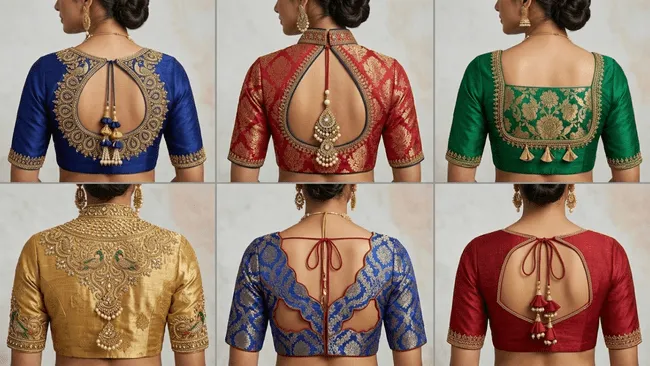
The back of a blouse has evolved from a functional garment piece into a premium designer’s primary canvas. As we head into 2026, intricate patch work is officially leading the ethnic fashion trend. Customers today are no longer satisfied with basic cuts; they walk into boutiques armed with inspiration, looking for master-level craftsmanship. Whether it is layered fabric patches, high-contrast borders, or geometric cutouts, these elements have the power to turn a simple saree blouse into a statement piece.
The Rise of Premium Patch Work Blouse Trends
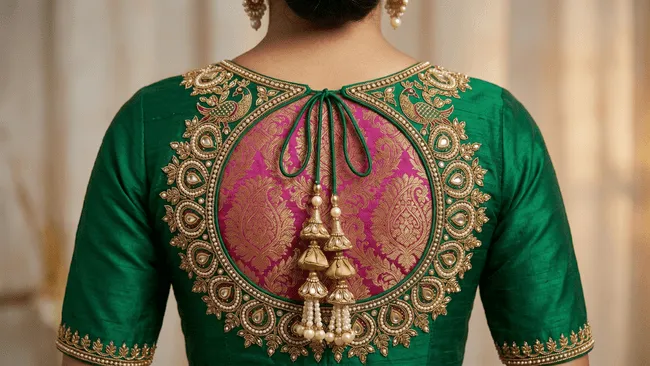
The artistry of a Patch Work Blouse lies in creating harmonious visual depth. For the upcoming season, expect to see single high-contrast asymmetrical patches, diagonal color-blocked paneling, and complex square-patch grids. The most requested look is the layered 'window' patch, where a rich raw silk outer layer is cut away to reveal a peeking interior of heavily woven brocade. This technique allows for a bespoke aesthetic that feels both artisanal and high-end.
Modern Silhouettes: Cut-out & Tie-up Blouse Styles
For festive shoppers, blending modern silhouettes with traditional roots is key. Cut-out Back Blouse designs, such as diamond-shaped windows accented with slim borders, are currently dominating social media feeds. When paired with a sophisticated Tie-up Blouse style—featuring handmade tassels or double-layered dori strings—these designs offer a perfect blend of modesty and allure. The structural lattice-work, or 'jaali' back, remains a top choice for those who want their blouse to serve as an architectural centerpiece.
Bridal Blouse Elegance
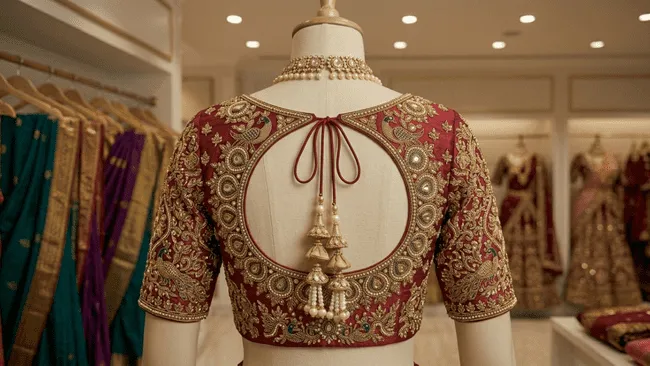
When it comes to wedding season, the Bridal Blouse must act as an opulent accessory. All-over maggam handwork, detailed peacock motifs, and glittering mirror-work borders are essential for the 2026 bride. Whether set on velvet or premium silk, these deep-neck designs ensure the wearer looks breathtaking from every angle, making them the most sought-after Blouse Back Neck Designs in the market today.
The Technical Hurdle: Why Traditional Drafting Falls Short
While these complex Designer Blouse Back Designs look spectacular, they present a significant challenge on the cutting table. Achieving mathematical symmetry across multi-panel layouts using hand-drafting methods is slow and prone to errors. Mismatching alignment during assembly can ruin expensive fabric, leading to wasted time and material.
Streamlining Production with Fashion Dot
This is where Fashion Dot changes the game. By utilizing our specialized Tailoring CAD platform, boutique owners can store complex, multi-component blueprints directly in a digital catalog. When a customer provides their measurements, our automatic grading algorithms scale every patch and curve to a perfect fit in seconds.
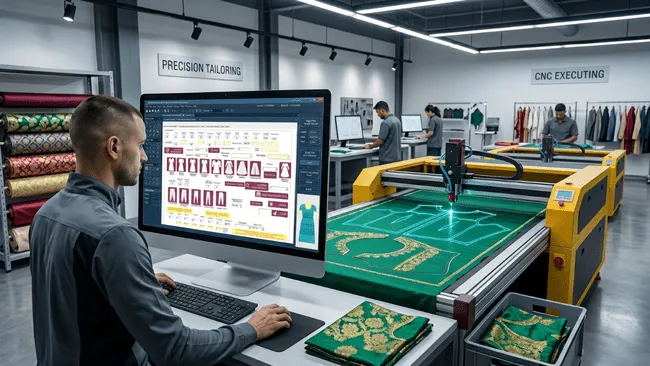
Our system eliminates human drafting bottlenecks, ensuring that your staff can execute elite, master-level cuts with millimeter-level accuracy. From pattern printing to automated laser cutting, we provide the technology stack needed to scale your business while maintaining artisanal quality. Ready to offer high-end patterns without the stress of manual errors? Book a free live system demo with Fashion Dot today and transform your tailoring workflow.
Pairing Patch Work With the Right Fabric
Patch work succeeds or fails on the pairing. Two fabrics that behave differently under the needle will pucker at the join however carefully the piece is cut.
| Base fabric | Patch that works | Avoid |
|---|
| Cotton | Contrast cotton, ikat, block print | Heavy brocade; it drags the base out of shape |
| Raw silk | Brocade, zari border, velvet | Chiffon; too light to hold the seam |
| Kanjivaram | Contrast pallu fabric, temple border | Anything needing a visible top-stitch |
| Georgette | Net, tissue, self-fabric | Stiff brocade patches |
| Velvet | Zari, mirror work, tissue | Fine cotton; the pile swallows the edge |
Where the two fabrics differ in weight, interface the lighter one before joining. That single step removes most patch-work puckering.
Where Patch Work Goes Wrong
The patch is placed after cutting
Placement belongs on the pattern. Once the back piece is cut, a patch that lands half an inch off centre cannot be moved without losing the seam allowance.
The grain is ignored
A patch cut across the grain will stretch differently from the base and the join will ripple after the first wash. Mark the grain on every piece, patch included.
Symmetry is judged by eye
Paired patches and mirrored panels have to be measured from the centre back, not matched visually. A quarter-inch difference is clearly visible on a finished back.
Seam allowance is forgotten on the patch itself
The finished patch size is not the cut size. This is the single most common reason a geometric grid ends up uneven.
Pricing Patch Work Without Losing Money
Patch work takes longer than a plain back, and it is easy to quote it as though it does not:
- Count the extra pieces, not the extra design. Each patch is a piece to cut, interface, place and stitch.
- Add the fabric wasted in matching a print or a border across a join.
- Charge separately for a design the customer brings that has to be worked out from a photograph.
- Price the second identical blouse lower — the pattern already exists, so only the stitching remains.
Frequently Asked Questions
Does patch work suit daily-wear blouses?
A single contrast patch or a simple border does. Layered and geometric grids belong on party and bridal pieces, where the extra stitching time can be charged for.
How do I stop patch edges from fraying?
Interface the patch before joining and finish the edge before assembly. Doing it after the blouse is together is far harder and rarely as neat.
Can a patch-work design be reused for another customer?
The placement can, once it is stored on the pattern. The pieces themselves are re-cut to her measurements, which is where a stored pattern saves the most time.
What is the most requested patch-work back for 2026?
The layered window patch, followed by diagonal colour-blocked panelling. Both photograph well, which is what drives the requests.
How much extra time does patch work add?
Cutting time roughly doubles when done by hand, because every patch is marked separately. Drafted and printed, the extra pieces come out with the rest of the pattern.