A hem is the last thing a tailor does and the first thing a customer checks, because it is the only edge of the garment she can see all the way round. It is also the one edge nobody plans.
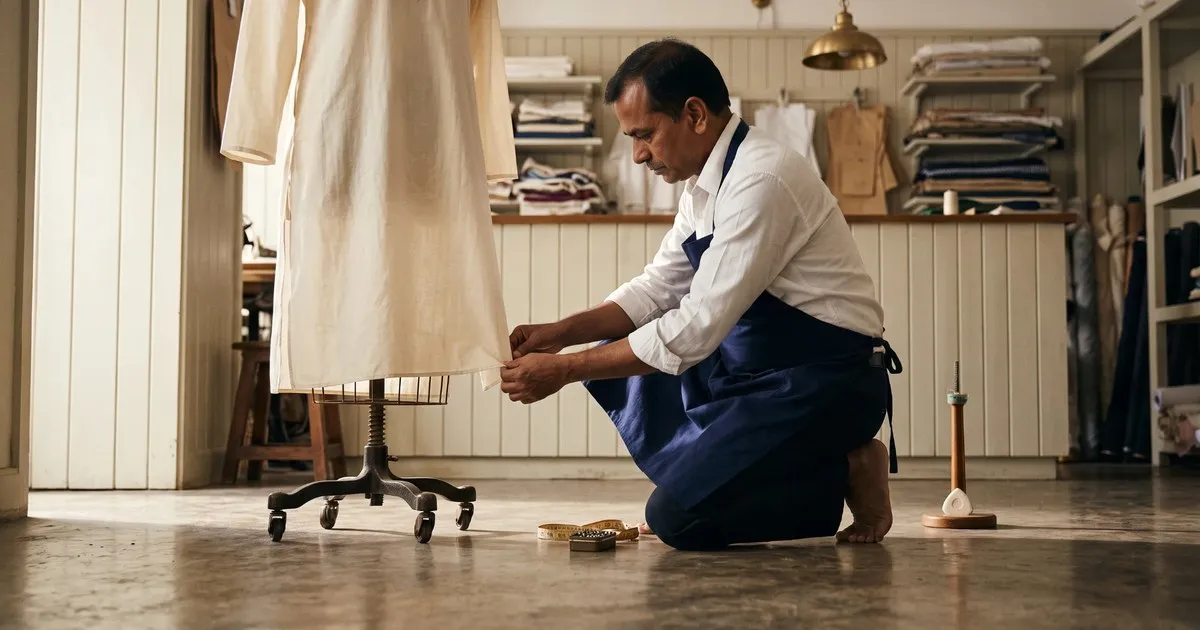
A tailor kneeling to pin up the hem of a long cream kurta on a dress form at floor level
Most hems are turned to whatever depth the cloth happened to leave. A kurta is cut a little long, trimmed a little to fit, and turned up by eye. The result looks fine on the table and wrong on the body, because a hem has to hang level to the floor, not level to the waist.
This guide covers how deep to turn a hem on each garment, which finish suits which cloth, how to mark it on the customer, and what changes when the hem is curved.
In this guide you will find:
- Why a hem looks uneven even when it was cut straight
- How deep a hem should be on a shirt, kurta, trouser and coat
- The hem finishes and when each one is the right choice
- How to mark a hem so it hangs level
- What changes on a curved or flared hem
- A working order that keeps the hem flat
Why a Hem Looks Uneven
Four reasons, and none of them is the stitching.
It Was Marked Flat on the Table
A hem marked on a flat table is level to the table, not to the body. Hips, a forward stoop and a prominent seat all lift the hem at the back or front by half an inch. Mark it on the person, or on a form of the right shape.
The Same Depth Was Used on Every Garment
A shirt hem and a coat hem do not want the same depth. A narrow hem on a heavy coat looks thin and flutters; a deep hem on a chiffon dupatta looks like a rope.
A Deep Turn Was Used on a Curve
The raw edge of a curved hem is longer than the line it turns to. A deep turn forces the extra length into a smaller space and the hem ripples. Curved hems need to be narrow.
The Garment Was Hemmed Before It Had Dropped
Cloth cut on the bias, or in a loose weave, stretches downward after it is hung. A hem marked straight away comes up at the seams and drops in the middle a day later.
How Deep a Hem Should Be
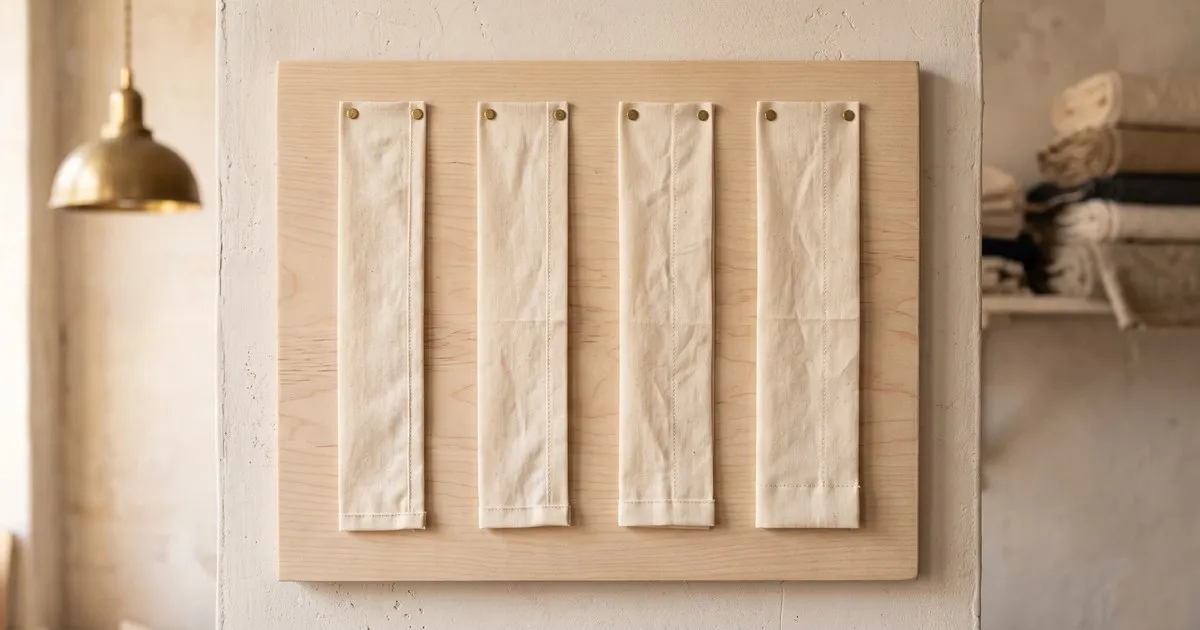
Four cloth samples pinned to a board showing hems turned to four different depths
Working figures in inches for a plain double-turned hem on a medium weight cotton. The allowance to cut is the finished depth turned twice, so it is double. Treat the numbers as a starting point and confirm the first garment on a body.
Garment | Finished depth | Allowance to cut | Usual finish |
|---|
Shirt | 0.25 – 0.50 | 0.50 – 1.00 | Double-turn, machine |
Blouse | 0.75 – 1.00 | 1.50 – 2.00 | Double-turn or blind |
Kurta and kurti | 1.00 – 1.50 | 2.00 – 3.00 | Double-turn, machine |
Salwar and palazzo | 1.50 – 2.00 | 3.00 – 4.00 | Double-turn, machine |
Trouser | 1.50 – 2.00 | 3.00 – 4.00 | Blind or machine |
Skirt and anarkali | 0.50 – 1.00 | 1.00 – 2.00 | Narrow or blind |
Lab coat and chef coat | 1.50 – 2.00 | 3.00 – 4.00 | Machine, fused |
Overcoat and blazer | 2.00 – 3.00 | 4.00 – 6.00 | Blind, hand-finished |
Where the cloth is serged first and turned once, the allowance is the finished depth plus about a quarter inch, not double. Keep the chart in the shop and pin it where the cutter works.
Choosing the Finish
Finish | What it looks like | Best for | Watch for |
|---|
Double-turn, machine | One or two lines of stitching on the outside | Shirt, kurta, salwar, uniform | The stitching shows, so the line must be straight |
Blind hem | Almost no stitching visible | Trouser, skirt, blouse, coat | Needs a blind-stitch machine or hand work |
Hand slip-stitch | Invisible on both sides | Silk, wedding blouse, lined coat | Slow, so price it |
Narrow or rolled | A thin rolled edge | Chiffon, georgette, dupatta | Hard to keep even on fine cloth |
Serge and single turn | Overlocked edge turned up once | Casual cotton, knits | Thick edge shows through light cloth |
Faced hem | A separate strip stitched on and turned in | Curved and flared hems | The facing must match the curve |
A hem that is expected to be let down later should always be turned wider than the table above, and finished with a stitch that can be taken out without leaving a line.
How much allowance to leave for letting out is covered in our garment alteration guide, and the allowances the rest of the garment is cut with are in the seam allowance guide for tailors.
How to Mark a Hem That Hangs Level
Mark it with the garment on, or on a form, and measure from the floor:
- Let the garment hang for several hours, or overnight if it is cut on the bias or in a loose cloth.
- Have the customer stand in the shoes she will wear it with, weight evenly on both feet.
- Mark with a hem marker, or by measuring up from the floor at the centre front, centre back and both sides.
- Join the marks with a rule and pin the line. Then walk her round once and check the hem from the front, the back and both sides.
- Take the garment off and fold the allowance up to the marked line, then trim to an even depth.
- Check the length against the customer's request. A hem that is level but too short is still wrong.
What the customer means by long or short is the biggest source of hem complaints – the kurti cutting measurement chart explains how to record the length so it is cut the same way every time.
Hems on Curves and Flares
- A flared kurta or an anarkali hem is a curve, so the raw edge is longer than the line it will be turned to.
- Keep the turn narrow – about half an inch finished – so the extra length is small enough to ease in.
- Run a line of ease stitching just inside the fold and draw it in slightly before pressing. Do not stretch the edge.
- For a deep flare, use a faced hem or a bias strip instead of turning the edge, and cut the facing to the same curve.
- Press over a curved ham, not flat on the board, so the curve is not flattened as it sets.
- Check the hem on the body after pressing. A curve that looked right pinned can drop at the seams once it is hanging.
What the Fabric Changes
- Cotton and linen – hold a crisp fold and take any hem. Press with steam and the hem sits flat.
- Chiffon and georgette – use a narrow rolled hem. A deep turn is too heavy and drags the cloth.
- Silk and satin – hand-finish, and test the stitch on a scrap, because holes from unpicking show.
- Heavy twill, denim and canvas – cut the allowance and trim the seam inside the hem so the stitching is not through six layers.
- Synthetics – press with a low heat and a cloth, and check the fold holds after a wash.
- Stripes, checks and borders – match the pattern at the hem so the line runs straight all the way round.
A Working Order That Keeps the Hem Flat
- Finish the seams first and press them open or to the side, so the hem is not turned over a bulky seam.
- Hang the garment and mark the hem on the body or form.
- Trim the allowance to an even depth, then fold and press the hem with a card gauge so every inch is the same.
- Fuse a strip of hem tape on thicker cloth, so the stitch does not pull the edge.
- Stitch, keeping the same distance from the fold all the way round.
- Press again from the wrong side, over a pressing cloth, and hang the finished garment for a check before it is bagged.
Finishing is where a good garment is made or lost. Our guide to pressing, finishing and the delivery check covers the final steps.
In tailoring CAD the hem allowance is set for each garment and printed on every piece, so the cutter never works it out. The hem line, the fold and the notch are marked on every size, and a curved hem is cut with its own narrower allowance. Our tailoring CAD software page shows how the marks print.
Questions Tailors Ask
How deep should a hem be?
It depends on the garment. About a quarter to half an inch on a shirt, one to one and a half on a kurta, one and a half to two on trousers, and two to three on a coat. Curved hems should be narrower.
How do I find the hem allowance to cut?
Double the finished depth for a double-turned hem. For a hem that is serged and turned once, add about a quarter inch to the finished depth.
Why does my hem ripple on a flared kurta?
The raw edge is longer than the line it turns to, and the turn is too deep. Make the hem narrower and ease it in with a line of stitching, or use a faced hem.
Should the hem be marked before or after the seams?
After. The seams decide how the garment hangs, and a hem marked before them will not match once they are sewn.
How do I keep the hem the same depth all the way round?
Fold and press it over a card gauge cut to the finished depth, and stitch at the same distance from the fold throughout.
Do I need to hem a garment on the customer?
For trousers, skirts and long kurtas, yes, or on a form of her shape. A hem marked flat on the table is level to the table, not to the person.
Plan the Hem Before You Cut
A hem is a decision about the whole garment, made when the pattern is drawn. Once the finished depth, the finish and the allowance are written down, the hem is the easiest part to get right.
Book a free demo – on-site or online, in your language, with no commitment. Bring a garment whose hem never hung right and we will plan the allowance on screen.