A blouse is cut from flat cloth but worn on a curved body. Darts are what make the difference – small folds stitched to a point that shape the fabric over the bust and in at the waist. When they are placed and sized correctly, nobody notices them. When they are not, the customer sees it straight away: a pointed bulge, a pucker, or a blouse that gapes at the armhole. This guide explains the darts in an Indian blouse, how to find the bust point, how deep each dart should be, the common dart problems and how to fix them.
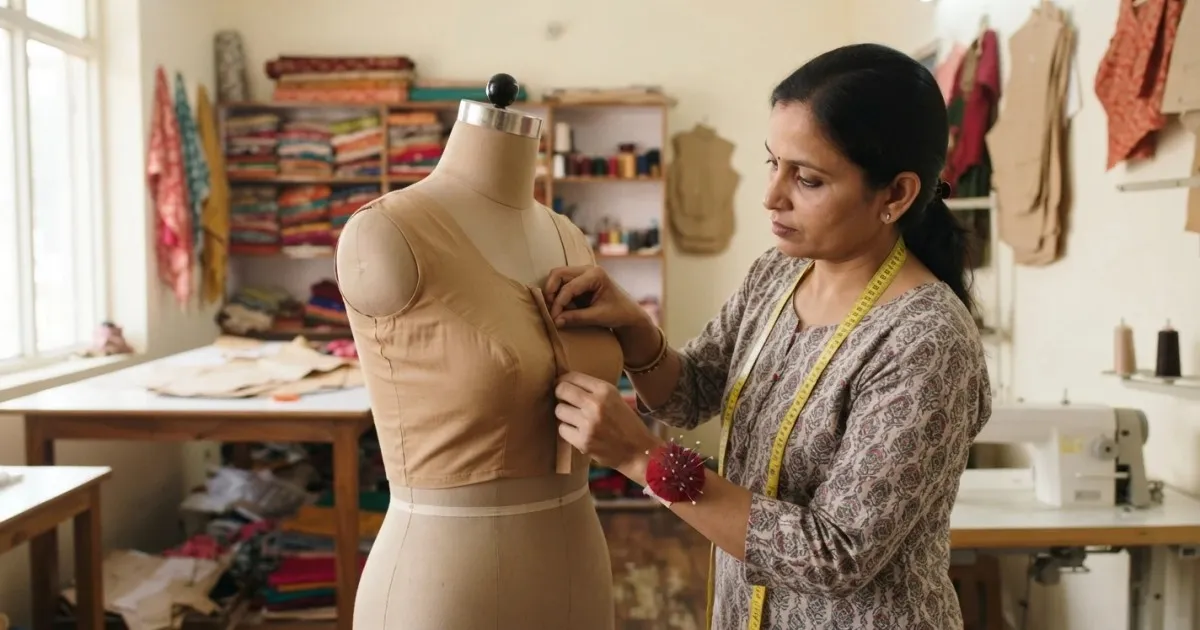
Tailor pinning a dart on a blouse front fitted on a dress form
Two blouses can share the same bust, waist and length measurements and still fit completely differently. In one, the darts point to the right place and share the shaping evenly. In the other, a dart ends two centimetres too high, and the fabric pokes out like a tent above the bust.
The measurements were not wrong. The darts were.
Darts are where blouse cutting moves from measuring to shaping, and they are one of the clearest differences between an average blouse and a blouse customers come back for.
In this guide you will find:
Why darts make or break a blouse
The darts used in an Indian blouse, and what each one does
How to find the bust point and bust span
How deep each dart should be
Common dart problems, their causes and fixes
How fabric and CAD change the way darts are made
Why Darts Make or Break a Blouse
Four reasons, and each one is visible from across the room.
Darts Do the Shaping
The difference between bust and waist has to go somewhere. Darts take it in. Too little dart and the blouse hangs loose at the waist; too much and it pulls and puckers.
The Point Has to Land in the Right Place
A dart that ends too high, too low or too far to the side shapes the fabric where the body is not. The result is a bubble or a hollow, however well it is stitched.
Every Body Is Different
Two customers with the same bust measurement can have very different bust points and bust spans. Darts copied from a standard block fit one of them and not the other.
Bad Darts Are Hard to Fix Later
A dart can be taken in a little after stitching, but a dart in the wrong place usually means unpicking and re-shaping the whole front.
The Darts in an Indian Blouse
Most fitted Indian blouses use some combination of these:
Front waist dart – rises from the waistline towards the bust point. Takes in the waist below the bust and gives the cup its shape.
Side bust dart – comes in from the side seam towards the bust point. Lifts the shaping and removes excess at the side and armhole.
Katori shaping – in katori-cut blouses, the bust area is cut as separate cup pieces. The shaping that darts would normally give is built into the cup seams instead.
Back waist darts – rise from the back waist towards the shoulder blades and shape the back in at the waist.
Princess-line blouses also move the dart shaping into seams that run over the bust. Whichever style, the rule is the same: the shaping must aim at the bust point.
Finding the Bust Point
Every front dart points towards the bust point (also called the apex). Two measurements fix it:
Bust point height – from the shoulder at the neck down to the bust point.
Bust span – the distance between the two bust points. Half of it gives the point’s distance from the centre front.
Darts point to the bust point but stop short of it – commonly a couple of centimetres away for a side dart and a little more for a waist dart. Stitching right up to the point produces a sharp, pointed shape instead of a smooth curve.
Both measurements belong on every blouse measurement sheet. They are covered in our blouse cutting measurement chart, and how to take them accurately is in our guide to body measurements for tailoring.
How Deep Should the Dart Be?
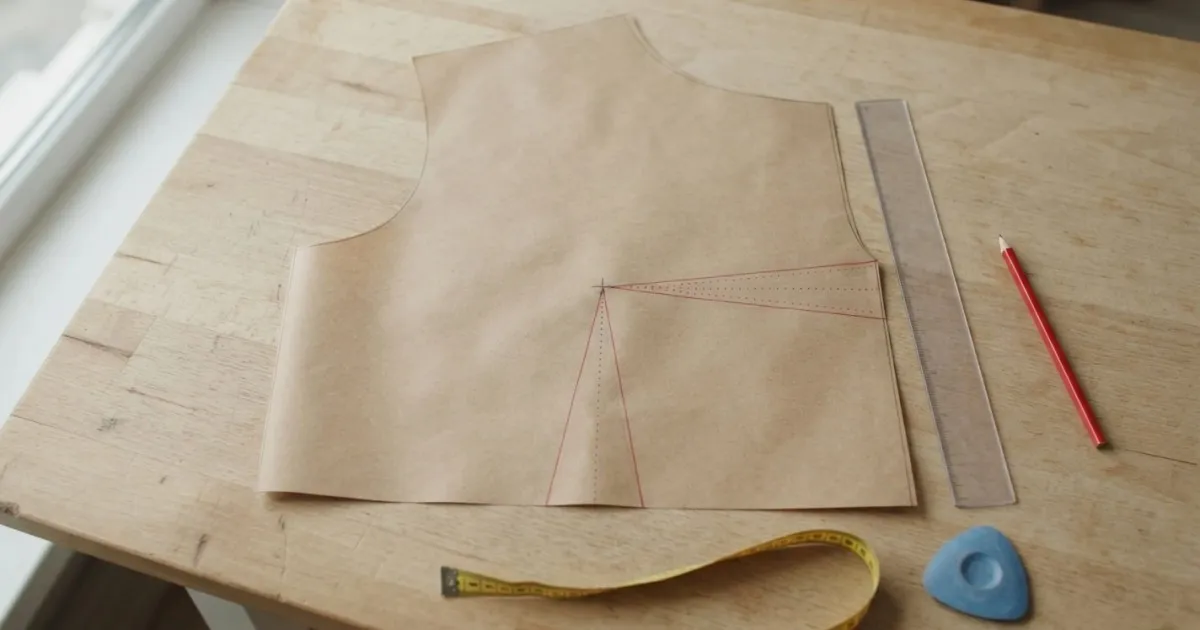
Blouse front pattern with the waist dart and side dart drawn towards the bust point
Dart depth comes from the difference between the measurements the dart has to bridge. The figures below are examples only, to show the method. Use your own customer’s measurements and your shop’s ease.
Line | Example | What it means |
|---|
Bust (with ease) | B | The width the blouse needs at the bust |
Waist (with ease) | W | The width the blouse needs at the waist |
Total shaping needed | B − W | The amount darts and seams must take in |
Shared between | Front darts, back darts, side seams | No single dart takes it all |
Front waist dart (each side) | A share of the front’s part | Deeper on fuller busts, shallower on slimmer ones |
Side bust dart | Set by bust and armhole fit | Removes excess at the side and lifts the shaping |
Sharing the shaping is the key. A single deep dart produces a pointed, uneven shape; two or three moderate darts plus a little from the side seams produce a smooth one. Customers with a fuller bust usually need deeper front darts and often a side dart as well.
Common Dart Problems and Fixes
Most dart faults have a clear cause, and the symptom tells you which:
Symptom | Likely cause | Fix |
|---|
Pointed tip, like a cone | Dart stitched right up to the bust point, or ends too sharply | Stop shorter of the point and taper the last stitches gradually |
Bubble or hollow above or below the bust | Bust point height wrong, so the dart ends in the wrong place | Re-measure bust point height and move the dart point |
Darts too far apart or too close | Bust span not measured, or copied from a block | Measure bust span and place darts from it |
Pucker at the end of the dart | Dart stitched in a straight line to the end, or backstitched at the tip | Taper off along the fold and tie the threads instead of backstitching |
Gape at the armhole | Not enough shaping at the side | Add or deepen a side bust dart |
Loose at the waist under the bust | Waist darts too shallow | Deepen the waist darts, sharing the change between them |
Darts and Fabric
The same dart behaves differently in different cloth:
Stiff silks and brocades show every dart. Taper the tips carefully and press over a rounded surface, not flat.
Soft cottons are forgiving and press easily into shape.
Lined blouses need the darts in the lining to match the outer fabric exactly, or the lining pulls.
Thick fabrics may need the dart cut open and pressed flat to reduce bulk.
Press waist darts towards the centre and side darts downward, unless the fabric needs otherwise.
More on matching fabric to garment is in our guide to which fabric for which garment.
Darts in CAD
In tailoring CAD software, darts are placed from the customer’s own bust point height and bust span, not copied from a standard block. Depth is calculated from her bust and waist with the shop’s ease, and shared between darts the same way every time.
The printed or plotted pattern shows each dart leg, fold line and point clearly, so the tailor stitching it does not have to guess. Blouse styles such as katori and princess cut are covered on the blouse pattern making software page.
Questions Tailors Ask
Where should a blouse dart point?
Towards the bust point, but stopping short of it – commonly a couple of centimetres for a side dart and a little more for a waist dart. Stitching right to the point makes the tip sharp and pointed.
How do I find the bust point?
Measure bust point height from the shoulder at the neck down to the bust point, and bust span between the two points. Half the bust span gives the distance from the centre front.
How deep should a blouse dart be?
It depends on the difference between bust and waist and how that difference is shared between darts and seams. Fuller busts need deeper darts; slimmer figures need shallower ones.
Why does my blouse dart look pointed?
Usually because the dart is stitched too close to the bust point or ends abruptly. Stop a little shorter and taper the last few stitches along the fold.
Does a katori blouse need darts?
A katori blouse builds the bust shaping into the cup seams instead of separate darts, but it still relies on an accurate bust point and bust span.
Can CAD software place darts automatically?
Yes. Darts are placed from the customer’s bust point and span, and their depth is calculated from her measurements and the shop’s ease, every time.
Shape Every Blouse the Same Way
Good darts are invisible: the customer only sees a blouse that fits. The quickest way to see darts placed from real measurements, every time, is to watch a blouse pattern drafted from measurements you brought yourself.
Book a free demo – on-site or online, in your language, with no commitment.