Half of all blouse complaints start at the shoulder. The blouse slips off one shoulder. The strap of the bra shows. There are folds from the neck to the armhole, or the armhole pulls tight under the arm. The customer says the blouse is wrong; the bust and waist are perfect.
Every customer's shoulders have a width and a slope. Most patterns use one average slope for everyone. Square shoulders and sloping shoulders need the shoulder seam drawn at a different angle, and the width has to be measured, not guessed.
In this guide you will find:
- Why blouses slip or pull at the shoulder
- How to measure shoulder width and slope
- How to adjust for sloping and square shoulders
- How to stop a wide neck slipping off
- How to correct a finished blouse
Why Blouses Go Wrong at the Shoulder
One Shoulder Slope for Everyone
A standard pattern has the same shoulder angle for every customer. On sloping shoulders, the outer end of the seam sits in the air, and folds run from the neck down to the armhole. On square shoulders, the seam pulls down, and the armhole tightens.
The Shoulder Width Was Guessed
A shoulder that is too wide drops over the arm, and the sleeve hangs. Too narrow, and the armhole cuts into the shoulder.
One Shoulder Is Lower
Most people have one shoulder lower than the other, often the side they carry a bag on. A blouse cut the same on both sides sits crooked.
The Neck Is Too Wide for the Shoulder
A boat neck or deep back on a narrow shoulder leaves only an inch of shoulder seam. It slides off with every movement.
Shoulder Slope Adjustments
Measure the slope as the drop from the neck point to the shoulder point. Working figures in inches.
| Shoulder type | Drop from neck to shoulder point | Pattern change at shoulder point |
|---|
| Very square | 1.00 to 1.25 | Raise by 0.50 |
| Square | 1.25 to 1.50 | Raise by 0.25 |
| Average | 1.50 to 1.75 | No change |
| Sloping | 1.75 to 2.25 | Lower by 0.25 to 0.375 |
| Very sloping | 2.25 and above | Lower by 0.50, add a shoulder stay |
Shoulder width and the other upper body figures are on our blouse cutting measurement chart. How the armhole changes with the shoulder is in our guide to sleeve and armhole fit.
How to Measure Shoulder Width and Slope
- Ask the customer to stand straight, arms relaxed, in the undergarment she will wear.
- Find the shoulder point, where the arm meets the shoulder, on both sides.
- Measure straight across the back from shoulder point to shoulder point for the shoulder width.
- Lay a ruler across the shoulders, level with the neck point, and measure the drop to the shoulder point on each side.
- Write down both sides. If they differ by more than 0.25, cut the two shoulders differently.
How to Adjust the Pattern
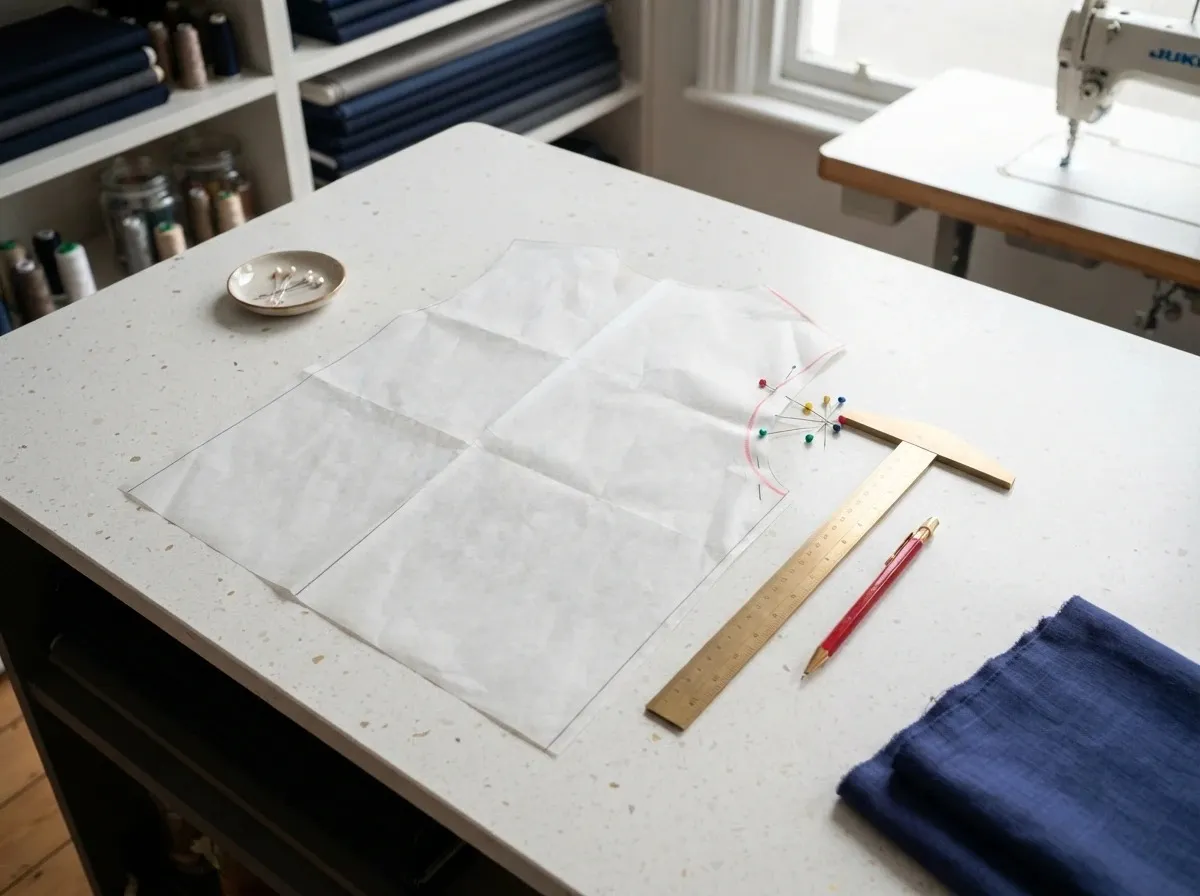
- On the front and back pattern, mark the neck point and the shoulder point.
- Raise or lower the shoulder point by the amount in the table, keeping the neck point where it is.
- Redraw the shoulder seam as a straight line from the neck point to the new shoulder point.
- Raise or lower the underarm point by the same amount, so the armhole keeps its depth.
- Redraw the armhole curve smoothly from the new shoulder point to the new underarm point.
- For a lower shoulder on one side, make the change on that side only, and mark the pattern left and right.
Stopping a Wide Neck Slipping Off
- Keep at least 1.50 inches of shoulder seam on a boat neck, and 2.00 on a deep back with a wide neck.
- Sew a shoulder stay, a short strip of straight tape, inside the shoulder seam.
- Add a lingerie strap holder, a small loop with a press button, inside each shoulder.
- For a deep back, add a dori or a hook at the top of the back opening.
Correcting a Finished Blouse
- If folds run from the neck to the armhole, unpick the shoulder and take it in at the shoulder point.
- If the armhole pulls, let out the shoulder seam at the shoulder point, if the seam allowance allows.
- If the blouse slips, add a shoulder stay or strap holders. Narrowing the neck needs a new facing.
- If one side is lower, adjust that shoulder only.
Shoulders in Tailoring CAD
In tailoring CAD the shoulder slope and width are entered for each customer, and both sides can be set separately. The armhole and sleeve are redrawn from the new shoulder automatically, so the sleeve always fits the armhole.
Our tailoring CAD software page shows how shoulders, necks and armholes are drafted from one set of measurements.
Questions Tailors Ask
Why does my blouse slip off the shoulder?
The neck is too wide for the shoulder, or the shoulder is too wide for the customer. Keep at least 1.5 inches of shoulder seam.
How do I know if a customer has sloping shoulders?
Measure the drop from the neck point to the shoulder point. More than about 1.75 inches is sloping.
What causes folds from the neck to the armhole?
The shoulder seam is too square for the customer. Lower the shoulder point.
Should both shoulders be cut the same?
Only if they measure the same. Check both sides every time.
What is a shoulder stay?
A short strip of straight tape sewn into the shoulder seam to stop it stretching.
Does shoulder slope affect the sleeve?
Yes. Changing the shoulder point changes the armhole, so the sleeve cap must be checked again.
Measure Both Sides, Draw the Seam to the Body
A blouse sits right at the shoulder when the width and slope are measured, the seam is drawn at the customer's own angle, and the armhole follows the change. Check both shoulders on every customer.
Book a free demo – on-site or online, in your language, with no commitment. Bring a blouse that slips off the shoulder and we will redraft it on screen.