A katori blouse is the traditional choice for silk sarees. Two shaped cups under the bust, joined to a band, giving a rounded, lifted front. It is also the blouse that comes back most often. The cups wrinkle at the centre. One cup sits higher than the other. The band gapes under the bust, or the point of the cup lands below the customer's bust point.
A katori is shaped by its seams, not by darts. Every cup piece has to start from the customer's own bust point and follow her own bust round. When those two figures are right, the katori sits smooth.
In this guide you will find:
- Why katori blouses wrinkle and gape
- Which measurements a katori needs
- How to draft the katori pieces
- How to join the katori to the band
- How to fix a katori that wrinkles
Why Katori Blouses Go Wrong
The Bust Point Was Guessed
The centre of each cup has to sit exactly on the bust point. Guess the shoulder-to-bust-point length and the cup sits too high or too low, and wrinkles across the top.
The Cup Is Too Deep or Too Shallow
A cup cut with too much curve for the customer stands away from the body. Too little curve flattens the bust. The cup depth comes from the difference between the full bust and the under-bust.
The Seams Were Not Notched
Katori pieces are curved, and curves stretch. Without notches the two pieces are pulled to fit, and the seam twists.
The Band Was Cut Straight
The band below the cups has to follow the under-bust curve. A straight band gapes at the centre front.
Measurements a Katori Needs
| Measurement | Where to take it | Why it matters |
|---|
| Full bust | Round the fullest part | Width of the cups |
| Under-bust | Round, just below the bust | Width of the band |
| Shoulder to bust point | From the neck point to the bust point | Height of the cup centre |
| Bust point to bust point | Straight across | Distance between the cups |
| Under-bust to waist | At the side | Depth of the band |
| Blouse length | Shoulder to finished hem | Overall length |
All six are on our blouse cutting measurement chart. Taking the bust point accurately is covered in our guide to taking body measurements.
Cup Depth by Bust Difference
The bust difference is the full bust minus the under-bust. Working figures in inches.
| Bust difference | Cup seam curve at bust point | Suits |
|---|
| 2.00 to 3.00 | 0.50 | Small bust, young customers |
| 3.00 to 4.00 | 0.75 | Average bust |
| 4.00 to 5.00 | 1.00 | Full bust |
| 5.00 and above | 1.25 | Very full bust, add a lining |
How to Draft the Katori Pieces
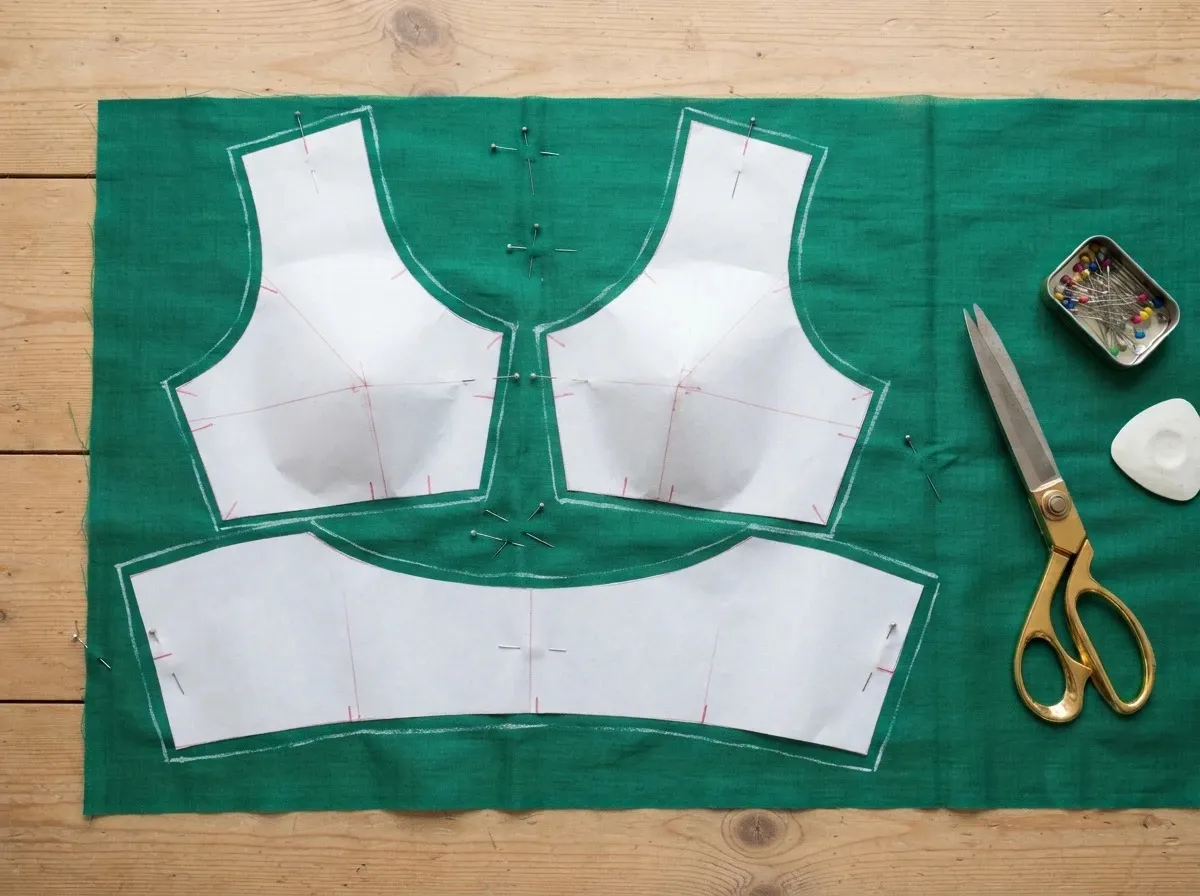
- Draft the basic front bodice to the full bust and blouse length, and mark the bust points.
- Draw the under-bust line across the front at the under-bust to waist depth above the hem.
- Below the line is the band. Above it, draw a seam from the bust point down to the under-bust line, and another from the bust point towards the side.
- Curve each seam out by the cup depth in the table at the bust point, so the two edges meet over the bust.
- Mark at least two notches on every curved seam.
- Trace each piece, add 0.375 seam allowance, and cut the katori pieces on the straight grain.
Joining the Katori to the Band
- Stay-stitch every curved edge as soon as it is cut.
- Join the katori pieces, matching the notches, with a short stitch through the bust point.
- Clip the seam allowance on the curve, and press it open over a tailor's ham or a rolled towel.
- Sew the cups to the band, easing the cups between the notches, with the cup side on top.
- Line the front with the same pieces, so the inside is clean and the cups hold their shape.
Fixing a Katori That Wrinkles
- If the cups wrinkle across the top, the bust point is too low. Unpick the top seam and raise the cup centre.
- If the cups stand away, take in the cup seam at the bust point.
- If one cup is higher, check the shoulder seams first. One shoulder is often lower.
- If the band gapes, unpick it and curve the top edge to the under-bust.
Katori Blouses in Tailoring CAD
In tailoring CAD the katori pieces are drafted from the bust point, the bust difference and the under-bust you enter. Both cups are drawn from the same figures, so they always match, and the band is drawn to meet them notch for notch.
Our blouse pattern making software page shows how katori, princess and dart blouses are drafted from one set of measurements.
Questions Tailors Ask
What is a katori blouse?
A blouse with shaped cup pieces, called katori, stitched to a band under the bust instead of using darts.
Which measurement matters most for a katori?
The shoulder to bust point length. If the cup centre misses the bust point, the cup wrinkles.
How do I make both cups match?
Draft one cup and copy it, and mark notches on both before cutting.
Should a katori blouse be lined?
Yes. A lining helps the cups hold their shape and hides the curved seams.
Which fabric suits a katori?
Silk, cotton silk and brocade. Very soft fabrics need a firmer lining.
Is a padded blouse the same as a katori?
No. A padded blouse has cups added inside. Our guide to padded blouses covers those.
Bust Point First, Then the Curve
A katori sits smooth when the cup centre is on the bust point, the curve matches the bust difference, and every seam is notched. Get those three right and the cups will match.
Book a free demo – on-site or online, in your language, with no commitment. Bring a katori that wrinkles and we will draft the cups on screen.