A strap looks like the easiest part of a garment, because it is only a long, narrow strip. Yet it is the part customers complain about most. It slips off the shoulder every time she lifts her arm. It twists as it hangs. It stretches until the neckline sags. Or it is so thick and stiff that it digs into the skin.
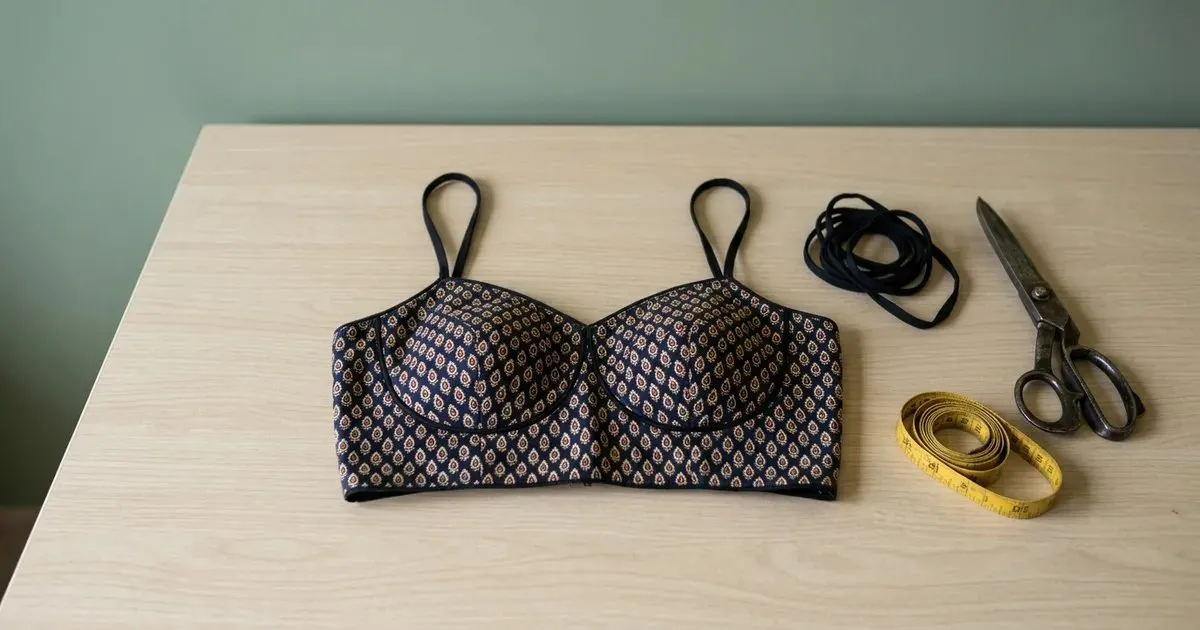
A short spaghetti-strap blouse in dark cloth with a small paisley print, sweetheart cups and two thin black straps, laid flat on a light wooden table beside a coil of black strap tube, steel shears and a yellow measuring tape
A strap carries the whole weight of the garment from one point, and it is the only thing holding it on the shoulder. If it is in the wrong place, the wrong width or the wrong length, no amount of finishing will make it stay.
The place it is set, the width it is cut and the way it is made decide whether it stays up.
In this guide you will find:
- Why straps slip, twist or stretch
- How wide and how long to cut a strap for each garment
- Which way of making a strap suits which cloth
- Where to place the strap on the shoulder
- How to sew a narrow strap tube without a struggle
- How to fix a strap that already slips
Why Straps Slip, Twist or Stretch
Four reasons, and all four are decided before the strap is sewn.
The Strap Was Set Too Far Out
A strap sewn near the shoulder point has nothing to rest on, because the shoulder slopes away beneath it. It slides off at the first movement. The strap needs to sit on the flat of the shoulder, nearer the neck.
The Strap Was Cut on the Bias and Left Unstayed
A tube for a narrow strap is cut on the bias so that it turns and curves smoothly. That same bias stretches under the weight of the garment, and a strap that was long enough when it was cut is too long after a month of wear.
The Width Does Not Suit the Cloth
A heavy silk on a narrow strap pulls it thin and digs in. A light cotton on a wide strap folds and twists. The width has to be chosen for the weight of the garment.
The Length Was Guessed
A strap that is too long lets the front drop and the neckline gape. One that is too short pulls the garment up and cuts into the shoulder. The length has to be measured on the customer, not guessed from the pattern.
Strap Width and Length for Each Garment
Measure the length on the customer, from the top of the front panel over the shoulder to the top of the back panel, and add 1.00 for the ends. The cut width is the finished width doubled, plus seam allowance. These are working figures in inches for a 36 bust (the frock for a 24 chest); always try the cut piece before finishing.
Strap | Finished width | Cut width | Cut length, each |
|---|
Spaghetti strap (bias tube) | 0.25 to 0.375 | 1.00 to 1.25 on the bias | 14.00 to 16.00 |
Flat strap | 1.00 to 1.50 | 3.00 to 4.00 | 14.00 to 16.00 |
Wide strap, sleeveless blouse | 2.00 to 2.50 | 5.00 to 6.00 | 14.00 to 16.00 |
Adjustable strap | 0.50 | 1.50 to 2.00 | 18.00 to 20.00 |
Halter tie strap | 1.00 | 3.00 | 22.00 to 26.00 |
Kids' frock strap | 0.75 to 1.00 | 2.50 to 3.00 | 10.00 to 12.00 |
The neck, shoulder and bust figures the straps are placed from are in our blouse cutting measurement chart and our kurti cutting measurement chart.
Which Strap Construction for Which Cloth
Method | Width | Best for | Watch for |
|---|
Bias tube, turned right side out | 0.25 to 0.375 | Silk, satin, georgette | Needs a strong turning tool |
Folded and stitched flat | 1.00 to 1.50 | Cotton and light silk | Press the folds sharp before sewing |
Folded edges, topstitched | 1.50 to 2.50 | Cotton and linen | Stitch both edges at the same distance |
Lined and interfaced | 2.00 to 3.00 | Heavy silk and brocade | Trim the layers to avoid bulk |
Ready-made tape or ribbon | 0.50 to 1.00 | Quick and kids' wear | Check it is washable and colourfast |
A bias tube is cut and joined in the same way as a binding strip, which is covered in our guide to bias binding. Where the strap meets the neckline, the facing widths and clipping in our guide to neck facing apply.
How to Place and Cut the Strap
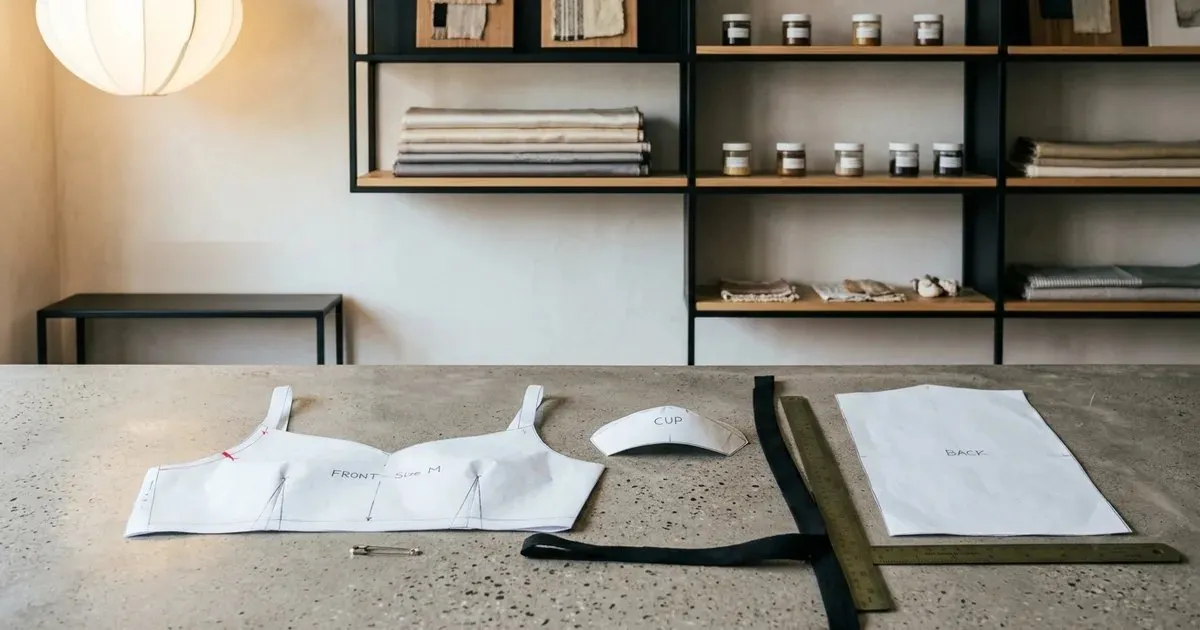
White paper pattern pieces of a spaghetti blouse, a front with the strap position marked in red pencil, a cup and a back piece, laid on a concrete table with a steel ruler, a black bias strip and a safety pin
- Fold the front pattern down the centre and mark the neck point where the neckline meets the shoulder line.
- Measure out along the shoulder line about 1.50 to 2.00 from the neck point, and mark the centre of the strap there. The strap sits on the flat of the shoulder, not near the shoulder point.
- Mark the strap width on either side of that centre line, and lean the strap slightly towards the neck at the front so that it falls straight.
- Mark the same position on the back pattern, so the strap goes straight over the shoulder and does not twist.
- Measure the strap length on the customer from the top of the front panel over the shoulder to the top of the back panel, and add 1.00.
- Cut a strap strip a little longer than needed, and trim it to the exact length after it has been sewn and pressed.
Sewing a Narrow Strap Tube
- Cut a bias strip 1.00 to 1.25 wide and fold it in half lengthwise with the right side inside.
- Stitch down the length about 0.25 from the fold, stretching the strip very slightly as you sew so that the seam does not snap when the strap is pulled.
- Trim the seam allowance to 0.125, and turn the tube right side out with a bodkin, a safety pin or a thread and needle drawn through.
- Roll the seam to the back of the tube and press it, so that the seam does not show on the front.
- Let the finished tube hang from a pin for a few hours, so that it stretches out before it is cut to length.
- Cut the strap to the length measured on the customer, and neaten the ends in the seam allowance of the garment.
Fixing a Strap That Slips
- If the strap slides off the shoulder, unpick it and move it 0.50 to 1.00 closer to the neck.
- If the strap has stretched, take it off at the back and shorten it. A stretched tube cannot be re-shaped, so cut a new one.
- If the strap twists, check that the front and back positions line up, and re-sew the back end.
- If the garment pulls forward and the strap slides, add a small elastic or a hook at the back of the strap to hold it in place.
- Press each repair from the wrong side, over a rolled towel, without stretching the strap.
Straps in Tailoring CAD
In tailoring CAD the neck and shoulder points are fixed from your measurements, so the strap position is placed on the shoulder line by the distance you enter. The front and back positions match exactly, and the strap length is printed with the pattern, so it does not need to be measured by hand each time.
Our tailoring CAD software page shows how necks, armholes and shoulders are drafted from one set of measurements.
Questions Tailors Ask
How wide should a spaghetti strap be?
About a quarter to three-eighths of an inch finished. Cut a bias strip 1 to 1.25 inches wide, and sew and turn it into a tube.
Where should a strap be placed on the shoulder?
On the flat of the shoulder, about 1.5 to 2 inches out from the neck point, and not near the shoulder point where the shoulder slopes away.
Why does my strap slip off the shoulder?
Most often it is set too far out. Move it nearer the neck by half to one inch.
Should a strap be cut on the bias?
A narrow tube is cut on the bias so that it turns smoothly. A flat strap is cut on the straight grain, so it does not stretch.
How long should a blouse strap be?
Usually 14 to 16 inches each. The exact length is measured on the customer, from the top of the front panel over the shoulder to the top of the back panel, plus an inch for the ends.
Can I make the strap adjustable?
Yes. A strap 18 to 20 inches long with a metal slider or a hook and a row of eyes can be shortened or lengthened by the customer.
Place It Close, Cut It Right, Let It Hang
A strap stays up only if it is set on the flat of the shoulder, cut to the right width and length for the cloth, and allowed to stretch before it is cut. Place it close to the neck, measure it on the customer, and it will not slip.
Book a free demo – on-site or online, in your language, with no commitment. Bring a blouse whose strap slips and we will work out the position on screen.