A georgette blouse with a seam that puckers no matter how it is pressed. A pair of jeans where the needle snaps at the belt loop. A stretch kurti whose seams skip stitches and then burst at the first wear. In every one of these, the cutting was fine and the tailor was skilled. The needle and the thread were wrong for the cloth.
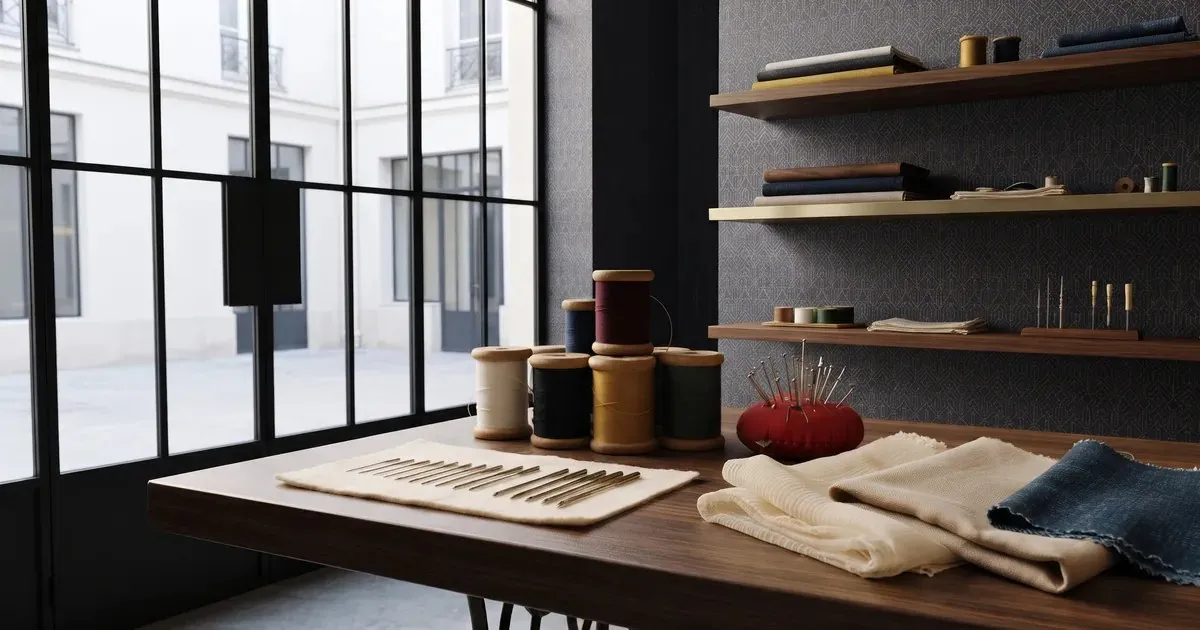
Sewing machine needles laid in a row on cream felt beside spools of thread, a red pin cushion and folded cloth samples of cream cotton and blue denim on a tailoring table
Most shops keep one size of needle in the machine and one kind of thread on the stand, and change them only when something breaks. That works for cotton. It fails on silk, georgette, denim and knits, which together make up a large part of the work in any busy shop.
Matching the needle and thread to the cloth takes a minute, and saves a remake.
In this guide you will find:
- Why seams pucker, skip or break
- Which needle size suits which fabric
- Which needle type to use, and how to tell it is wrong
- How to test before sewing the garment
- How to set stitch length and tension
- The difference between home and industrial machine needles
Why Seams Pucker, Skip or Break
Four reasons, and the needle or thread is behind every one.
The Needle Was Too Thick for the Cloth
A thick needle punches large holes in fine cloth and pushes the threads aside, so the seam gathers and puckers. Fine cloth needs a fine needle and fine thread.
The Needle Was Too Thin for the Layers
A fine needle bends when it hits several layers of denim or a heavy seam crossing, then strikes the plate and snaps. Heavy cloth needs a heavy needle and stronger thread.
The Wrong Point Was Used on a Knit
A sharp needle cuts the loops of a knit, leaving small holes and skipped stitches. Knits need a ballpoint or stretch needle that slides between the loops.
The Needle Was Blunt
A needle that has been in the machine for days pulls threads, snags silk and makes a popping sound as it goes through the cloth. Change it often; it is the cheapest part of the machine.
Needle Size for Each Fabric
Needle sizes are given as two numbers, metric and the older system, for example 80/12. The higher the number, the thicker the needle. These are working choices; test on a scrap first.
Fabric | Needle size | Needle type | Thread |
|---|
Chiffon, georgette, organza | 60/8 to 70/10 | Sharp (microtex) | Fine polyester |
Silk, crepe, voile | 70/10 | Sharp or universal | Fine polyester or silk |
Cotton, poplin, rayon | 80/12 | Universal | General-purpose polyester or cotton |
Linen, suiting, light denim | 90/14 | Universal | General-purpose polyester |
Denim, canvas, heavy cloth | 100/16 to 110/18 | Jeans | Heavy polyester |
Knits, lycra, jersey | 75/11 to 90/14 | Ballpoint or stretch | Polyester (stretches) |
Which cloth suits which garment in the first place is covered in our guide to which fabric for which garment.
Needle Types and How to Tell They Are Wrong
Needle type | Point | Best for | Sign it is the wrong one |
|---|
Universal | Slightly rounded | Most woven cloth | Pulls threads on fine silk |
Sharp (microtex) | Very sharp, slim | Silk, georgette, straight top-stitching | Holes in knits |
Ballpoint (jersey) | Rounded | Cotton knits, jersey | Wavy seams on woven cloth |
Stretch | Medium ball | Lycra, very stretchy knits | Skipped stitches if missing |
Jeans (denim) | Strong and sharp | Denim, canvas, thick seams | Breaks on denim if missing |
Embroidery | Large eye | Machine embroidery thread | Thread frays and breaks |
A twin needle, two needles on one shank, gives two parallel rows of stitching for hems on knits and for pin tucks.
How to Choose and Test
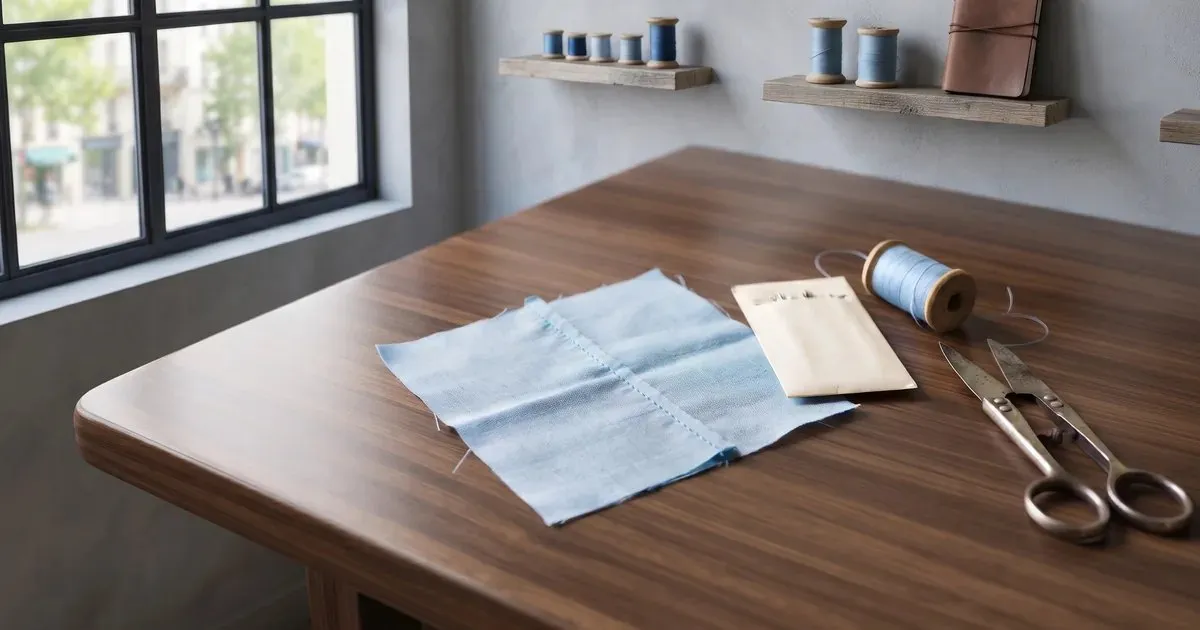
A test seam stitched on a folded scrap of cloth on a cutting table, with a needle packet, a spool of thread and small thread snips beside it
- Feel the cloth and note three things: is it fine or heavy, woven or knitted, slippery or firm.
- Choose the needle size and type from the tables, and a thread that matches the weight of the cloth.
- Fold a scrap of the same cloth in two, or in as many layers as the thickest seam, and sew a test seam.
- Look at the seam from both sides: no puckering, no skipped stitches, and the stitch locked in the middle of the layers.
- Pull the seam gently. On a knit it should stretch with the cloth without the thread snapping.
- If it is not right, change one thing at a time: the needle first, then the tension, then the stitch length.
Stitch Length and Tension
- Fine cloth – a shorter stitch, about 2 mm, so the seam is not stiff and does not pucker.
- Cotton and general sewing – about 2.5 mm.
- Heavy cloth and top-stitching – a longer stitch, 3 to 3.5 mm, so it lies flat and looks even.
- Knits – a narrow zigzag or a stretch stitch, so the seam can stretch.
- Tension – the two threads should lock in the middle of the layers. If the bobbin thread shows on top, loosen the top tension; if loops show underneath, tighten it.
- Always set the tension on a scrap, never on the garment itself.
Seam allowances and finishes for each seam are in our seam allowance guide for tailors.
Home and Industrial Machine Needles
Most busy shops run industrial straight-stitch machines, which take a different needle system from home machines. The sizes use the same numbers, but the needles are not interchangeable.
- Industrial straight-stitch machines usually take DBx1 needles, sold by size as 9, 11, 14, 16 and 18.
- Home machines usually take 130/705 H needles, sold as 70/10, 80/12, 90/14 and so on.
- Overlock machines take their own system; check the machine manual before buying.
- Keep each size in a labelled box, so a fine needle is never put into a denim job by mistake.
- For denim and heavy work on an industrial machine, size 16 or 18 is usual; for shirting, 11 or 14.
Heavy cloth also needs the right pressing at the end; see our guide to pressing, finishing and the delivery check.
Choosing and Storing Thread
- Polyester thread is strong and slightly stretchy; it suits most garments, including knits.
- Cotton thread has no stretch; use it on cotton garments that will be pressed hot, never on knits.
- Use the same thread on top and in the bobbin, so the tension stays balanced.
- Match the thread colour to the cloth, or go one shade darker; a lighter thread shows on the seam.
- For top-stitching on denim, use a heavier thread on top and normal thread in the bobbin.
- Keep thread out of the sun and away from dust; old, faded thread breaks easily.
Jeans and trousers in denim take the heaviest needles and thread in the shop; the measurements they are cut from are in our gents pant cutting measurement chart.
Questions Tailors Ask
Which needle size should I use for cotton?
An 80/12 universal needle on a home machine, or size 11 or 14 on an industrial machine, with general-purpose polyester thread.
Which needle is best for georgette and chiffon?
A fine sharp needle, 60/8 or 70/10, with fine polyester thread and a short stitch, so the seam does not pucker.
Why does my machine skip stitches on stretch cloth?
The needle point is wrong. Change to a ballpoint or stretch needle and use a narrow zigzag or a stretch stitch.
How often should I change the needle?
After about a full day of sewing, after every heavy garment such as jeans, and straight away if it makes a popping sound or pulls threads.
Why does the needle break on jeans?
It is too fine for the layers. Use a jeans needle, 100/16 or 110/18, sew slowly over thick seams, and hammer the seam flat first.
Can I use the same needle on home and industrial machines?
No. Industrial straight-stitch machines usually take DBx1 needles and home machines 130/705 H. The size numbers match, but the needles do not fit each other's machines.
Match the Needle to the Cloth
A needle and a spool of thread cost very little, but the wrong ones can spoil the most expensive cloth in the shop. Choose the size and point for the fabric, test on a scrap, set the stitch and tension, and change the needle often, and the seams will lie flat on every garment.
Book a free demo – on-site or online, in your language, with no commitment. See how our tailoring CAD software cuts every piece accurately, so the sewing starts from a perfect pattern.