A customer holds up her new blouse and says one thing: the neck is too deep. Or too wide. Or it gapes at the front and slips off the shoulder. The blouse was cut to her chest, waist and sleeve measurements, and every one of them was right. The neck was cut by eye.
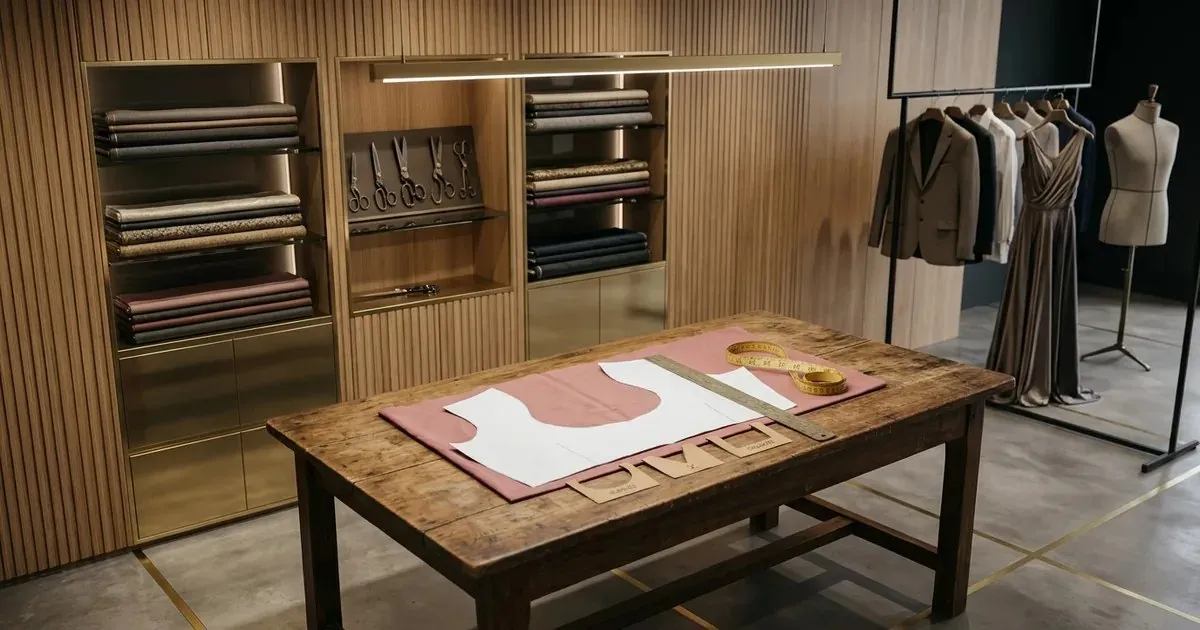
Dusty rose cotton cloth with white paper blouse pattern pieces laid on it, a deep round neckline cut into the front, with three small brown paper neck templates, a steel ruler and a measuring tape
The neckline is the first thing anyone looks at on a blouse or a kurti, and the one part that cannot be put right once the cloth is cut. A bust measurement can be let out later. A neck that was cut half an inch too deep cannot be put back.
Every neck comes down to two numbers: how deep it goes, and how wide it is. Once you know them for each style, you can cut any neck in a few minutes and cut it the same way every time.
In this guide you will find:
- Why necklines come out too deep, too wide or uneven
- Depth and width for round, V, square, boat and sweetheart necks
- Neck sizes for kurtis, kurtas, frocks and chudi tops
- How to measure, mark and cut the front neck
- How to match the back neck to the front
- How to finish the cut neck so it keeps its shape
Why Necklines Go Wrong
Four reasons, and all four happen before the neck is finished.
It Was Cut to Full Depth in One Go
Cloth cannot be put back. Cut the neck about half an inch smaller than the figure, try the piece against the customer or a trial blouse, and then take it to full depth. Cutting small is a correction. Cutting deep is a remake.
Depth Was Measured From the Wrong Place
Neck depth is measured straight down the centre front, from the line of the shoulder at the neck point, not from the top of the cloth or the collar bone. Two tailors measuring from two different places will cut two different necks from the same figure.
The Front and Back Neck Did Not Match
The front and back necks must be the same width where they meet at the shoulder seam. If the back is cut even a quarter inch wider, the shoulder seam is short at the neck and the blouse pulls backwards and slides off the shoulder.
The Curve Was Cut Free-hand
A neck cut free-hand has a flat spot or a kink, and a curve is where the cloth is cut on the bias, so it stretches as it is handled. Mark the curve from three points or with a template and stay-stitch it straight away.
Neck Depth and Width for a Blouse
Neck width here is the total width across the neck, from one shoulder neck point to the other. Depth is measured down the centre front. These are working figures in inches for a blouse of about 36 bust; always try the cut piece before the final cut.
Neck | Front depth | Neck width | Back depth | Notes |
|---|
Round neck | 3.50 to 4.00 | 6.00 to 6.50 | 1.50 to 5.00 | Everyday blouse; shallow back |
Deep round neck | 6.00 to 7.00 | 6.50 to 7.00 | 8.00 to 9.00 | Party and silk blouses |
V neck | 5.00 to 6.00 | 6.00 to 6.50 | 5.00 to 7.00 | Sharp point at the centre |
Square neck | 4.50 to 5.50 | 6.50 to 7.00 | 5.00 to 6.00 | Corners need a clipped facing |
Boat neck | 2.00 to 2.50 | 9.00 to 10.50 | 1.50 to 2.00 | Wide and shallow, shoulder to shoulder |
Sweetheart neck | 5.50 to 6.50 | 7.00 to 7.50 | 5.00 to 6.00 | Needs a stiff interfacing |
For every 2 inches the bust is above or below 36, add or take off about 0.125 on the width and 0.25 on the depth. The bust, shoulder and armhole figures the neck is cut with come from our blouse cutting measurement chart. For the looks and styling of each neck, see our guide to 40 latest blouse neck designs.
Neck Depth and Width for Other Garments
A kurti or a frock does not take a blouse neck. The depth is greater, because the garment is not close-fitting and must go over the head, and the back neck is almost always shallow.
Garment | Front depth | Neck width | Back depth | Opening |
|---|
Kurti, round neck | 5.00 to 6.00 | 7.00 to 7.50 | 1.00 to 1.50 | Slips over the head |
Kurti with placket | 6.00 to 7.00 | 7.00 to 7.50 | 1.00 to 1.50 | Slit down the front |
Chudi top, round neck | 4.00 to 5.00 | 7.00 | 1.00 to 1.50 | Slips over the head |
Gents kurta, round neck | 3.50 to 4.00 | 7.50 to 8.00 | 1.00 | Placket below the neck |
Kids' frock, round neck | 3.00 to 3.50 | 5.00 to 5.50 | 1.00 | Back opening or button |
Salwar-suit kameez | 5.00 to 6.00 | 7.00 to 7.50 | 2.00 | Slips over the head |
Whether a garment needs a placket or a plain opening depends on whether the neck is wide enough to clear the head. If the width is under about 7 inches, the opening needs a slit or a button. The length and shoulder figures for kurtis are in our kurti cutting measurement chart.
How to Measure, Mark and Cut the Front Neck
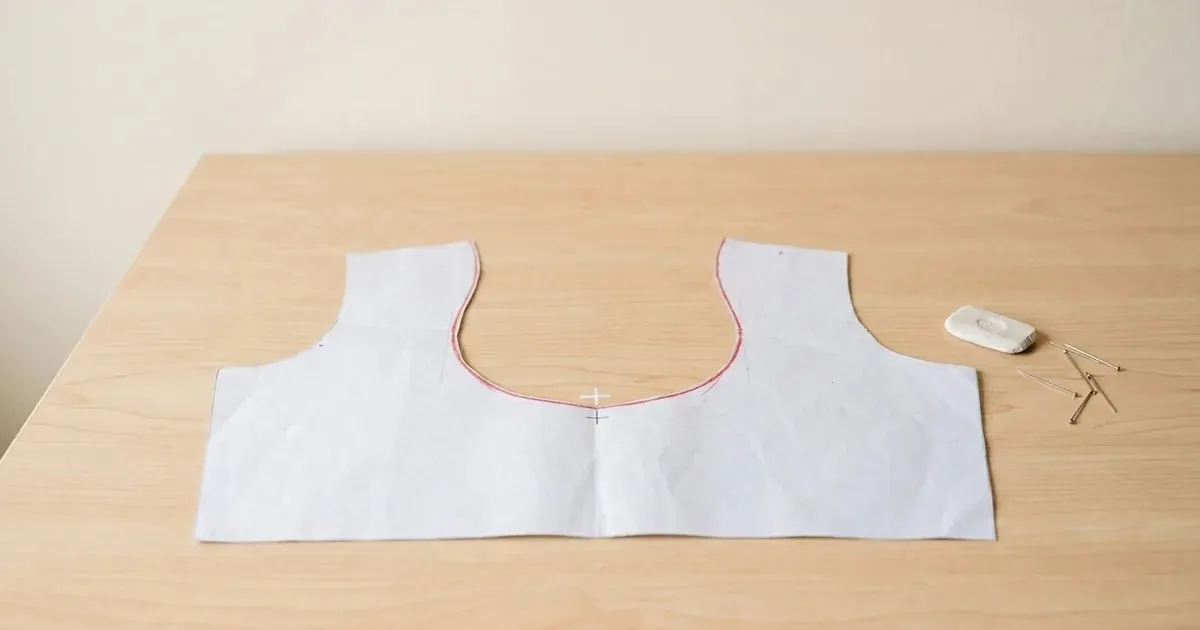
A white paper blouse front pattern laid flat with the neckline curve drawn in red pencil and a white chalk cross at its lowest point, with a piece of chalk and dressmaker pins beside it
- Fold the front pattern or cloth in half down the centre front, so the neck is cut in one go and both sides match.
- Mark the neck point on the shoulder line, half the neck width from the centre front.
- Mark the neck depth on the centre front, straight down from the line of the shoulder at the neck point. Use a steel ruler, not the tape, so the line is straight.
- Join the two marks with a smooth curve. For a round neck, mark a third point on a diagonal between them, about 0.50 outside the straight line, and curve through all three.
- For a V neck, join the two marks with a straight line. For a square neck, draw a straight line across at the depth and down at the neck width, with a small curve at each corner.
- Cut inside the line, about 0.50 smaller than the figure, try it, then take it to the final line.
Matching the Back Neck to the Front
- Cut the back neck the same width as the front, so the two necks meet exactly at the shoulder seam.
- The back depth is measured from the line of the shoulder at the neck point, straight down the centre back, exactly as for the front.
- A closed back needs only 1.00 to 1.50 of depth. A deep back neck of 8.00 or more needs the hooks or dori placed before the neck is cut, because the back opening decides where they go.
- Measure the shoulder seam on the front and the back after both necks are cut. The two must be the same length, or the neck will pull to one side.
- Mark a notch on the neck curve at the shoulder seam on both pieces, so the facing or binding can be matched exactly.
Finishing the Cut Neck
- Stay-stitch the neck curve straight after cutting, about an eighth of an inch inside the seam line, so the bias cannot stretch.
- Clip the curve every half inch, almost to the stitching, before turning the facing.
- Use a facing for a clean neck with nothing showing on the outside; the width to cut for each edge is in our guide to neck facing.
- For a V neck, stitch one stitch across the point and clip right into it, or the point will pucker.
- Press the neck from the wrong side, over a rolled towel, so the curve keeps its shape.
Necklines in Tailoring CAD
In tailoring CAD the neck is not drawn free-hand. You enter the style, the depth and the width, and the software draws the curve, matches the front and the back at the shoulder, and prints a facing that follows the same line. A customer who wants the neck half an inch deeper can have it changed on screen in seconds, before any cloth is cut.
Our tailoring CAD software page shows how necks, collars and facings are drafted from one set of measurements.
Questions Tailors Ask
How deep should a blouse front neck be?
About 3.5 to 4 inches for an everyday round neck, 6 to 7 inches for a deep round neck, and 5 to 6 inches for a V neck, on a blouse of about 36 bust.
What is the neck width of a blouse?
The width across the neck, from one shoulder neck point to the other. For a round neck it is about 6 to 6.5 inches, and for a boat neck 9 to 10.5 inches.
Where is neck depth measured from?
Straight down the centre front, from the line of the shoulder at the neck point. Always use the same starting point, or two tailors will cut different necks.
How deep should the back neck be?
1 to 1.5 inches for a closed back and 5 to 9 inches for a deep back neck. Cut it the same width as the front.
Why does my blouse neck gape?
It is cut too wide or too deep, or it was not stay-stitched and the bias stretched. Cut it smaller, stay-stitch it, and finish it with a facing.
How do I make a neck deeper after cutting?
You can cut a shallow neck deeper, but never the other way round. That is why you cut it small first, try it, and then take it to the final depth.
Measure First, Cut Small
A neckline looks simple and decides how the whole blouse is judged. Measure the depth from the shoulder line, take the width across the neck, match the back to the front, cut half an inch small, stay-stitch the curve and then take it to the final line. The neck will fit every time.
Book a free demo – on-site or online, in your language, with no commitment. Bring a blouse whose neck never sat right and we will draft the neck on screen.