A puff sleeve is one of the most asked-for sleeves in a blouse catalogue. A small, round puff at the shoulder, gathered into the armhole and finished with a band. It looks easy, and then the garment comes back. One puff is fuller than the other. The gathers bunch at the front. The band cuts into the arm, or the puff collapses flat by the end of the day.
A puff is extra cloth, added in the right place and gathered evenly. How much cloth you add, where you add it, and how you gather it decide whether the sleeve stands up or falls flat.
In this guide you will find:
- Why puff sleeves go wrong
- How much extra width to add for each puff
- How to slash and spread the sleeve pattern
- How to gather the cap evenly
- How to cut and attach the band
- How to fix a puff that has collapsed
Why Puff Sleeves Go Wrong
Four reasons, and all four are decided at the cutting stage.
Too Little Extra Cloth
A puff needs at least half as much width again as a plain sleeve. Add only an inch or two and the gathers are too few to stand up. The sleeve looks creased, not puffed.
Extra Cloth Added Only at the Sides
If the width is added only at the underarm seam, the gathers fall under the arm where nobody sees them. The puff has to be added across the cap, through the centre of the sleeve.
Gathers Pulled Unevenly
Gathers pulled with one thread, or pulled tighter at the front than the back, give a puff that leans. Two rows of gathering stitch and matching notches keep both sleeves the same.
The Band Cut to the Wrong Size
A band cut to the exact arm round leaves no room to bend the arm. A band cut too loose lets the puff slide down. The band is cut to the arm round plus ease, never to the sleeve width.
Extra Width for Each Puff
These are working figures in inches for a 36 bust with an 11 inch arm round. Always try the cut sleeve before finishing.
| Puff style | Extra width at cap | Extra height at cap | Band (arm round plus) |
|---|
| Soft puff | 3.00 to 4.00 | 0.75 | 1.00 |
| Standard puff | 5.00 to 6.00 | 1.25 | 1.00 |
| Full puff (party) | 7.00 to 9.00 | 1.50 to 2.00 | 1.25 |
| Puff at cap only, plain hem | 4.00 to 5.00 | 1.00 | No band |
| Kids' frock puff | 3.00 to 4.00 | 0.75 | 0.75 |
The arm round and sleeve length the sleeve is cut from are in our blouse cutting measurement chart. How a sleeve cap matches the armhole is covered in our guide to sleeve and armhole fit.
How to Slash and Spread the Sleeve Pattern
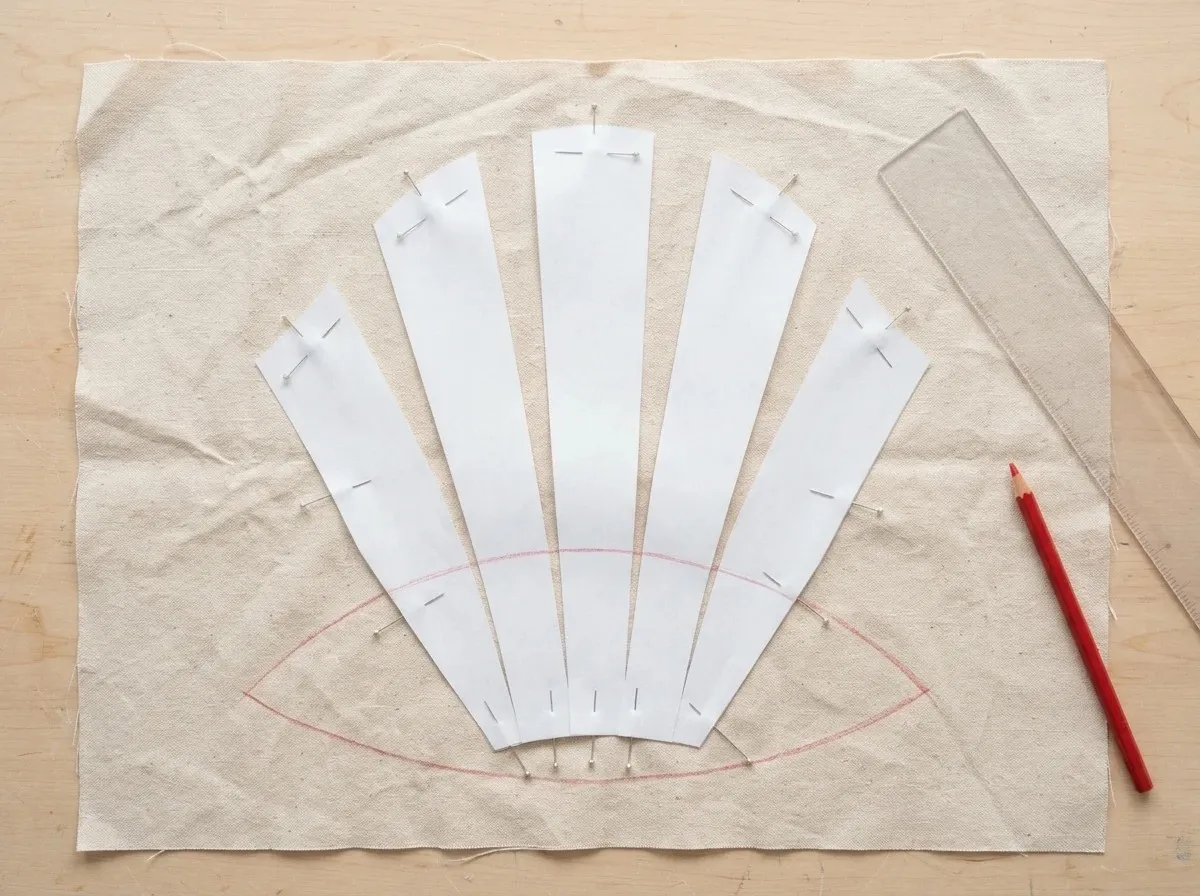
- Draft a plain short sleeve to the customer's armhole and arm round.
- Draw four or five vertical lines from the cap down to the hem, evenly spaced.
- Cut along the lines from the cap down to, but not through, the hem edge.
- Spread the strips apart at the cap on a fresh sheet of paper, so that the total extra width matches the table.
- Raise the top of the cap by the extra height in the table, and redraw the cap as one smooth curve.
- Mark notches at the centre of the cap and at the front and back, so the gathers can be shared out evenly.
For a puff that is also full at the hem, spread the strips at both the cap and the hem. For a puff gathered only at the cap, keep the hem width the same as the plain sleeve.
Gathering the Cap Evenly
- Sew two rows of long gathering stitch across the cap, between the front and back notches, one at 0.25 and one at 0.50 from the edge.
- Leave long thread tails at both ends, and do not back-tack.
- Pin the sleeve to the armhole at the underarm, the notches and the shoulder point.
- Pull the bobbin threads from both ends together, sliding the gathers until the cap fits the armhole between the notches.
- Share the gathers out so that slightly more sits just in front of the shoulder point and just behind it, and almost none sits under the arm.
- Sew the sleeve in with the gathers on top, then remove the gathering stitches that show.
Gather both sleeves before sewing either one in, and lay them side by side to check that the puffs match.
Cutting and Attaching the Band
- Cut the band on the straight grain, twice the finished width plus seam allowances, and the arm round plus the ease in the table.
- Press a light interfacing to half of the band for a puff that has to stand up.
- Gather the hem of the sleeve to the length of the band.
- Sew the band to the sleeve, right sides together, fold it over and stitch it down from the front.
For a soft puff with no band, finish the hem with a narrow elastic casing instead. Our guide to elastic waistbands gives the same rule for how much elastic to cut.
Fixing a Puff That Has Collapsed
- If the puff is flat, add a strip of net or soft organza under the cap, gathered with it, to hold it up.
- If one puff is fuller than the other, unpick the cap and share the gathers out again against the notches.
- If the band is too tight, unpick it and cut a new band with the right ease. A band cannot be stretched.
- If the gathers bunch at the front, move them back towards the shoulder point and resew the cap.
Puff Sleeves in Tailoring CAD
In tailoring CAD the plain sleeve is drafted from the armhole and arm round, and the puff is added by the width and height you enter. The slash-and-spread is done on screen, and the band is drawn from the same arm round, so both sleeves always match.
Our blouse pattern making software page shows how sleeves of every style are drafted from one set of measurements.
Questions Tailors Ask
How much extra cloth does a puff sleeve need?
About 5 to 6 inches extra at the cap for a standard puff on a 36 bust. A soft puff needs 3 to 4 inches, a full party puff 7 to 9 inches.
Why does my puff sleeve go flat?
There is too little extra width, or the cap was not raised. Add more width across the cap and raise the cap by 1 to 1.5 inches.
Where should the gathers sit?
Mostly just in front of and just behind the shoulder point. Keep the underarm almost flat.
How tight should the band be?
The arm round plus about an inch, so the arm can bend without the band cutting in.
Can I make a puff without gathers?
Yes. Small pleats at the cap give a neater, more structured puff. Our guide to pleats shows how much cloth each pleat takes.
Which fabrics hold a puff best?
Cotton, cotton silk and organza hold their shape. Soft georgette and rayon need a net lining under the cap.
Add Width, Raise the Cap, Gather Evenly
A puff sleeve stands up when there is enough cloth in the cap, the cap is raised, and the gathers are shared out evenly between the notches. Cut both sleeves the same way, gather them together, and the puffs will match.
Book a free demo – on-site or online, in your language, with no commitment. Bring a blouse with a puff that falls flat and we will draft the sleeve on screen.