Hang two pleated school skirts side by side. On one the pleats fall straight from the waist to the hem, every fold the same width. On the other they splay open at the hip, two pleats are wider than the rest, and the last one at the zip is half a pleat because the cloth ran out.
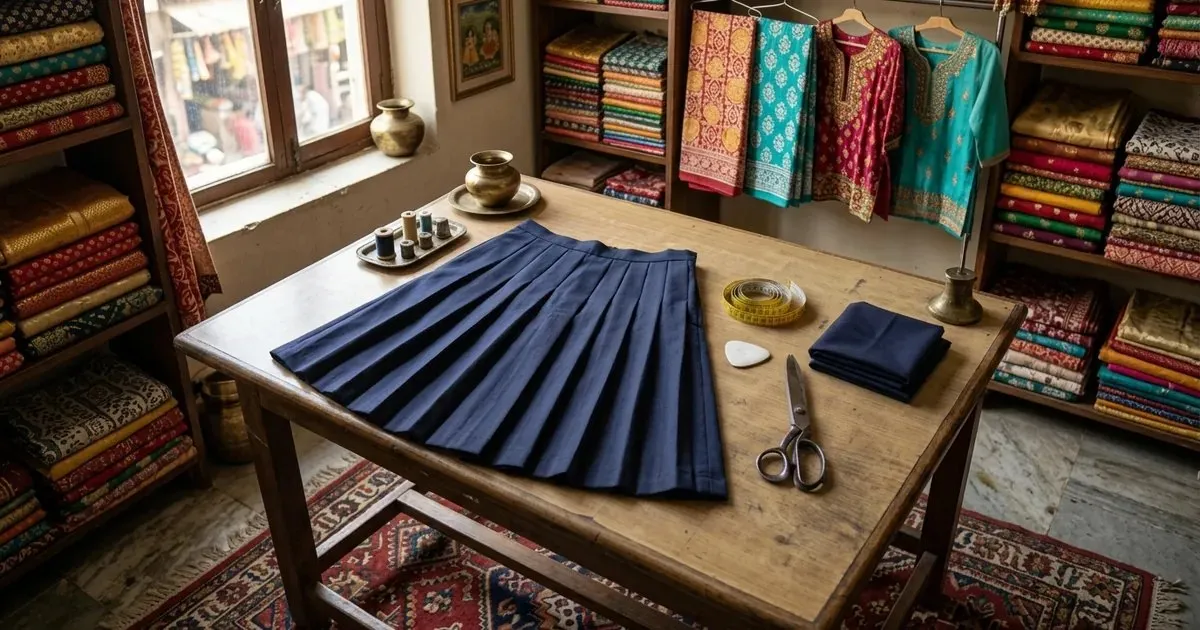
A navy pleated school skirt with crisp knife pleats laid flat on a tailoring table, with a measuring tape, chalk and shears beside it
A pleat is a fold of cloth pressed or stitched in place. Unlike a gather, which spreads the fullness evenly, a pleat puts it in exact, measured folds, and that is why a pleat shows every mistake. One pleat cut a quarter inch short is visible from across the room.
The good news is that pleats are pure arithmetic. Once you know how much cloth each pleat takes, the cutting is the same every time.
In this guide you will find:
- Why pleats splay, twist or come out uneven
- The cloth each type of pleat takes
- How to work out the cloth for a whole garment
- How to mark and fold pleats on the table
- How to stitch and press them so they stay
- How the fabric changes the pleat you can use
Why Pleats Go Wrong
Four reasons, and three of them happen before the cloth is folded.
The Folds Were Not on the Grain
A pleat must fold along the lengthwise grain. If the fold line drifts off the grain, the pleat twists as it hangs and the hem dips at one side. Fold on a pulled thread or a ruled line parallel to the selvedge, never by eye.
The Marks Were Guessed
Many shops measure the first pleat and fold the rest by eye. Each fold is a little off, and across twenty pleats the error adds up to a whole pleat at the end. Mark every fold line on the cloth before the first one is pressed.
The Cloth Was Worked Out on the Waist Only
Pleats are closed at the waist and open below it. If they are not stitched down to the hip, the hip pushes them open and the skirt looks tight. Check the hip, not just the waist, and decide how far down to stitch the pleats before you cut.
The Fabric Will Not Hold a Fold
A crisp cotton or a polyester-viscose suiting holds a pleat for years. A soft georgette or a knit drops it after one wear. If the cloth will not hold a pressed fold, use soft unpressed pleats or gathers instead.
Pleat Types and the Cloth Each Takes
The depth of a pleat is how far the fold goes under. Every pleat uses twice its depth in extra cloth, because the cloth goes in and comes back out. All figures are in inches.
Pleat | Extra cloth per pleat | Pleats touching | Where it is used |
|---|
Knife pleat | 2 x depth | 3 x finished width | School skirts, frocks, kurta fronts |
Box pleat | 4 x depth (2 x each side) | 3 x finished width | Uniform skirts, frocks, shirt backs |
Inverted box pleat | 4 x depth | 3 x finished width | Skirt centre front, coat and kurti backs |
Kick pleat | 2 x depth, at the hem only | Not used | Straight skirts, coat back vents |
Pin tuck | 2 x tuck width | Not used | Blouse yokes, kids' wear, kurta fronts |
Pleats touching means each fold reaches the next one underneath, as in a school skirt. That is full pleating, and it always takes three times the finished width. Gathers work on ratios instead; see our guide to gathers and fullness.
Working Out the Cloth for a Garment
Add the extra cloth for every pleat to the finished width. Then add the seam allowances and any placket or zip allowance. These are working figures for checking a cutting plan:
Garment | Finished width | Pleats | Cloth before seams |
|---|
School skirt, waist | 26.00 | 13 knife pleats, touching | 78.00 (3 x 26) |
Kids' frock skirt | 28.00 | 7 box pleats, 1.00 deep each side | 56.00 (28 + 7 x 4) |
Uniform skirt | 30.00 | 2 inverted pleats, 2.00 deep | 46.00 (30 + 2 x 8) |
Shirt back at yoke | 18.00 | 1 box pleat, 1.00 deep | 22.00 (18 + 4) |
Kurta yoke | 8.00 | 10 pin tucks, 0.125 wide | 10.50 (8 + 10 x 0.25) |
If the total is wider than the cloth, plan the joins so they fall inside a pleat, where the seam is hidden in the fold. The waist and hip figures for each garment are in our school uniform cutting measurement chart and our kids' frock cutting measurement chart.
How to Mark and Fold Pleats
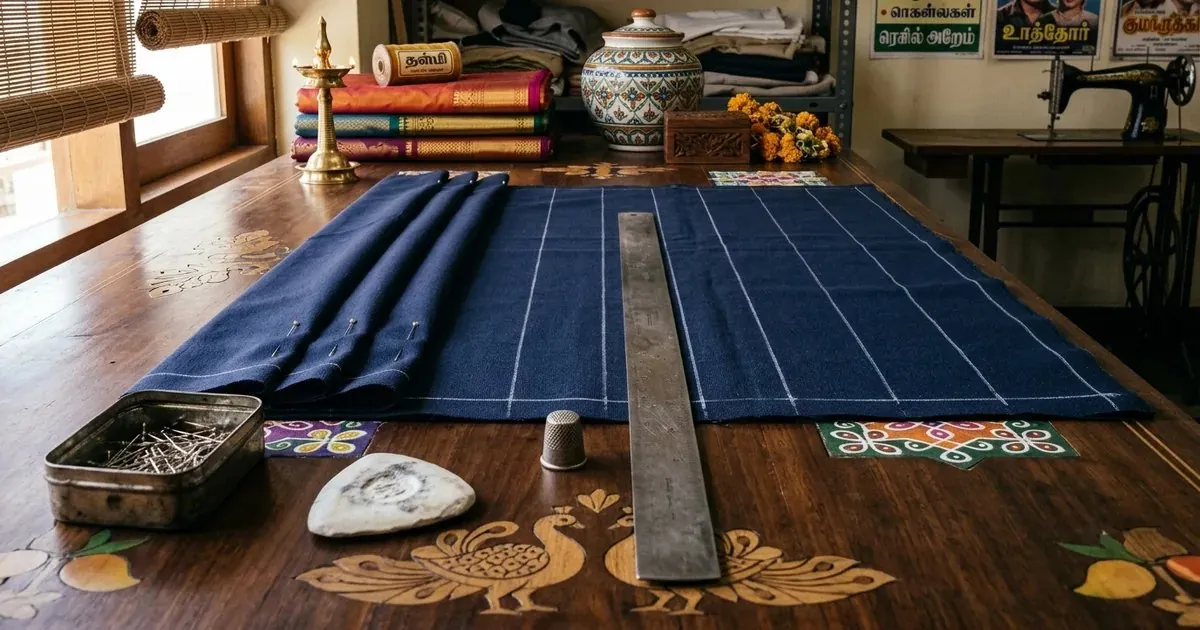
Navy cloth on a cutting table with chalk lines marking each pleat, three pleats folded and pinned, and a steel ruler beside them
- Square the cloth on the table and pull a thread or rule a line so the first fold runs straight along the lengthwise grain.
- Mark two lines for every pleat: the fold line and the placement line it folds to. Use a different chalk colour, or a dot and a dash, so the two never get mixed up.
- Rule all the lines with a long steel ruler before folding anything. Count the pleats on the cloth against your plan.
- Fold each pleat along its fold line and bring it to its placement line. Pin at the waist, the hip and the hem.
- Keep the cloth flat on the table the whole time. A pleat folded in the air never lands where it was marked.
- Baste across the top of all the pleats before the cloth is moved, so nothing shifts on the way to the machine.
Sewing and Pressing Pleats
- Stitch the pleats down from the waist to the hip, on the fold edge, so the hip cannot push them open.
- Hem the skirt before pressing the full length of the pleats. A hem turned after pressing puts a bulge in every fold.
- Press each pleat from the wrong side first, then from the right side through a damp pressing cloth.
- Let the pleats cool and dry on the table before you lift the garment. A warm pleat drops as soon as it hangs.
- For school uniforms, a line of edge-stitching on the inside fold of each pleat keeps the crease through many washes.
How much heat and steam each cloth can take is in our guide to pressing, finishing and the delivery check.
How the Fabric Changes the Pleat
- Cotton and poplin – hold a crisp knife or box pleat well, but need pressing after every wash.
- Polyester-viscose suiting – the best cloth for uniform pleats; it holds the crease for years.
- Wool and terry wool – press with steam and a pressing cloth; the pleat sets as it cools.
- Silk – takes a soft pleat; press lightly with a low iron and test on a scrap first.
- Georgette and chiffon – will not hold a pressed pleat at home; use soft unpressed pleats or gathers.
- Heavy cloth – use fewer, wider pleats, and trim the inside depth at the waist to cut the bulk.
Pleats in Tailoring CAD
In tailoring CAD the pleats are drafted into the pattern, not worked out on the table. You enter the finished width, the number of pleats and their depth; the software spreads the pattern, adds the extra cloth and prints the fold and placement lines on the piece. Every pleat comes out the same, and the last one never runs short.
Our tailoring CAD software page shows how pleated pieces are drafted from one set of measurements.
Questions Tailors Ask
How much cloth does a pleat take?
Twice its depth. A knife pleat that folds one inch under takes two inches of extra cloth. A box pleat folds on both sides, so it takes four times its depth.
How much cloth do I need for a fully pleated skirt?
Three times the finished waist when the pleats touch underneath, plus seam allowances. A 26-inch waist needs about 78 inches of cloth across.
What is the difference between a box pleat and an inverted pleat?
They are the same fold seen from opposite sides. A box pleat has its two folds facing away from each other on the front; an inverted pleat has them meeting in the middle.
Why do my pleats open at the hip?
They were not stitched down far enough. Stitch the pleats closed from the waist to the hip line so the hip cannot push them apart.
How do I keep pleats sharp after washing?
Choose a cloth that holds a crease, such as polyester-viscose, and edge-stitch the inside fold of each pleat. Cotton pleats need pressing again after every wash.
Where should I join the cloth in a pleated skirt?
Inside a pleat, on the hidden fold. The seam disappears into the pleat and the outside looks unbroken.
Measure Every Pleat, Not Just the First
A pleated garment looks right only when every fold is the same. Work out the cloth from the depth of each pleat, mark every line before you fold, stitch the pleats down to the hip, and press them flat on the table until they cool.
Book a free demo – on-site or online, in your language, with no commitment. Bring a pleated skirt that never came out even and we will draft every pleat on screen.