A child grows out of a frock faster than she wears it out, so a kids frock cutting measurement chart has to do two jobs: fit today, and still fit in six months. This guide covers the eight measurements a frock is cut from, an age-wise reference to start from, how much growth allowance to add, and what changes in the pattern for each frock style.
Recording each customer's numbers in a body measurement app keeps them safe, searchable and ready for the cutting table.
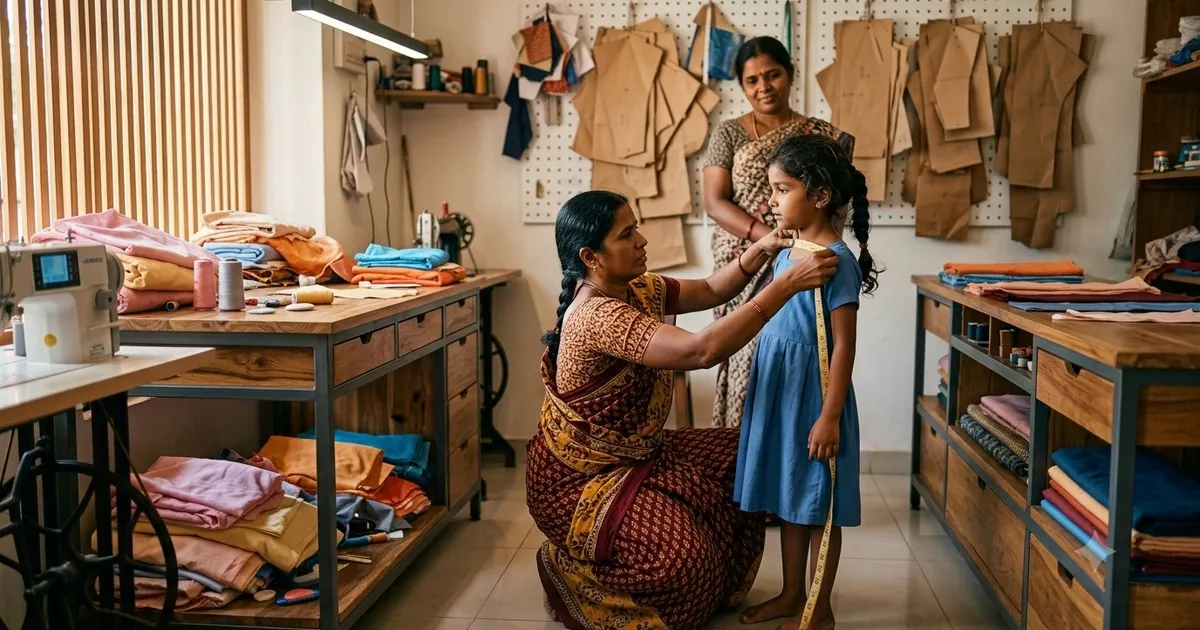
Tailor measuring a young girl for a frock with a soft measuring tape in a tailoring shop
A mother brings her daughter in before a function. The frock is stitched, it fits beautifully, and she is delighted. Four months later she is back, and the same frock will not close at the chest.
That is not a fitting failure. It is a growth-allowance failure, and it is the one thing that separates cutting for children from cutting for adults.
The other difference is the chart itself. Most of what you find online is a retail size chart, written to help a parent choose which ready-made size to buy. A tailor needs something different — the measurements to cut from, and what to add to them.
In this guide you will find:
The eight measurements a kids frock is cut from
An age-wise reference chart to start from
How much growth allowance to add, and where
What changes in the pattern for each frock style
The four mistakes behind most kids alterations
How to measure a child who will not stand still
A Size Chart Is Not a Cutting Chart
This is worth being clear about, because it is the reason most online charts disappoint a tailor.
| Retail size chart | Cutting chart |
|---|
Written for | A parent choosing a ready-made size | A tailor cutting cloth |
Based on | Age bands | The child in front of you |
Contains | Finished garment sizes | Body measurements plus ease plus growth allowance |
Handles a tall six-year-old | Badly — buy the next size | Correctly — measure and cut |
Useful for | Shopping | Drafting |
Use an age chart to sanity-check a figure that looks wrong. Never use it instead of measuring.
Kids Frock Cutting: The 8 Measurements a Frock Needs
Measure over light clothing, with the child standing straight and relaxed. Keep the tape snug, never tight — on a child a tight tape reads a full inch small.
# | Measurement | Where it is taken | Typical ease |
|---|
1 | Chest | Fullest part of the chest, tape level all the way round | 2-3 in |
2 | Waist | Natural waist, just above the navel | 2-3 in |
3 | Hip | Fullest part of the hip, for a fitted or panelled frock | 3-4 in |
4 | Frock length | Shoulder top straight down to the required hem | as ordered |
5 | Shoulder | Shoulder point to shoulder point across the back | 0-0.25 in |
6 | Sleeve length | Shoulder point to the required sleeve end | as ordered |
7 | Sleeve round | Fullest part of the upper arm | 1.5-2 in |
8 | Armhole | Round the arm through the underarm | 1-1.5 in |
Write the raw measurement in one column and the finished measurement with ease in another. On kids work add a third column for growth allowance, because it is a separate decision from ease.
Age-Wise Baby Frock Measurement Chart
A baby frock measurement chart by age is useful as a starting point and a cross-check only. Children of the same age vary by several inches, and a chart has never yet fitted a specific child.
Age | Chest | Waist | Frock length | Shoulder |
|---|
1-2 years | 20-21 in | 19-20 in | 16-18 in | 7-8 in |
2-3 years | 21-22 in | 20-21 in | 18-20 in | 8-8.5 in |
3-4 years | 22-23 in | 21-22 in | 20-22 in | 8.5-9 in |
4-6 years | 23-25 in | 22-23 in | 22-25 in | 9-10 in |
6-8 years | 25-27 in | 23-25 in | 25-28 in | 10-11 in |
8-10 years | 27-29 in | 25-26 in | 28-32 in | 11-12 in |
10-12 years | 29-31 in | 26-28 in | 32-36 in | 12-13 in |
If the child in front of you falls outside these ranges, trust the tape, not the table. The chart is there to catch a number written down wrongly, nothing more.
Growth Allowance: The Part Adults Do Not Need
Ease lets a garment move. Growth allowance lets it last. They are different, and adding one while forgetting the other is why a frock stops fitting in a season.
<strong>Length</strong> — add 1 to 2 inches in a deep hem that can be let down later. This is where most of the growth goes.
<strong>Chest</strong> — add half an inch beyond normal ease on a fitted bodice, or use a gathered style that forgives growth on its own.
<strong>Shoulder and armhole</strong> — leave alone. Adding here makes the frock look wrong now and does not help later.
<strong>Waist</strong> — on a gathered frock the waist takes care of itself. On a fitted one, elastic or a tie-back buys a season.
<strong>Sleeve</strong> — a deep sleeve hem gives the same benefit as a deep skirt hem.
Tell the mother what you have done. A deep hem she does not know about is wasted; a deep hem she can let down herself next year is a reason she comes back to you.
Frock Styles and What Changes in the Pattern
Style | Suits | What changes in the pattern |
|---|
A-line | Everyday, all ages | Simplest draft; flare added from the underarm down |
Gathered / frilled | Toddlers, party wear | Skirt is a rectangle two to three times the waist; forgiving of growth |
Yoke frock | Ages 2-8, cotton daily wear | Separate yoke piece; gathers start below it |
Umbrella / circular | Function and photo wear | Circular skirt drafted from a radius, not a rectangle; needs the most cloth |
Panelled / princess cut | Older girls, fitted look | Bodice split into panels; fit depends on the hip measurement |
Long gown | Weddings and functions | Length and lining both matter; hem weight changes how it hangs |
The gathered and yoke styles absorb growth better than the fitted ones. On a customer who orders once a year, that is worth suggesting.
Four Mistakes Behind Most Kids Alterations
1. Measuring Over a Thick Dress
A child measured over a padded or layered dress reads one to two inches large everywhere. Measure over a thin garment, or the frock will be loose the day it is collected.
2. Cutting the Armhole Generous "to Last"
A generous armhole does not grow with the child, it just gapes now. Growth belongs in the length and the hem, not the armhole.
3. Taking the Length While She Is on Tiptoe
Children stretch up when they are being measured. Take the length with her flat-footed, and check it once more before cutting.
4. No Hem Allowance on a Party Frock
Party frocks are worn a few times over a year or two. A deep hem is the difference between one function and three.
How to Measure a Child Who Will Not Stand Still
Practical, and it decides your accuracy more than any chart:
Measure the chest and waist first, while she is still cooperative. Those two carry the fit.
Let her hold something — a toy, the tape roll, her mother’s phone. A still child measures better.
Take the length last, when she is tired of standing.
If a figure looks wrong, re-take it rather than averaging. Children move; tapes do not lie twice the same way.
Write the date next to the measurements. Six months is a long time at that age, and an undated figure is a guess.
What Changes When the Frock Is Drafted on a Computer
Fashion Dot has built tailoring technology from Coimbatore since 2003, and the modules have been shaped by feedback from more than 11,000 tailors and boutiques. On kids work the difference shows up in three places:
The frock is drafted to the child’s own measurements rather than to an age band.
Measurements are stored against her name and dated, so next year is a re-draft rather than a fresh start.
A style change — A-line to yoke, short sleeve to puff — is a selection rather than a redraw.
Seam allowance and the deep hem are applied automatically, so the growth allowance is never forgotten.
The pattern prints full scale on 15-inch roll paper, ready to lay on the cloth.
The kids and dress modules are described on the dress pattern making software page.
Plans and what each one includes are on the tailoring CAD software price page.
Questions Tailors Ask
How many measurements are needed for a kids frock?
Eight for a standard frock. A panelled or fitted style needs the hip as well, and a long gown needs the lining length noted separately.
How much growth allowance should I add?
One to two inches in the length as a deep hem, and about half an inch extra at the chest on a fitted bodice. Leave the shoulder and armhole as measured.
Can I use a baby frock measurement chart instead of measuring?
Only to check a figure that looks wrong. A baby frock size chart is built on age bands, not on the child. Children of the same age differ by several inches, so a chart will fit some of them and disappoint the rest.
Which frock style lasts longest as the child grows?
Gathered and yoke styles, because the waist is not fitted. A panelled or princess-cut frock looks the best but has the shortest useful life.
How often should a child be re-measured?
Every order, and certainly every six months. This is exactly why storing the measurements with a date attached is worth more on kids work than on adult work.
Does the same chart work for a kids kurti or a lehenga?
The body measurements carry over. The ease and the pieces change, and a lehenga needs the waist and the flare calculated rather than judged.
With pattern making software, these same measurements produce a ready-to-cut pattern in under a minute.
See a Frock Drafted From Your Own Measurements
Bring one child’s measurements to a free demo and watch the frock pattern drafted and printed to full scale, hem allowance included.
Book a free demo — on-site or online, in your language, with no commitment.