Two skirts are cut from the same pattern and the same cloth. One falls in soft, even folds, and the other looks thin and stiff at the waist. The difference is not the stitching. It is how much cloth went into the gathers.
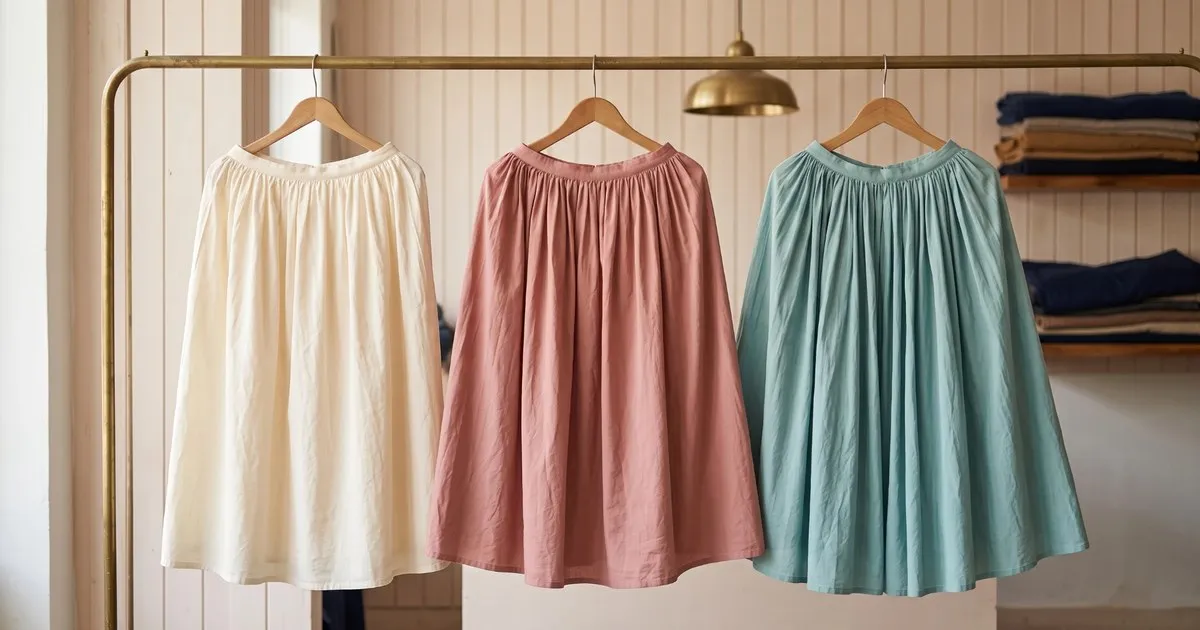
Three gathered skirts of the same length hung side by side showing light, medium and full gathers
A gathered garment is cut wider than it is worn, and the extra width is what gives it its swing. Too little and the gathers look sparse and pull open; too much and the waist is bulky and the cloth is wasted.
Most shops decide the amount by eye, panel by panel, and every cutter lands on a slightly different figure. This guide gives you a number to work to instead: the fullness ratio, how to choose it, and how to turn it into cloth.
In this guide you will find:
- Why gathers look sparse, bulky or uneven
- What a fullness ratio is and how to work it out
- Working ratios for frocks, skirts, sleeves and yokes
- How the fabric changes the ratio you can use
- How to gather evenly so every fold is the same
- How to work out the cloth you need
Why Gathers Look Wrong
Four reasons, and all four are decided at the cutting table.
The Ratio Was Guessed
Without a figure, a cutter adds a little extra and hopes. Two cutters guess two different amounts, and the second frock does not match the first.
The Gathers Were Pushed to One Side
A gathering thread drawn up without marks bunches where it was pulled first. The fullness piles up at one end of the seam and the other end is nearly flat.
The Cloth Was Too Heavy for the Ratio
A ratio that looks lovely in georgette makes a lump in a cotton twill. The heavier the cloth, the less it can be gathered before the seam is a hard ridge.
The Gathering Stitch Was Wrong
A short stitch will not draw up, a single row twists, and a stitch at the wrong distance from the edge shows through the finished seam.
What a Fullness Ratio Means
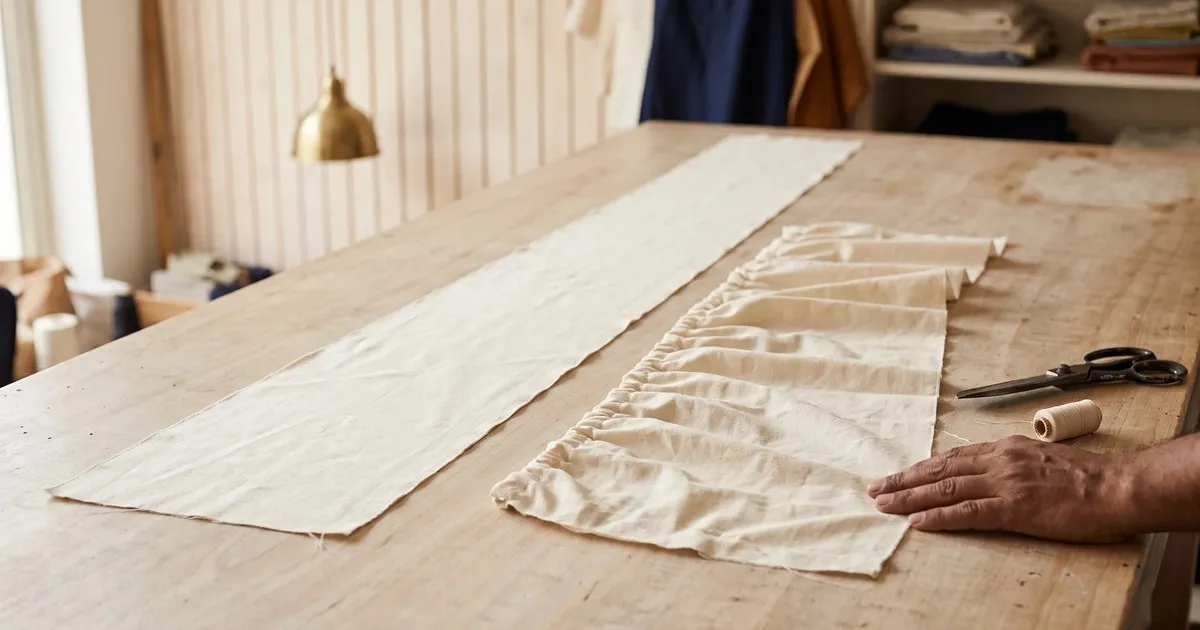
A flat strip of cloth beside the same cloth gathered to half its length
The fullness ratio is the cut length divided by the finished length. If a strip is cut 56 inches long and gathered to 28 inches, the ratio is two to one. The same strip, gathered to 20 inches, is a ratio of nearly three to one.
It is the only number you need. Once you know the ratio for the garment, the cloth follows from the finished width:
- Finished width at the gathered edge, for example a 28 inch waist.
- Multiply by the ratio, for example 2, which gives 56 inches.
- Add the seam allowances at the side seams and the opening.
- That is the width of cloth to cut for that skirt panel.
Working Ratios by Garment
These are working figures for a medium weight cotton. Treat them as a starting point, and confirm the first garment on a body.
Garment | Gathered into | Ratio | Notes |
|---|
Kids frock, skirt | Yoke or waist | 2.0 – 2.5 | Full and swingy, light cloth |
Pattu pavadai | Waistband | 2.5 – 3.0 | Needs a lot of cloth to fall properly |
Adult gathered skirt | Waistband | 1.5 – 2.0 | Lower ratio keeps the hip smooth |
Anarkali and flared kurti | Yoke or seam | 2.0 – 3.0 | Full flare, so a light cloth |
Gathered kurti yoke | Yoke seam | 1.5 – 2.0 | Gentle fullness below the yoke |
Puff sleeve | Sleeve head | 1.5 – 2.0 | More only on a very soft cloth |
Sleeve into cuff or band | Cuff | 1.5 – 2.0 | The same cuff, a smaller opening |
Frill and ruffle | Seam | 2.0 – 3.0 | Cut lightweight, hem narrow |
The finished frock and pavadai measurements these gather into are in our kids frock cutting measurement chart and the pattu pavadai cutting measurement chart.
How the Fabric Changes the Ratio
Fabric | Ratio it can take | Why |
|---|
Georgette, chiffon, voile | 2.5 – 3.0 | So light that more cloth is needed to look full |
Mulmul and soft cotton | 2.0 – 2.5 | Soft, folds easily, a good gathering cloth |
Poplin and crisp cotton | 1.75 – 2.0 | Holds its shape, so the gathers stand out |
Silk and satin | 2.0 – 2.5 | Drapes well, but slippery to gather |
Twill, denim, canvas | 1.25 – 1.5 | Too heavy to gather tightly |
Velvet and napped cloth | 1.25 – 1.5 | Gathers crush the pile, so use less |
A heavier cloth does not gather like a light one. When a style needs a high ratio and the cloth will not allow it, use pleats instead – they take the same fullness with far less bulk.
Which cloth suits which garment in the first place is covered in our guide to which fabric for which garment.
How to Gather Evenly
- Cut the panels on the lengthwise grain, so the gathers hang straight and do not twist.
- Mark the quarter points on both the gathered piece and the piece it is joining, so the fullness has a place to go.
- Sew two rows of long machine stitch, about a quarter inch apart, just inside the seam line. Do not backstitch at the ends.
- Draw up the bobbin threads, from both ends, until the piece fits the shorter one. Spread the gathers evenly between the marks.
- Pin at every mark and at every few inches between, with the gathers on top, then stitch between the two rows.
- Steam the gathers lightly from the wrong side, away from the seam, then press the seam toward the gathers.
A gathered panel is wider than the finished piece, so it changes how the cloth is laid. Laying panels economically is covered in our guide to reducing fabric wastage in tailoring.
Working Out the Cloth
A worked example for a gathered skirt, for a 28 inch waist and a 24 inch finished length in a mulmul cotton:
- Choose the ratio from the fabric table: 2.0 for mulmul.
- Finished waist 28 inches times 2.0 equals 56 inches of gathered width.
- Add 2 inches of seam allowance at the side seams and opening, for 58 inches in total.
- A 58 inch wide cloth gives this in one panel; a 44 inch cloth needs two panels joined.
- Add the length: 24 inches finished plus the hem allowance plus the waist seam.
- Multiply by one panel or two, depending on the cloth width, to find the cloth to buy.
The same sum, done once and written down, is the figure every cutter in the shop works to.
Fixing Gathers That Already Look Wrong
- Sparse gathers – the ratio was too low. Add a gusset or re-cut the panel wider; do not try to stretch the cloth.
- Bulky waist – the ratio was too high for the cloth. Re-gather with fewer folds, or replace the gathers with pleats.
- Gathers all at one end – the thread was drawn up without marks. Unpick the stitching, re-mark the quarters and redistribute.
- A hard ridge at the seam – the gathers were pressed flat into the seam. Re-press the seam toward the gathers, not toward the skirt.
- Twisting – the panel was cut off-grain. Re-cut on the lengthwise grain; no amount of pressing will fix it.
In tailoring CAD the fullness ratio is set once for each style, and the panel width, the cloth needed and the quarter-point notches are worked out and printed on the piece in every size. Nobody guesses at the cutting table. Our tailoring CAD software page shows how a gathered panel is drafted.
Questions Tailors Ask
How much extra cloth should I add for gathers?
About one and a half times the finished width for light gathers, twice for medium and two and a half to three times for full gathers. Lighter cloth takes a higher ratio than heavier cloth.
What is a fullness ratio?
The cut length of the cloth divided by the finished length it is gathered to. A strip cut 56 inches and gathered to 28 inches has a ratio of two to one.
How do I gather evenly?
Mark the quarter points on both pieces, sew two rows of long stitch inside the seam line, and draw up the threads, spreading the fullness between the marks before pinning.
How many rows of gathering stitch do I need?
Two rows, a quarter inch apart. A single row twists and pulls into pleats; two rows hold the fullness in place while it is joined.
Can heavy fabric be gathered?
Only lightly, with a ratio of about one and a quarter to one and a half. A heavier cloth that needs more fullness is better pleated.
Does gathering change the layout of the cloth?
Yes. A gathered panel is wider than the finished piece, so it takes more cloth. Work out the cloth from the ratio before buying the fabric.
Decide the Ratio Before You Cut
A gathered garment looks full or thin because of a single decision made at the cutting table: how much extra cloth goes in. Once the ratio is written down for each style and each cloth, every cutter in the shop reaches the same result.
Book a free demo – on-site or online, in your language, with no commitment. Bring a frock or a pavadai you cut by eye and we will work out the panel width and the cloth on screen.