A pattu pavadai is the most expensive garment most tailors cut for a child, and the one with the least room to get it wrong. The silk is bought for a specific function, there is rarely a spare metre, and the zari border is not something you can trim off and re-hem when the length is out.
It is also the order where the family expects the garment to last. A pavadai cut to the child's exact measurements fits beautifully in October and is short by the next Deepavali, and the parents will say so.
This is the full measurement list for the pavadai and the blouse together, how much growing room to build in and where to put it, how the zari border changes the way you plan the length, the cloth each age takes, and the four mistakes that cause most re-cutting.
Pattu Pavadai, Langa Davani and the Full Half Saree
The words change with the age of the girl and with the district. Confirm which set the family wants before you take measurements, because the second and third versions need extra cloth that has to be bought at the same time.
Pattu Pavadai
The silk skirt and a matching blouse, worn by younger girls. Two garments, two sets of measurements, one length decision that matters more than all the others.
Langa Davani
The same skirt and blouse with a davani, the half saree draped over one shoulder and tucked at the waist. Usually from around ten years upward, and the classic set for a half saree function.
The Function Set
Skirt, blouse, davani and a lining or inskirt under the pavadai. Silk pavadais are usually lined, because the lining carries the weight of the zari and keeps the skirt standing away from the legs.
If the family wants a stitched frock instead of a pavadai set, that is a different draft, and the measurements come from the kids frock cutting measurement chart rather than from this sheet.
The 13 Measurements a Pavadai Set Needs
Take the child's measurements over a thin vest, not over a thick dress, and let her stand straight with her arms down. Ease is added to the body measurement before drafting. Growing room is a separate allowance and is covered in the next section.
# | Measurement | Where it is taken | Typical ease |
|---|
1 | Waist | Round the natural waist, where the pavadai cord will sit | 1 inch |
2 | Pavadai length | Waist to the ankle bone, standing in her function footwear | Nil |
3 | Hem sweep | Finished circumference at the hem, set by the kali count | By style |
4 | Waistband width | Finished cord casing or elastic width | 1 to 1.5 inches |
5 | Chest | Round the fullest part of the chest | 1.5 to 2 inches |
6 | Shoulder width | Shoulder point to shoulder point across the back | Nil |
7 | Blouse length | Shoulder point down the front to the waist | Nil |
8 | Front neck depth | Shoulder line down the centre front to the lowest point | By design |
9 | Back neck depth | Shoulder line down the centre back to the lowest point | By design |
10 | Armhole round | Round the arm through the armpit and over the shoulder point | 1.5 inches |
11 | Sleeve length | Shoulder point to where the sleeve will end | Nil |
12 | Sleeve round | Round the fullest part of the upper arm | 1.5 inches |
13 | Davani length | Shoulder to the tuck at the waist, plus the fall | By age |
Growing Room: The Allowance That Is Not on the Body
A pattu pavadai is expected to be worn for more than one season, and a child grows in length long before she grows in width. Build that in deliberately, write it on the sheet, and tell the family it is there so nobody mistakes it for a loose fit.
Put two to three inches of extra length into the hem as a deep turn-up rather than cutting the skirt short. It can be let down once without touching the border. The blouse gets one inch at the shoulder seam and one inch in the side seams, which is where a child widens first.
Finish the pavadai waist with a cord rather than a fixed band wherever the family will accept it. A cord adjusts through two years of growth; a stitched waistband adjusts through none.
Do not add growing room to the width of a fitted blouse. A blouse cut loose on a small child looks wrong in the photographs the family is paying for, and the side seam allowance is there precisely so it can be let out later instead.
The Zari Border Decides the Length, Not the Tape
This is what makes a pavadai different from every other skirt. The zari border has to finish at the hem, exactly parallel to the floor, and it cannot be cut through or turned up inside. The border position in the cloth therefore fixes the finished length before you have measured anything.
Measure the cloth from the border edge upward to find out what length the silk can give you. If that is longer than the child needs, the surplus goes into the waist as a deeper casing and into the hem as a turn-up above the border, never into the border itself.
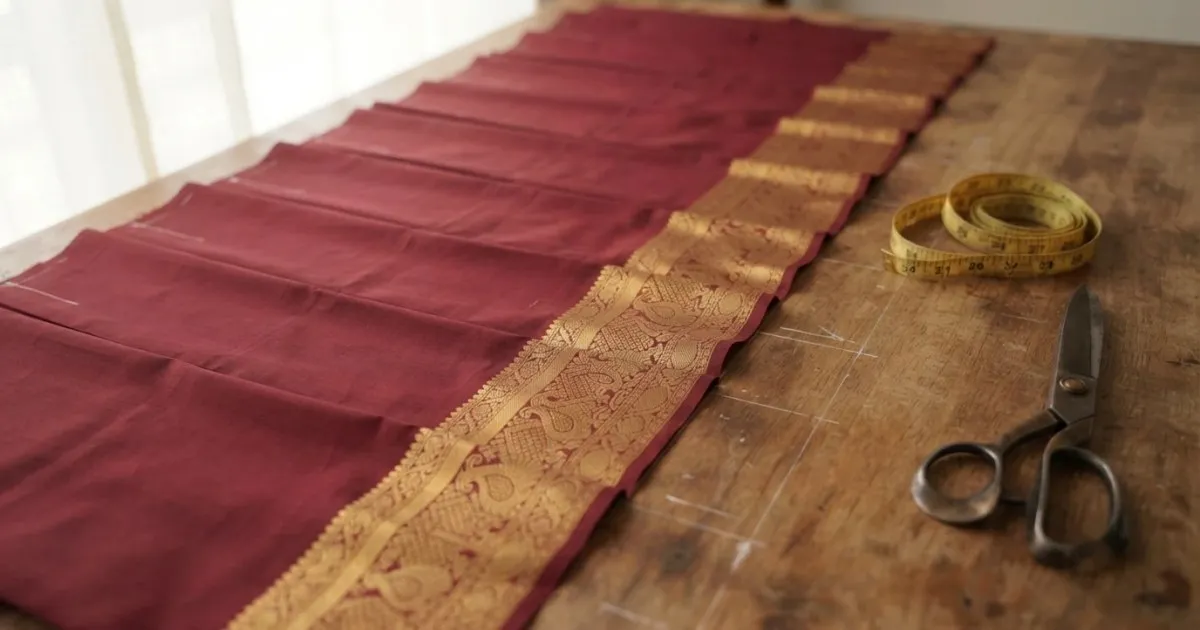
If the silk is shorter than the length you need, the honest answer is a contrast waist yoke of four to six inches in a matching plain silk, hidden under the davani or the blouse. Tell the family before you cut, not after.
Kali skirts complicate this further, because a border has to line up across every kali seam. Cut all the kalis from the same position relative to the border, or the border steps up and down round the hem where the seams fall.
Kali Count, Hem Sweep and Cloth by Age
Typical figures for a lined pattu pavadai with a matching blouse, on 44 inch silk. The davani is bought separately, usually 2 to 2.5 metres depending on the girl's height.
Age | Waist | Chest | Pavadai length | Kalis | Hem sweep | Silk needed |
|---|
2 to 4 years | 19 to 21 in | 21 to 23 in | 20 to 24 in | 4 kali | 44 to 52 in | 1.5 metres |
5 to 7 years | 21 to 23 in | 24 to 26 in | 25 to 29 in | 6 kali | 60 to 70 in | 2 metres |
8 to 10 years | 23 to 25 in | 27 to 29 in | 30 to 34 in | 6 kali | 76 to 86 in | 2.5 metres |
11 to 13 years | 25 to 27 in | 30 to 32 in | 35 to 38 in | 8 kali | 92 to 104 in | 3 metres |
14 to 16 years | 26 to 29 in | 32 to 34 in | 38 to 40 in | 8 kali | 104 to 116 in | 3.5 metres |
Add the same quantity again in cotton or soft lining for the inskirt. On 36 inch silk add roughly half a metre to every figure, and expect to lose more to the border matching.
The Four Mistakes That Cause Most Re-Cutting
1. No Growing Room Was Built In
The pavadai fits perfectly for one function and is short for the next. Two to three inches in the hem and a cord waist cost nothing at cutting time and save the family the whole garment.
2. The Length Was Taken Barefoot
A function pavadai is worn with chappals or small heels, and a child stands differently when she is dressed up. Measure to the ankle bone in the footwear she will wear on the day.
3. The Border Was Not Planned Before Cutting
The length was measured on the child, the skirt was cut from the top of the cloth, and the border finished two inches above the hem or was cut through at a kali seam. Start from the border and work upward.
4. The Blouse Was Cut Snug Because She Is Small
A child's armhole and shoulder tighten faster than anything else on the garment. Give the armhole its full inch and a half of ease and put an inch of allowance in the side and shoulder seams, or the blouse becomes unwearable months before the pavadai does.
The Pieces a Pavadai Set Produces
The skirt is cut as four, six or eight kalis with a cord casing at the waist and a deep hem turn-up above the border. The lining or inskirt repeats the same kali shape, cut about half an inch shorter so it never shows below the silk.
The kali template itself is built the same way as a lehenga's, from the waist circumference and the hem sweep - the arithmetic in the lehenga cutting guide applies to a pavadai of any size.
The blouse produces a front, a back, two sleeves, a neck facing and a lining. On a young child the back usually carries the opening with hooks or a tie, because a zip against a small back is uncomfortable through a long function.
The blouse draft is a scaled version of the adult one, and the measurement logic is the same as in the blouse cutting measurement chart.
What Changes When the Pavadai Is Drafted on a Computer
Everything above is the same whether you draft with chalk or with software. The kali template, the border matching and the cloth are what change.
A kali template drawn from the waist and hem figures closes into a true circle every time, which matters more on a bordered silk than on any other fabric: if the kalis do not close evenly, the border steps at the seams and there is no way to hide it.
The marker is where a short length of silk is saved or lost. Kalis are long tapered pieces, and laying them by hand on a bordered cloth, all from the same position relative to the border, is slow and easy to get wrong.
A computer nests them to the width and prints the marker at full size, and pattern making software keeps the child's record so next year's pavadai starts from what she measured last year rather than from a guess.
Good Pavadai Cutting Starts With the Cloth, Not the Child
Every other garment starts with the measurements. A pattu pavadai starts with the border, because the border fixes the finished length before the tape comes out, and it cannot be moved afterwards.
Measure the silk from the border upward, take the thirteen measurements, put two to three inches of growing room in the hem and an inch in the blouse seams, and write the footwear and the growing room on the sheet. If the silk will not give the length, say so before cutting. That conversation is short. The one after a wrongly cut pattu silk is not.
Frequently Asked Questions
How many measurements are needed for a pattu pavadai set?
Thirteen for the skirt and blouse together: waist, pavadai length, hem sweep, waistband width, chest, shoulder, blouse length, front and back neck depth, armhole, sleeve length, sleeve round, and the davani length if the set includes one.
How much growing room should a pattu pavadai have?
Two to three inches as a deep hem turn-up above the border, one inch in the blouse side seams and one inch at the shoulder seam. Finish the waist with a cord rather than a fixed band so it adjusts as she grows.
How much silk does a pattu pavadai need?
On 44 inch cloth, roughly 1.5 metres for a 2 to 4 year old, 2 metres for 5 to 7, 2.5 metres for 8 to 10, 3 metres for 11 to 13 and 3.5 metres for 14 to 16, plus the same again in lining. A bordered silk needs more, because every kali has to be cut from the same position relative to the border.
How many kalis should a pavadai have?
Four for a very young child, six through most of the primary school years and eight from about eleven upward. More kalis give a rounder flare but make border matching harder, because every seam is another place the border has to line up.
Can a pattu pavadai be let out as the child grows?
The length can, once, by letting down the hem turn-up, which is why it is cut as a deep turn-up above the border instead of being trimmed away. The blouse can be let out at the side and shoulder seams. The skirt width adjusts at the cord.
Cut Pavadai Sets With Fashion Dot CAD
Fashion Dot CAD drafts pavadai skirts and children's blouses from the measurements on your sheet, builds the kali template from the waist and hem figures so the border lines up at every seam, and nests the kalis to the width of the silk you actually have. Each child's record stays saved for next year. See what it costs on the tailoring CAD software price page.
See a Pavadai Drafted From Your Own Measurements
Bring one child's measurements and your silk width to a free demo and we will draft the set live, print the kali template full size and show you the marker with the border matched. Book a free demo at a time that suits your shop.