Nobody measures a pocket. They just look at the shirt and something is off — the pocket sits too high, or too close to the buttons, or the two on a lab coat are not level. The customer cannot say what is wrong, but he will not wear it.
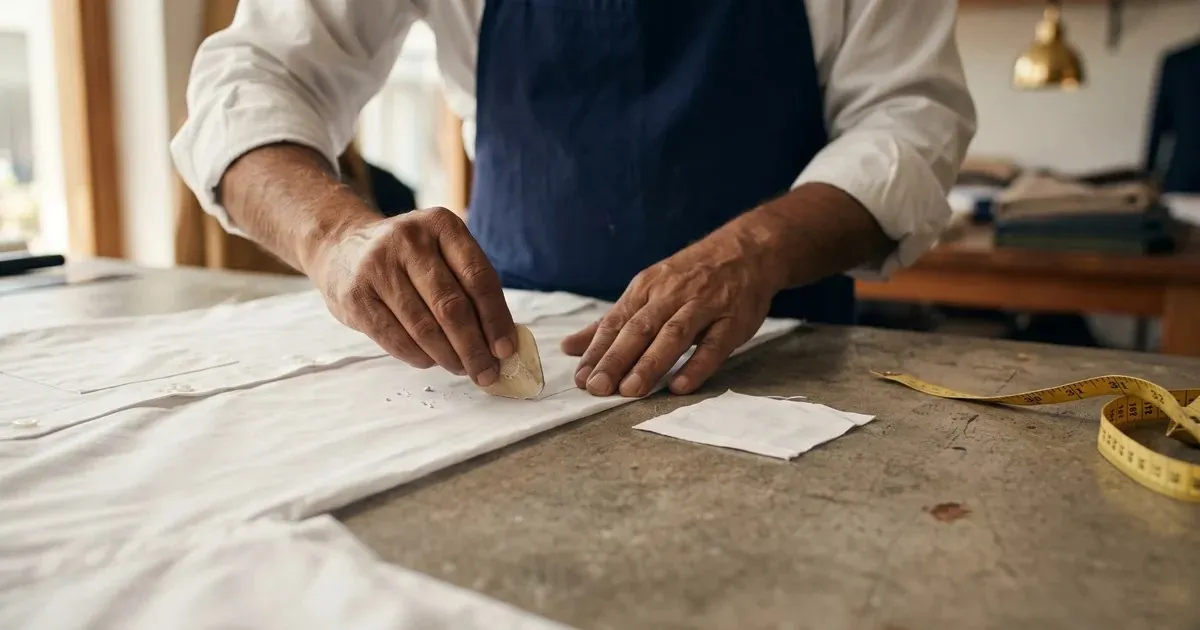
A tailor chalking a pocket position on a shirt front, with a cut pocket piece and a measuring tape on the cutting table
A pocket is the one part of a garment the eye can check without a tape. It has two straight edges right next to two other straight edges — the button placket and the shoulder seam — and the eye is very good at spotting when two straight lines are not parallel or not evenly spaced.
That is why a pocket half an inch out is visible across a room while half an inch at the waist is not. It is also why pockets should be marked from a seam with a rule, never judged by eye.
In this guide you will find:
- Why a small error in a pocket is so visible
- How to mark a shirt chest pocket from the seams
- Placement figures for shirts, kurtas, coats and trousers
- Pocket sizes that look right on each garment
- What patch, welt and in-seam pockets each need
- What moves and what stays when you grade the sizes
Why a Small Error Is So Visible
Four reasons, and all of them are about what the pocket sits next to.
The Eye Measures It Against the Placket
A chest pocket has a vertical edge running alongside the button placket. Two near-parallel lines make any difference in the gap obvious. Nobody notices a pocket two inches from the placket; everybody notices one that is two inches at the top and an inch and a half at the bottom.
It Is Marked After the Garment Is Made Up
Mark the pocket on the flat cut piece, before the shoulder and side seams are joined, and it moves when the garment is assembled. The pocket should be marked on the cut front with the seam allowances already accounted for.
The Same Figure Is Used for Every Size
A pocket eight inches down from the shoulder looks right on a 40 chest and sits almost at the waist on a small size. The drop has to change with the size, even though the pocket itself does not.
The Two Sides Do Not Match
On a lab coat or a cargo trouser there are two pockets and the eye compares them directly. Each one has to be marked from its own seam with the same figure, not marked once and copied across by folding.
How to Mark a Shirt Chest Pocket
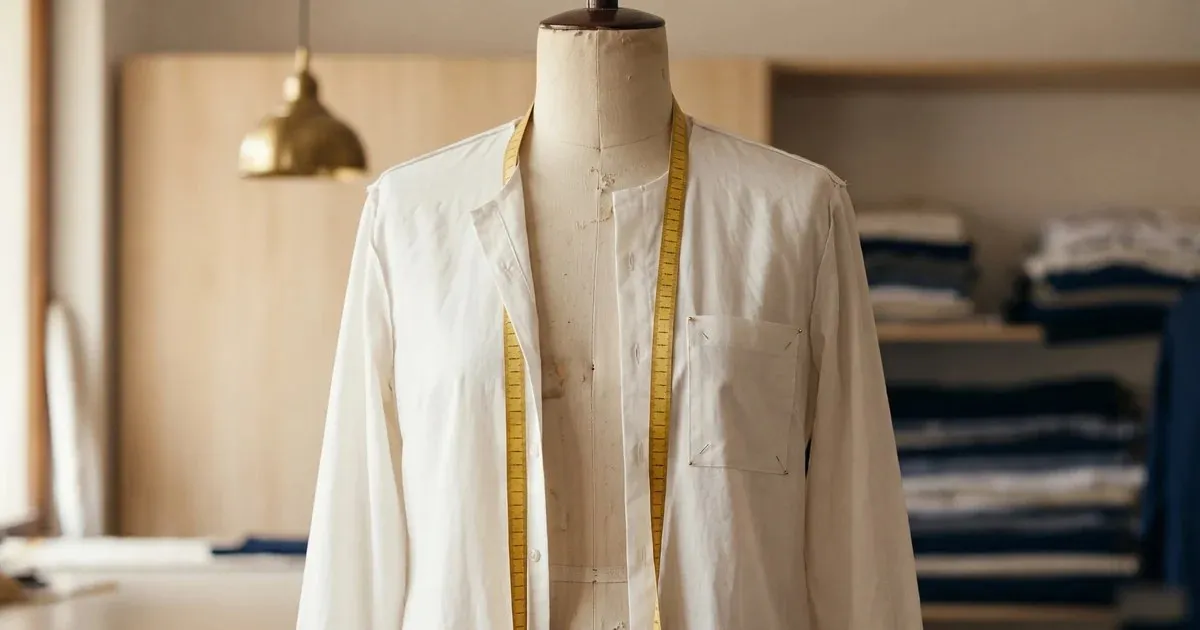
A half-made shirt on a dress form with a patch pocket pinned on the chest and a measuring tape over the shoulder
Work on the cut front, flat on the table, with a rule:
- Measure down from the shoulder seam line, not from the raw edge and not from the collar.
- Measure across from the finished placket edge, not from the raw front edge.
- Mark the top two corners of the pocket first, then square down from them for the depth.
- Check the top edge is parallel to the shoulder, and the inner edge parallel to the placket. If one is off, the pocket will look crooked however neatly it is stitched.
- Pin the pocket and look at it on a form or on the body before topstitching. A pocket is one of the few things worth checking standing up.
The shoulder and chest figures this is measured from are in our gents shirt cutting measurement chart, and the allowances are in the seam allowance guide for tailors.
Placement by Garment
Working figures in inches for a medium size, measured on the cut piece from the seam line. Treat them as a starting point and confirm the first garment on a body, because the right drop also depends on the wearer's height.
Garment and pocket | Down from | Distance | Across from placket or seam |
|---|
Shirt chest patch | Shoulder seam | 7.5 – 8.5 | 1.5 – 2.0 from placket edge |
Kurta chest patch | Shoulder seam | 8.5 – 9.5 | 2.0 – 2.5 from placket edge |
Kurta side in-seam | Natural waist | 1.0 – 1.5 | On the side seam |
Lab coat chest patch | Shoulder seam | 9.0 – 10.0 | 1.5 – 2.0 from front edge |
Lab coat lower patch | Natural waist | 3.0 – 4.0 below | 2.0 from front edge |
Trouser back welt | Waistband seam | 6.5 – 7.0 | Centred on the back leg |
Trouser side in-seam | Waistband seam | 1.0 – 1.5 | On the side seam |
Pocket Sizes That Look Right
A pocket that is correctly placed but the wrong size still looks wrong. These are the finished sizes most shops settle on:
Pocket | Width | Depth |
|---|
Shirt chest | 4.5 – 5.0 | 5.0 – 5.5 |
Kurta chest | 5.0 – 5.5 | 5.5 – 6.0 |
Lab coat chest | 5.0 | 5.5 |
Lab coat lower | 7.0 – 7.5 | 8.0 |
Trouser back welt | 5.5 – 6.0 | 6.0 |
Cargo and shorts | 6.0 – 6.5 | 7.0 |
A chest pocket is almost always a little deeper than it is wide. Cut it square and it reads as too small even when the measurements are inside the range.
Patch, Welt and In-Seam
- Patch – sits on the outside and shows every error of placement, but needs no opening in the garment. Turn and press the pocket before marking, so what you pin is the finished size.
- Welt – set into a slit, so the placement error is permanent. Mark the slit, not the pocket bag, and interface behind it or the opening will stretch into a smile.
- In-seam – hidden in the side seam. The only placement decision is how far down the opening starts and how long it is; usually six to seven inches for a hand to pass.
- Flap – treat the flap as part of the pocket when you measure the drop. A flap added afterwards pushes the visual centre up by its own depth.
Checks, Stripes and Prints
- On a check or a stripe, cut the pocket to match the cloth behind it, so the lines run straight through. A pocket that breaks the pattern is the first thing anyone sees.
- Cut the pocket from the same part of the lay as the front, so the repeat lines up without hunting.
- On a one-way print, the pocket has to run the same way up as the garment. It is easy to turn a small piece by accident.
- A pocket cut on the bias against a striped front is a design choice and looks deliberate. A pocket half a stripe out looks like a mistake.
What Moves When You Grade the Sizes
Two things change with the size and two do not:
- The drop from the shoulder changes – roughly a quarter to a half inch per size, following the chest.
- The distance across from the placket changes very little, because the placket width does not change.
- The pocket itself stays the same on every size. A pen and a phone are the same size on an S and a 3XL.
- The flap stays the same as the pocket, for the same reason.
How the rest of the set grades is in our guide to pattern grading for tailors, and the final look of a stitched pocket depends as much on the press as the placement – see pressing, finishing and the delivery check.
In tailoring CAD the pocket position is part of the pattern, so it is marked on the printed piece in every size and the drop grades automatically. Nobody measures down from a shoulder with a tape, and the second shirt is marked exactly like the first. Our tailoring CAD software page shows how the marks come off the plotter.
Questions Tailors Ask
How far down should a shirt chest pocket be?
Between seven and a half and eight and a half inches from the shoulder seam on a medium size, and measured from the seam line, not the raw edge. Add about a quarter inch per size going up.
How far from the placket should a chest pocket sit?
One and a half to two inches from the finished placket edge. Keep the pocket's inner edge parallel to the placket; a pocket that leans is more noticeable than one that is slightly too close.
Why do my two lab coat pockets never look level?
Because they were marked once and copied across by folding the garment. Mark each pocket from its own front edge with the same two figures.
Does the pocket get bigger in bigger sizes?
No. The drop from the shoulder changes with the size; the pocket itself stays the same. Grading the pocket is what makes a small shirt look like it has a pocket halfway round the front.
How do I match a pocket on a checked shirt?
Cut the pocket from the cloth directly beside where it will sit, so the check continues through it. Mark the position on the front first, then cut the pocket to match that exact spot.
Should the pocket be marked before or after stitching the seams?
On the cut front, before the shoulder and side seams are joined, but measured from the seam lines rather than the raw edges.
Mark It From the Seam, Not by Eye
A pocket is a small piece that carries a lot of the shop's reputation, because it is the part a customer can check without knowing anything about tailoring. Two figures and a rule are all it takes to get it right every time.
Book a free demo – on-site or online, in your language, with no commitment. Bring a shirt whose pocket never looked right and we will mark it properly on screen.