A collar is the first thing anyone sees and the last thing most shops measure. The body can fit perfectly and the customer will still notice a collar that stands away at the back or buckles at the button.

Shirts with spread, button-down, mandarin and Chinese collars hanging in a tailoring workshop while a tailor presses a collar on a tailor's ham
Almost every collar fault comes from one thing: the collar was cut to the neck measurement, and then sewn to a neckline that is not that measurement. The neckline on the stitched garment is its own length, set by the front, the back and the shoulder seams. Cut the collar to the body and it will never sit.
This guide covers how to measure the neckline you actually have, how long to cut the stand and the leaf, and what changes between a spread collar, a mandarin band and a lab coat notch.
In this guide you will find:
- Why collars stand away, buckle or twist
- The three pieces of a shirt collar and what each one does
- How to measure the neckline before you cut the collar
- A working chart for stand length, leaf length and heights
- What each collar type needs, from spread to mandarin
- How to match the interlining to the cloth
Why Collars Go Wrong
Four reasons, and all four happen before the collar reaches the machine.
The Neckline Was Not Measured After Stitching
The neck measurement is taken on the body. The neckline is what is left once the shoulder seams are joined and the front edge is finished. They are rarely the same number. Measure the neckline on the garment, with the tape standing on its edge along the stitching line.
The Stand and the Leaf Were Cut the Same Length
The leaf has to travel over the top of the stand, so it covers a longer path. Cut them the same and the leaf pulls tight at the back and the collar points lift away from the chest.
The Interlining Was Wrong for the Cloth
A soft interlining in a crisp poplin gives a limp collar. A hard interlining in a soft cotton gives a collar that stands like cardboard and creases across the fold. The interlining is part of the pattern, not an afterthought.
The Collar Was Eased In by Guess
A collar is always slightly shorter than the neckline it is sewn into, and that small difference is eased in evenly. Pushed in at one point instead, it becomes a pleat at the back or a twist at the button.
The Three Pieces of a Shirt Collar
A standard shirt collar is three pieces, and each has one job:
- The stand – the band that sits against the neck and carries the top button. Its length sets the collar size.
- The leaf – the part that folds over and shows. It is cut a little longer than the stand so it rolls without pulling.
- The interlining – fused or sewn inside, it decides how crisp the collar stands and how the fold holds after washing.
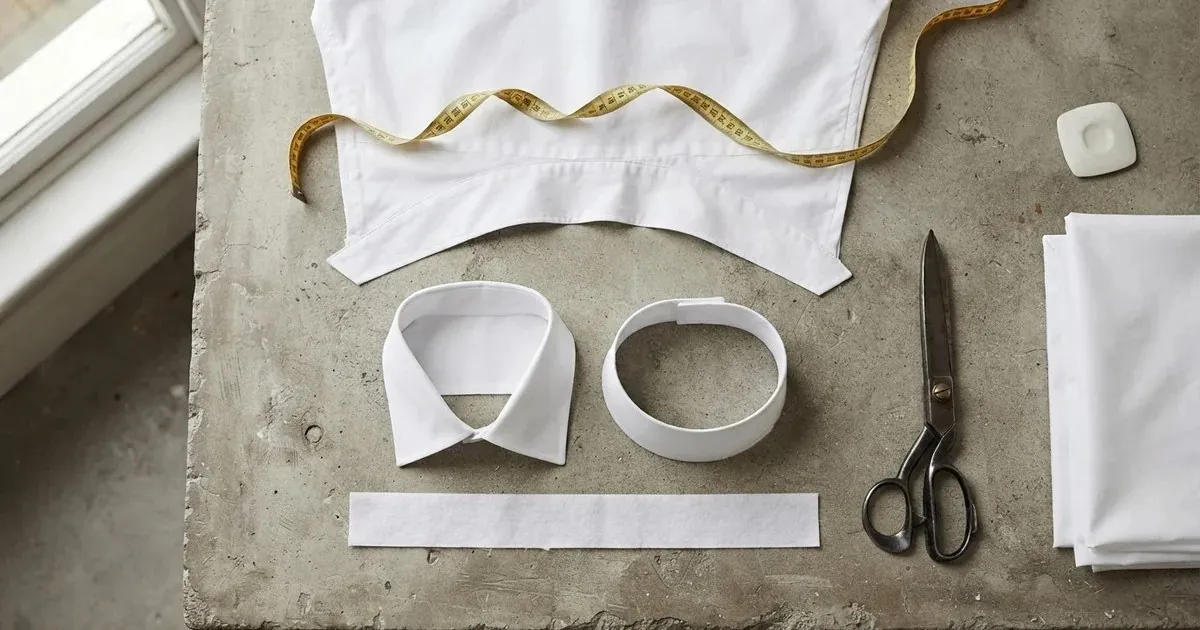
Shirt collar leaf, collar stand and interlining laid flat on a cutting table beside a neckline with a measuring tape along the curve
A mandarin or Chinese collar is the stand on its own, with no leaf. A lab coat notch is a leaf with no separate stand, cut in one with the front facing. Once the three pieces are clear, every other collar is a variation.
Measuring the Neckline Before You Cut
Do this on the stitched garment, not on the pattern:
- Join the shoulder seams and finish the front edge first.
- Stand the tape on its edge and run it along the neckline stitching line, front edge to front edge.
- Note the number. This, not the neck measurement, is what the collar is cut to.
- Mark the centre back and the two shoulder points on the neckline, and the same three points on the collar stand. The ease is distributed between those marks, not all at the back.
The neck measurement still matters as the starting point – it is one of the twelve in our gents shirt cutting measurement chart, and the tape work is covered in how to take body measurements for tailoring.
These are working figures in inches, finished sizes before seam allowance. They are a starting point, not an official standard – check the first collar against your own block before cutting a run.
Neck | Neckline | Stand length | Leaf length | Stand height | Leaf fall |
|---|
14.0 | 15.0 | 15.0 | 15.5 | 1.25 | 1.75 |
14.5 | 15.5 | 15.5 | 16.0 | 1.25 | 1.75 |
15.0 | 16.0 | 16.0 | 16.5 | 1.38 | 1.75 |
15.5 | 16.5 | 16.5 | 17.0 | 1.38 | 1.88 |
16.0 | 17.0 | 17.0 | 17.5 | 1.50 | 1.88 |
16.5 | 17.5 | 17.5 | 18.0 | 1.50 | 2.00 |
17.0 | 18.0 | 18.0 | 18.5 | 1.50 | 2.00 |
Two rules hold across the whole chart. The leaf is cut about half an inch longer than the stand so it can roll over. The fall is kept about half an inch deeper than the stand height, so the leaf covers the stand completely at the back.
Collar Types and What Each One Needs
The stand and leaf change with the style. The neckline measurement does not.
Collar | Stand height | Leaf fall | Point | Suits |
|---|
Spread | 1.38 – 1.50 | 1.88 – 2.00 | 2.75 – 3.00 | Formal shirt, wide tie knot |
Button-down | 1.25 – 1.38 | 1.75 – 1.88 | 3.00 – 3.25 | Casual shirt, oxford cloth |
Mandarin / Chinese | 1.25 – 1.50 | band only | – | Kurta, chef coat, uniform |
Notched | 1.00 – 1.25 | 2.00 – 2.25 | – | Lab coat, overcoat, blazer |
Convertible | hidden stand | 2.50 – 3.00 | 3.00 | Safari and half-sleeve shirt |
A mandarin band is the easiest collar to cut and the least forgiving to sew. There is no leaf to hide a wobble, so the top edge has to be pressed and topstitched evenly all the way round.
Matching the Interlining to the Cloth
- Crisp poplin and broadcloth – medium fusible. The cloth already has body; a hard interlining makes it board-like.
- Soft cotton and linen – firm fusible, or a sewn-in canvas on a better shirt. Soft cloth needs the support.
- Silk and fine voile – light fusible only, and test on a scrap first. Heat marks show on silk.
- Heavy twill for chef and lab coats – firm fusible in the stand, medium in the leaf, so the band holds and the fall still sits flat.
- Always fuse a test piece and wash it. An interlining that bubbles after the first wash will bubble on every collar you cut.
Which cloth suits which garment in the first place is covered in our guide to which fabric for which garment.
A Stitching Order That Keeps the Collar Square
- Fuse the interlining to the under-leaf and to one side of the stand, not to both.
- Stitch the leaf, trim the corners, turn and press flat before anything else touches it.
- Topstitch the leaf while it is still a flat piece. It is far harder once it is on the stand.
- Join the leaf between the two stand pieces, matching the centre back notch first, then the ends.
- Pin the stand to the neckline at centre back and both shoulders, then ease the small difference between those points.
- Press over a tailor's ham, not flat on the table, so the collar keeps the curve it will sit in.
The allowances all of this is cut with are set out in our seam allowance guide for tailors.
The Same Collar on a Kurta, a Blouse and a Coat
- Kurta – a mandarin band, usually a little lower than a shirt stand, with the placket opening set before the band is attached.
- Blouse – the neckline is wider and lower, so the band is longer than the neck measurement suggests. Measure the finished neckline every time.
- Lab and chef coats – the collar is cut in with the front facing, and the neckline is larger because the coat is worn over a shirt.
In tailoring CAD the collar is drafted from the neckline the pattern actually produces, so the stand length, the leaf length and the ease are correct for every size in a set without anyone measuring a stitched garment. Our tailoring CAD software page shows how the draft is built.
Questions Tailors Ask
Why does the collar stand away from the neck at the back?
Usually the stand is longer than the neckline, or the ease was pushed to the back instead of spread between the shoulder marks. Check the neckline measurement on the stitched garment before blaming the pattern.
How much longer should the leaf be than the stand?
About half an inch. The leaf has to travel over the fold, so a leaf cut the same length as the stand will pull and lift the points.
Why does the collar buckle at the top button?
Too much length in the stand at the front, or an interlining too stiff for the cloth. Take the extra out at the front edge, not at the back.
What stand height should a formal shirt collar have?
Between one and a quarter and one and a half inches for most builds. A longer neck takes the higher stand; a short neck looks crowded in it.
Can I use the same collar pattern for every size?
No. The stand length changes with every neck size, and the leaf changes with it. The stand height and the fall can stay the same across a few sizes, but the lengths cannot.
How do I stop the collar twisting after washing?
Fuse only the under-leaf and one stand piece, pre-wash the interlining with a test piece, and press the finished collar over a ham so it keeps its curve.
Make Every Collar Sit the Same
A good cutting master gets the collar right by eye and by habit. A shop gets it right by measuring the neckline, cutting the stand and the leaf to a written figure, and easing between marked points every time.
Book a free demo – on-site or online, in your language, with no commitment. Bring a shirt that never sat right and we will draft the collar for it on screen.