Two shops cut lab coats from the same chest measurement. One set fits over a full-sleeve shirt and one set will not button across the front. The measurements were the same. The ease was not.
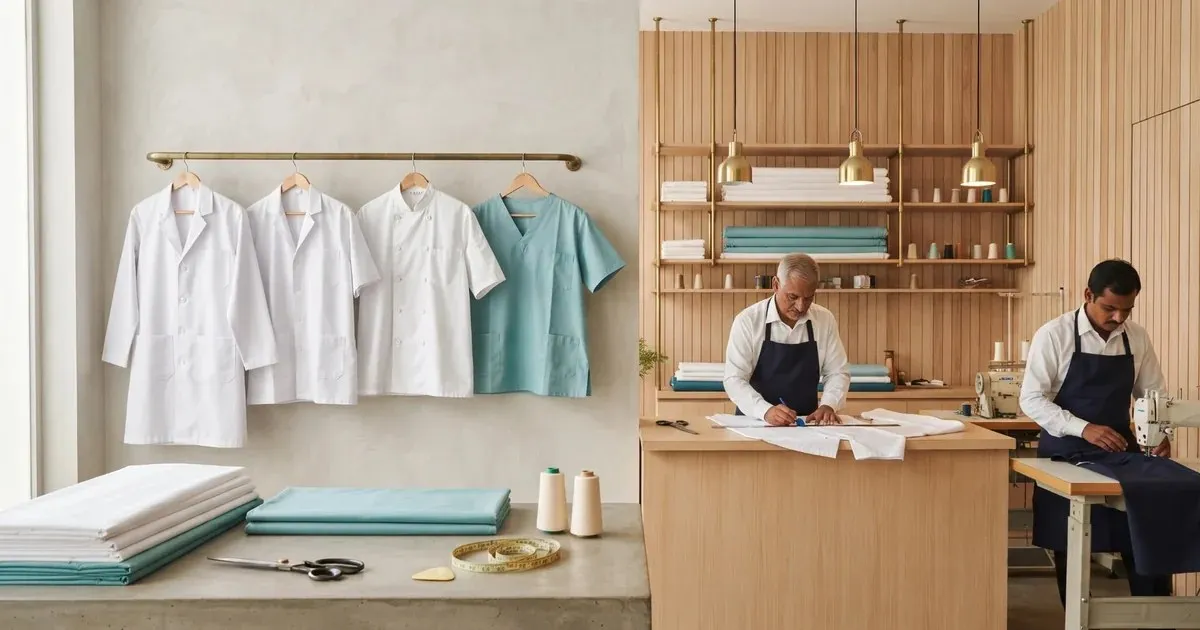
Lab coats, chef coat and OT top hanging in a tailoring workshop with white fabric, shears and a measuring tape on the cutting table
A lab coat is outerwear. It is worn over a shirt, over an ID lanyard, over pens in the chest pocket. A shirt is cut to the body; a lab coat is cut over whatever the body is already wearing. Cut one like the other and the coat binds the moment the arm lifts.
That single idea is behind almost every lab coat that comes back. The chart in this guide is the one our tailors use for hospital, laboratory, pharmacy and college orders.
In this guide you will find:
- Why lab coats come back when the measurements were right
- The twelve measurements to take, and how to take them
- Working size charts for men's and women's lab coats
- How much to add between one size and the next
- What changes for a chef coat and an OT top
- How to cut a 200 coat order without measuring 200 people
Why Lab Coats Come Back When the Measurements Were Right
Four reasons, and not one of them is a stitching fault.
The Coat Was Measured Over a Vest
Every measurement for a lab coat is taken over the clothes the person will actually wear under it. Measure over a vest and the whole set comes out a size small.
Ease Was Added at the Shoulder
Six inches went on the chest, correctly, and an inch went on the shoulder as well. The armhole seam now sits halfway down the arm and the coat hangs off the body. No amount of pressing will fix it.
The Armhole Was Scooped
A deep, curved armhole is right for a fitted shirt. On a coat worn over a shirt it binds as soon as the arm lifts. Cut the lab coat armhole lower and straighter than feels correct.
One Chart Was Used for Men and Women
A 38 inch chest is a 38 inch chest, but the shoulder, the length and the waist are not the same garment. Grade the two sets separately or half the order is re-cut.
The Measurements to Take
Take all of these over a normal shirt, tape snug but never pulled.
- Chest, waist and hip – the three body rounds, tape level at the back
- Shoulder – seam point to seam point across the back
- Full length – shoulder-neck point straight down to where the coat should finish
- Full sleeve and half sleeve length – shoulder point to wrist, and to just above the elbow
- Armhole and upper arm – round the shoulder joint, and round the fullest part of the bicep
- Cuff and neck – round the wrist, and round the base of the neck over the shirt collar
- Front chest width – armhole to armhole across the front, five inches down from the shoulder-neck point
That last one is the measurement most shops skip, and it is the one that makes the front placket pull open when the person sits. For the tape work itself, see our guide on how to take body measurements for tailoring.
Write the length down as a decision, not a measurement. A knee-length coat and a hip-length coat come off the same body.
Men's Lab Coat Size Chart
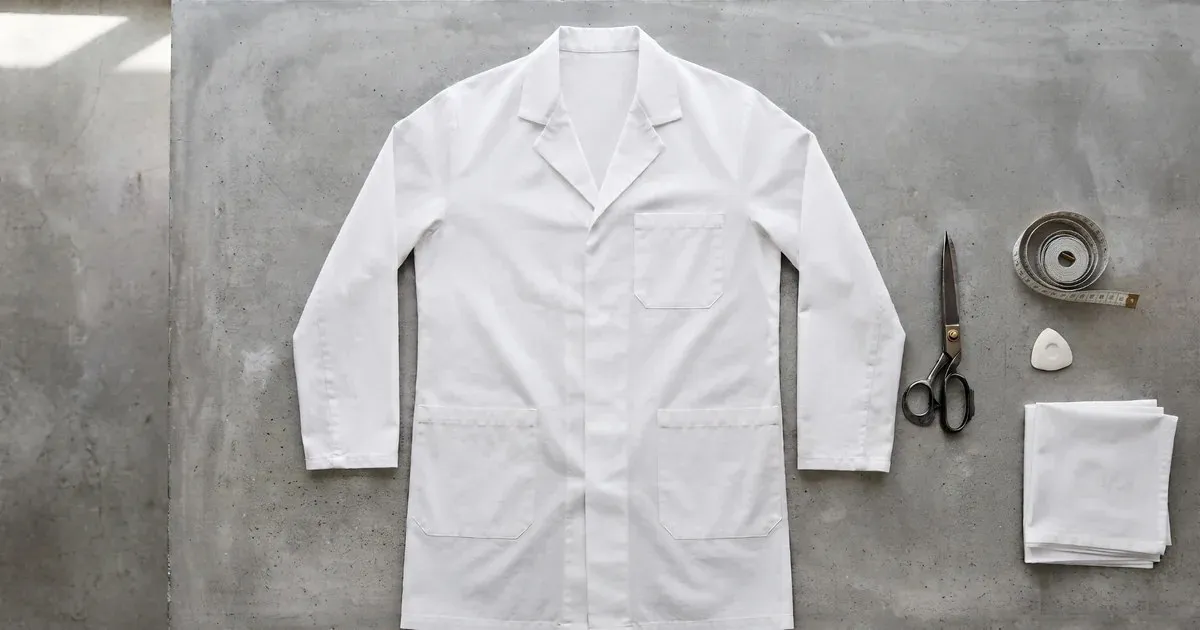
Lab coat laid flat on a cutting table with shears, a measuring tape and folded white fabric
All figures in inches. Body chest is what you measure; garment chest is what you cut – six inches more. The length column is the common hospital length; laboratory, pharmacy and college coats are often cut two to three inches shorter. These are working figures, not an official standard, so confirm the first set against your own block before cutting the bulk.
Size | Body chest | Garment chest | Shoulder | Full length | Full sleeve | Cuff | Neck |
|---|
S | 36 | 42 | 17 | 38 | 23.5 | 10.5 | 15 |
M | 38 | 44 | 17.5 | 39 | 24 | 11 | 15.5 |
L | 40 | 46 | 18 | 40 | 24.5 | 11.5 | 16 |
XL | 42 | 48 | 18.5 | 40 | 25 | 12 | 16.5 |
XXL | 44 | 50 | 19 | 41 | 25.5 | 12.5 | 17 |
3XL | 46 | 52 | 19.5 | 41 | 26 | 13 | 17.5 |
Women's Lab Coat Size Chart
A women's lab coat is not a small men's coat. For the same chest the shoulder is narrower, the length is shorter, and the garment waist is cut about two inches under the chest so the coat does not read like a box.
Size | Bust | Garment chest | Garment waist | Shoulder | Full length | Full sleeve |
|---|
XS | 32 | 38 | 36 | 14.5 | 35 | 22 |
S | 34 | 40 | 38 | 15 | 35 | 22.5 |
M | 36 | 42 | 40 | 15.5 | 36 | 23 |
L | 38 | 44 | 42 | 16 | 36 | 23.5 |
XL | 40 | 46 | 44 | 16.5 | 37 | 24 |
XXL | 42 | 48 | 46 | 17 | 37 | 24.5 |
The allowances these figures are cut with are in our seam allowance guide for tailors.
How Much to Add Between One Size and the Next
Most re-cutting in a bulk coat order comes from grading by eye – somebody adds an inch everywhere and the shoulder ends up two sizes too wide. Pin these increments above the cutting table:
- Garment chest and waist – add 2 inches, the size step itself
- Shoulder, armhole depth, cuff and neck – add half an inch, never more
- Upper arm – add 1 inch, half of the chest step
- Sleeve length – add half an inch; taller sizes, not wider ones
- Full length – add 1 inch, and only on every second size
- Pocket – no change at all. A pen fits the same pocket on an S and a 3XL
Chef Coat and OT Top: What Changes
The same block carries most of the institutional coat family. These are the changes that matter:
- Chef coat – double-breasted, so each front needs about four inches of overlap. Cut the fronts wider, not the back. Length drops to 30–32 inches, the collar becomes a mandarin, and heavier cloth needs a little more upper-arm ease.
- OT top – pull-on, so the neck has to clear the head: a V of nine to ten inches from the shoulder seam. Length 28–30 inches, no collar stand, no placket, no facing. The piece count drops by about half.
- Attender and ward coat – the men's chart with a shorter length and a simpler collar. The specification varies between hospitals, so take it from the institution's own sample rather than from any chart, including this one.
Cutting a 200 Coat Order Without Measuring 200 People
A hospital order is not two hundred individual measurements. It is a size set, and the shop's job is to get the set right and then count heads against it.
- Cut one sample in the middle size – L for men, M for women.
- Send it across and have three or four people of different builds try it on over their normal clothes, sitting and reaching.
- Correct the sample once. This is the only round of changes you should need.
- Grade the set up and down from the corrected sample using the increments above.
- Send the size set and let the institution return a head count per size. Keep that sheet – next year's order starts from it.
- Cut three to five percent extra in the two middle sizes. Somebody is always missed, and one late coat costs more to cut than five spare ones.
The same method runs a school order – the numbers are in our school uniform cutting measurement chart – and the costing and delivery side is covered in our guide to uniform stitching bulk orders.
In tailoring CAD the corrected sample is typed once and every other size is graded from the increment table automatically, so nothing is added by eye. The pieces come out named and counted, the marker is laid for the whole size set together, and next year the same file is reopened and re-cut in minutes. The full institutional range – lab coat in full and half sleeve, chef coat, OT top in three necklines, OT coat and blazer coat – is on our uniform cutting output page.
Questions Tailors Ask
How much ease should a lab coat have at the chest?
Six inches over the body chest. A 40 inch chest is cut at 46 inches finished. Less and the coat will not close over a full-sleeve shirt; more and it reads as oversized rather than professional.
What is the standard length of a lab coat?
For a hospital doctor's coat, 38 to 41 inches depending on size – roughly knee length. Laboratory, pharmacy and college coats are commonly two to three inches shorter. Confirm with the institution, because this is the one measurement they usually have an opinion about.
How much fabric does one lab coat need?
For a full-sleeve coat in 58 inch wide fabric, allow roughly 2.3 to 2.6 metres depending on the size, and a little less for a half-sleeve. Laying the marker for the whole size set together will usually bring that down on a bulk order.
Do men's and women's lab coats need separate charts?
Yes. For the same chest the shoulder, the length and the garment waist all differ. One chart for both is the fastest way to re-cut half an order.
Why does the sleeve bind when the measurement was correct?
Almost always a scooped armhole or too little upper-arm ease. The sleeve has to pass over a shirt sleeve, so allow four inches over the bicep and keep the armhole low and straight.
Can the size set be graded automatically?
Yes. The corrected sample is entered once and the software applies the shop's increments to every size, so the set is consistent whoever cuts it.
Make Every Coat Fit the Same
Good cutting masters have always judged a coat by eye. The best shops write the numbers down, so the hundredth coat fits like the first and a new staff member cuts it the same way.
Book a free demo – on-site or online, in your language, with no commitment. Bring one of your own hospital orders and we will cut the size set on screen while you watch.