One school contract can be the best year a tailoring shop has, or the year it works for nothing. This guide covers how uniform stitching bulk orders are quoted, cut and delivered, what to check before you accept one, and the four mistakes that turn a large order into a loss.
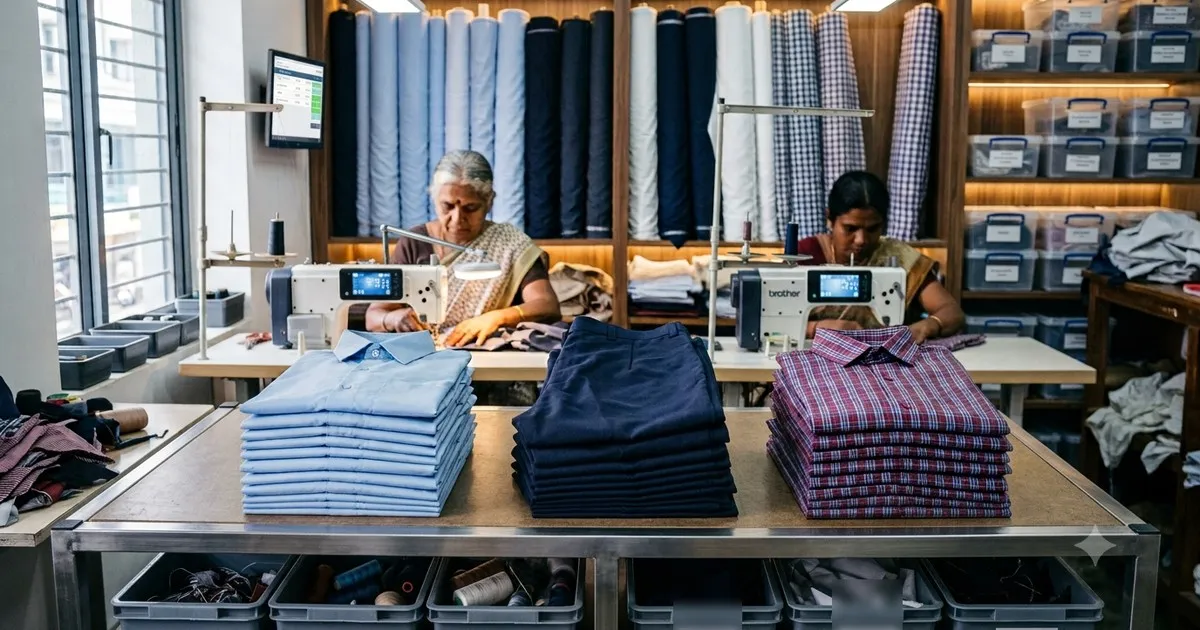
Stacks of finished school uniform shirts and trousers on a tailoring workshop table ready for delivery
A shop takes its first uniform order. Four hundred sets, one school, delivery in three weeks. The rate looked fine on the phone.
Week one goes well. In week two the sizes start coming back wrong, because the size set was guessed from the previous supplier’s list rather than measured. Cloth runs short because the lay was calculated per piece instead of per bulk. The shop finishes on time by paying overtime it never quoted for, and clears about what it would have made stitching twenty blouses.
None of that is a stitching problem. Bulk work fails at the quotation and at the cutting table, almost never at the machine.
In this guide you will find:
How bulk uniform orders differ from ordinary shop work
The four kinds of bulk order and which suits a small shop
What to check before you quote a price
How to cost an order so the margin survives
The size-set problem, and why it decides your profit
What changes when patterns are cut by machine at this volume
Why Bulk Uniform Work Is a Different Business
The garment is simpler than a bridal blouse. Everything around it is harder.
| Ordinary shop work | Bulk uniform order |
|---|
Measurements | One customer at a time | A size set covering hundreds of bodies |
Cutting | One piece, judged by eye | Layered lay, calculated before the cloth is touched |
Cloth | Customer brings it | You buy it, and you carry the risk |
Payment | Advance and balance | Often after delivery, sometimes after inspection |
A mistake | One garment re-cut | The same mistake repeated 400 times |
Deadline | Flexible by a day or two | Fixed to the first day of term |
That last row is the one to respect. A school does not want the uniforms late; it wants them before the session starts, and a day late is a season lost.
School Uniform, Corporate and the Other Two Kinds of Bulk Order
They are not equally suited to a small shop:
School uniforms — the largest volume, the tightest rate, and the most predictable calendar. Orders are placed before the academic session and repeat every year if you deliver.
Corporate uniform and office wear — fewer pieces, better rate, higher finish expected. Shirts, trousers and blazers, often with embroidery on the pocket.
Hotel, hospital and industrial — steady year-round work, durable fabric, less pressure on style and more on wash life.
Sports and event wear — short runs, quick turnaround, good margin, but the deadline is immovable because the event has a date.
Most shops start with one school and add a corporate client the following year. Trying to serve all four in the first season is how quality slips.
What to Check Before You Quote
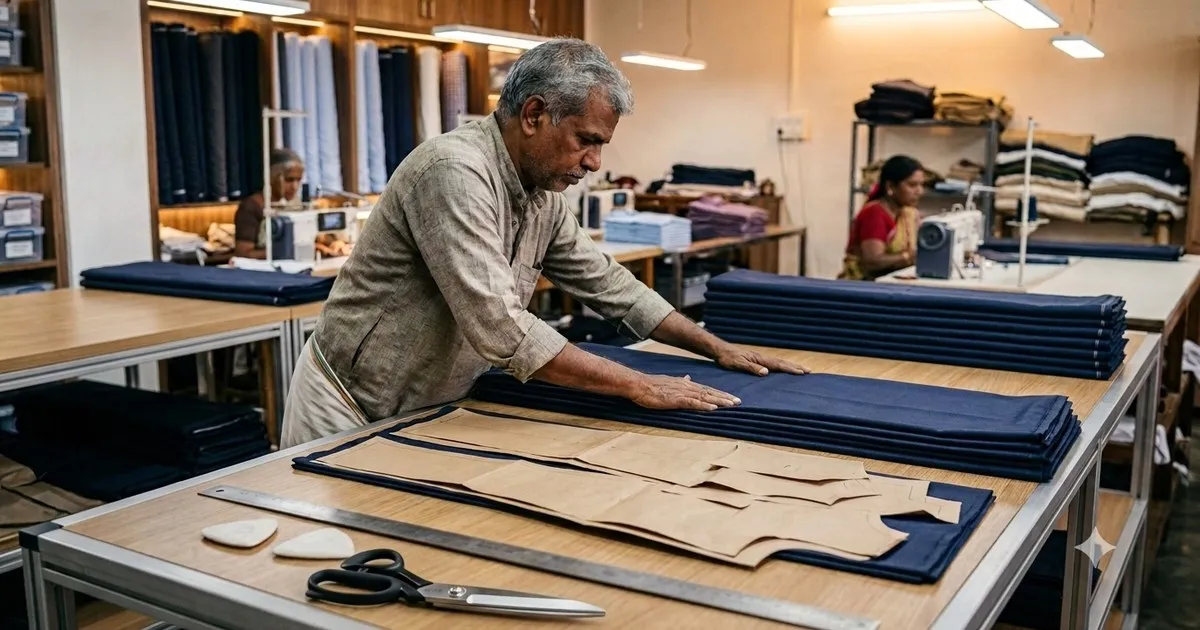
Tailor laying out uniform fabric in layers on a large cutting table for a bulk order
Ask every one of these before a price leaves your mouth. Each one has ended a shop’s margin at some point:
Ask | Why it matters |
|---|
Exact piece count, by size | A total without a size split is not an order, it is a guess |
Who supplies the cloth | If you do, the price risk and the shortage risk are both yours |
How the sizes will be confirmed | Measured, or taken from last year’s list? These are not the same |
Delivery date, and what happens if it slips | Get the penalty in writing, or the absence of one |
Payment terms | On delivery, or 30 days after? This decides whether you can buy cloth |
Who pays for size exchanges | There will be some. Decide before, not after |
Sample approval | One approved sample in writing prevents the whole lot being rejected |
Labels, buttons, embroidery | Small items, long lead times, and usually forgotten in the quote |
Costing a Bulk Order So the Margin Survives
Work through these in order, on paper, before quoting:
Cloth per piece, at today’s rate, plus wastage. Assume real wastage, not ideal.
Stitching labour per piece, at what you actually pay, including any overtime the deadline forces.
Cutting time. On bulk this is a real cost, not a rounding error.
Buttons, labels, thread, elastic, packing. Small per piece, large across four hundred.
Size exchanges and rejects. Budget three to five percent even on a good order.
Transport and delivery, in the number of trips it will really take.
The money you are out of pocket until payment lands.
Then add your margin — and quote per size band rather than one flat rate. Larger sizes take more cloth, and a flat rate quietly pays for them out of your profit.
The Size Set: Where Bulk Orders Are Won or Lost
This is the part that separates shops that make money on bulk from shops that survive it.
An ordinary order is drafted for one body. A bulk order is drafted once and graded across a size run — say 24 to 42 for a school, or S to XXL for an office. Every size needs its own pattern, correctly graded, before a single piece is cut.
Done by hand, that means redrawing the block for every size, and a small error in the grading is repeated across every piece in that size. Done on a computer, the grading is calculated and the pattern for each size prints identical every time.
Measure a real sample of the group rather than accepting last year’s list.
Confirm the size split in writing before cutting anything.
Cut and approve one full sample per size band first.
Keep the graded pattern. Next year the same school is a repeat, not a new job.
That last point is the whole argument for keeping patterns digitally: the second year of a school contract should cost you a fraction of the first.
What a 400-Piece School Uniform Order Looks Like Week by Week
Stage | What happens | Where it goes wrong |
|---|
Before the order | Size set measured, sample approved in writing | Sizes taken from an old list |
Week 1 | Cloth bought, patterns graded, lay planned | Cutting starts before grading is checked |
Week 1-2 | Bulk cutting in layers | Lay calculated per piece, so cloth runs short |
Week 2-3 | Stitching in batches by size | All sizes at once, so nothing is finishable |
Week 3 | Finishing, buttons, labels, pressing | Labels ordered late |
Week 3 | Checking and packing by size | No count sheet, so the delivery is short |
Delivery | Delivered by size, signed for | Delivered loose and re-sorted at the school |
Stitch in batches by size and finish each batch completely. A shop that stitches all sizes at once has nothing ready to deliver until the very end, which is exactly when problems appear.
Four Mistakes That Kill the Margin
1. Quoting Before the Size Split Is Known
Four hundred pieces at an average size is a fiction. The large sizes consume more cloth and more time, and if they are a bigger share than you assumed, the whole margin is gone.
2. Cutting Piece by Piece Instead of in a Lay
Bulk cutting is layered, and the pieces are placed to use the cloth. Cutting one at a time on a bulk order wastes both cloth and days, and it is the single biggest avoidable cost.
3. Accepting the Deadline Without the Cloth in Hand
The delivery date is fixed the moment you agree. Cloth delivery is not. Do not commit to a date until you know when the fabric actually arrives.
4. No Written Sample Approval
One approved sample, signed or on message, protects you from the whole lot being questioned later. Verbal approval protects nobody.
How to Win a School Uniform or Corporate Contract
The work goes to whoever is standing there when the decision is made, which is earlier than most shops think:
Approach schools two to three months before the academic session, not at the start of it.
Carry finished samples, not photographs. Let them feel the cloth and the stitching.
Bring a written quotation per size band, with the delivery date on it.
Offer a small first order if they already have a supplier. A hundred sets delivered well is a better argument than any discount.
Ask for a reference letter after a clean delivery. It is what opens the next school.
Corporate uniform clients respond to the same approach, with one addition: they care about repeat consistency, because next year’s new joiners must match this year’s staff. A corporate uniform order is smaller than a school uniform order but usually pays better and renews more quietly.
What Changes at Bulk Volume With CAD Cutting
Fashion Dot has built tailoring technology from Coimbatore since 2003, and the modules have been shaped by feedback from more than 11,000 tailors and boutiques. At bulk volume the difference is not comfort, it is whether the order is profitable:
The size run is graded by the software instead of redrawn by hand for every size.
The lay is planned before the cloth is cut, so the fabric goes further — shops typically use 5-15% less than hand marking.
Every piece in a size is identical, so a size exchange is a swap rather than an alteration.
The graded pattern is stored, so next year’s repeat order starts from a finished pattern.
Patterns print full scale on continuous roll paper, or feed a laser cutter directly.
For layered bulk cutting on paper, see the pattern cutting machine page.
For cutting the fabric itself with a sealed edge, see the laser cutting machine page.
Plans and what each one includes are on the tailoring CAD software price page.
Questions Tailors Ask About Bulk Orders
How many pieces counts as a bulk order?
In practice anything above about fifty identical pieces, because that is the point where cutting in a lay and grading a size run start to matter more than stitching speed.
Should I buy the cloth or ask the client to supply it?
For a first order with a new client, let them supply it if they offer. You carry less risk while you learn how they work. Once the relationship is proven, supplying cloth is where the margin is.
What margin is realistic on school uniform stitching?
Thinner than retail tailoring, and made up on volume and on the repeat. The money is in the second and third year, when the patterns and the size set already exist.
How do I handle size exchanges?
Agree the rule before delivery: who pays, and how many days the window runs. Then cut a small buffer in the two commonest sizes so an exchange is a swap from stock rather than a fresh cut.
Can a small shop take a 500-piece order?
Yes, if the cutting is planned and the stitching is batched. What stops small shops is not the number of machines, it is drafting and cutting time — which is exactly the part that scales when the patterns come off a computer.
When should I approach schools for next season’s uniform stitching?
Two to three months before the session starts. Decisions are made well before the first day, and a shop that turns up in week one is a year early for the following season, not late for this one.
See a Full Size Run Graded and Printed
The quickest way to judge whether CAD changes your bulk work is to watch a size run graded and printed to full scale, from a real order you have quoted.
Book a free demo and bring the size split from an order you are working on now. On-site or online, in your language, with no commitment.