A boutique cuts each garment to one customer. A uniform maker, a kidswear unit or a shop selling ready sizes has to cut the same garment in five, eight or twelve sizes – and every size has to fit like the first. This guide explains what pattern grading is, how grade points and grade rules work, a worked example you can follow, where manual grading usually goes wrong, and how CAD grades a full size set in one step.
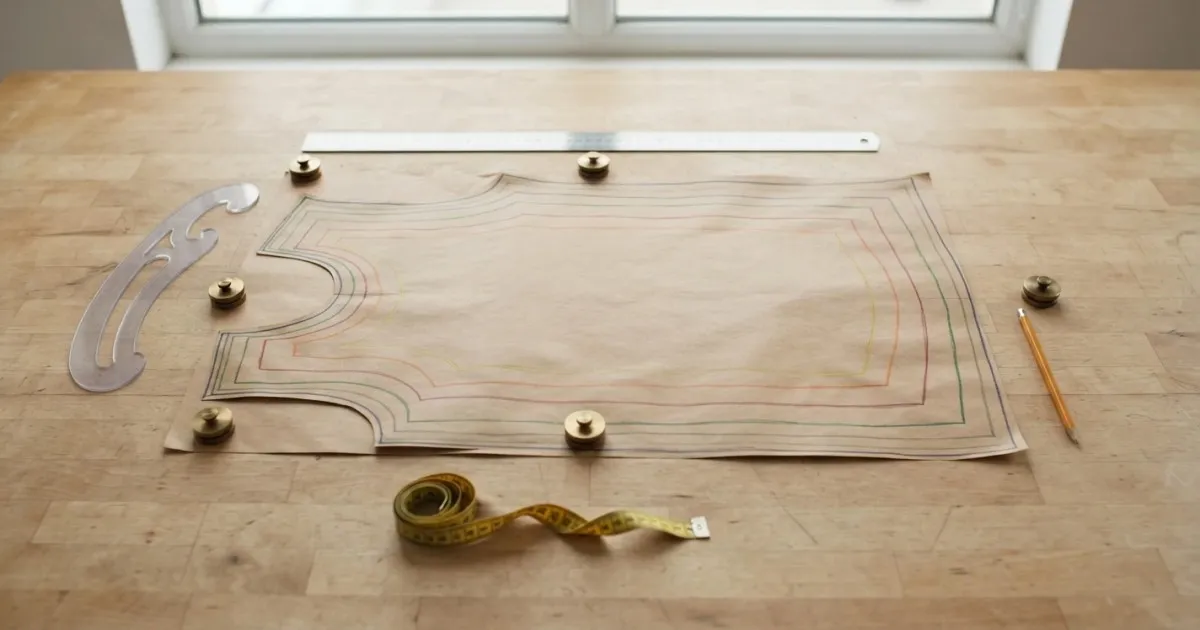
A front pattern graded into nested sizes, each size drawn in a different colour, on a cutting table
A school order arrives: four hundred shirts, sizes from 22 to 40. The cutting master drafts the middle size beautifully. Then, one by one, he drafts every other size by hand, each from scratch, each a little different in its own way.
By the largest size, the collar no longer matches the neck, the armhole has grown faster than the sleeve, and the smallest size pulls across the back. Nobody did anything wrong. Eleven separate drafts simply cannot stay in proportion with each other.
Grading is the answer to that problem: draft one base pattern properly, then grow and shrink it by fixed, consistent steps, so every size keeps the same shape.
In this guide you will find:
Why grading matters for uniforms, kidswear and ready sizes
What grading is, and how it differs from re-drafting
How grade points and grade rules work
A worked example you can repeat with your own size chart
Where manual grading usually goes wrong
How CAD grades a full size set in one step
Why Grading Matters
Four reasons, and all of them show up in the finished garment.
Every Size Must Keep the Same Design
A neckline, a pocket position or a yoke depth that looks right on the base size has to look right on the smallest and the largest. Grading moves each part by a planned amount, so the design keeps its proportions.
Re-Drafting Every Size Is Slow
Drafting each size from measurements takes as long as drafting the first one. Across a full size run, that is a day of work before a single piece is cut.
Bulk Orders Leave No Room for Error
When one size is wrong in a uniform order, it is wrong a hundred times. Mistakes are found at delivery, by the customer, in front of everyone.
Sizes Must Match Between Orders
A school that re-orders next year expects size 32 to be the same size 32. A graded set, saved and reused, gives the same result every time.
What Grading Is, and What It Is Not
Grading is not drafting a new pattern for each size. It starts from one finished, tested base pattern – usually a middle size – and moves its key points outward for larger sizes and inward for smaller ones.
The base pattern carries the design, the ease and the style lines.
Grading changes only the measurements that change between sizes – width, length, neck, armhole.
Things that should stay the same – seam allowances, button spacing rules, pocket shape – are kept the same or changed only on purpose.
Grading also does not replace made-to-measure tailoring. For a single customer, drafting from her measurements is still right. Grading is for when the garment is made in a set of standard sizes.
Grade Points and Grade Rules
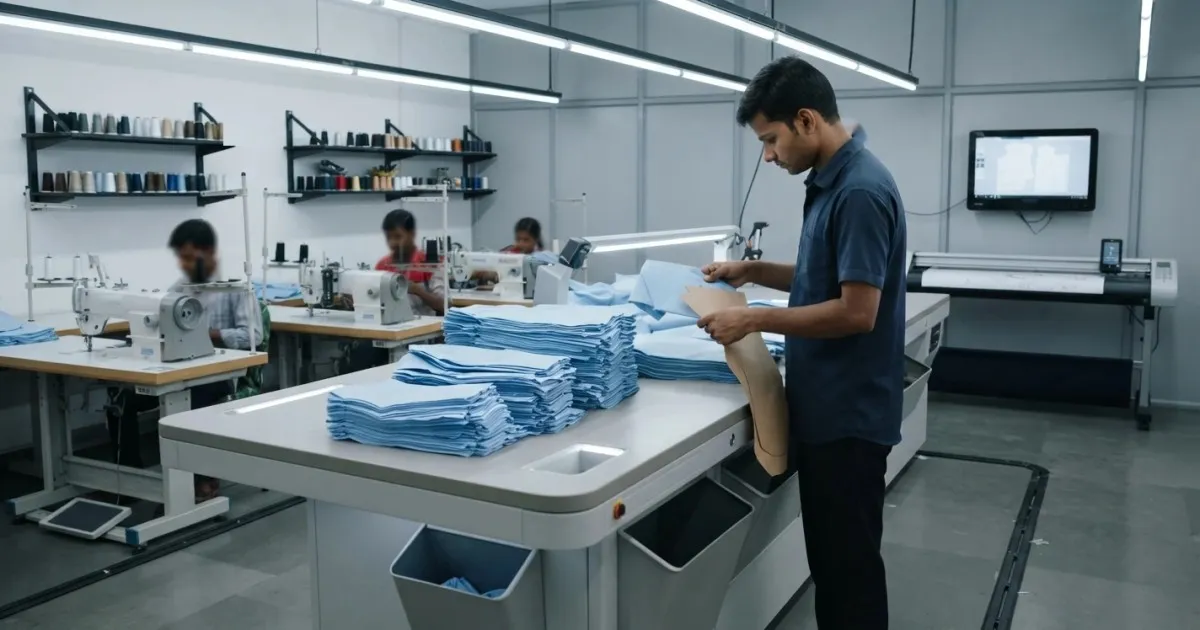
Cut uniform shirt pieces stacked by size in a workshop, checked against the paper pattern
Every pattern piece has a few key corners and points where the outline changes direction. These are the grade points. A grade rule says how far each point moves, and in which direction, from one size to the next:
Grade point | What moves | Why |
|---|
Centre front neck | Up or down slightly | Neck depth grows a little with size |
Shoulder neck point | Out and up | Neck width grows with the body |
Shoulder tip | Out and up | Shoulder width and slope change |
Underarm (side seam top) | Out and down | Bust or chest width and armhole depth grow |
Waist at side seam | Out | Waist width grows |
Hem at side seam | Out and down | Hip width and garment length grow |
Centre front hem | Down | Garment length grows |
The rules come from the size chart. If the chest grows by a fixed amount from one size to the next, that amount is shared between the pattern pieces – front and back, left and right – so each piece moves only its share.
The measurements behind a kurti size set are in our kurti cutting measurement chart.
A Worked Example
The figures below are examples only, to show the method on a half front kurti pattern. Use the increments from your own size chart.
Measurement | Change per size (whole garment) | Movement on the half front piece |
|---|
Bust | +4 cm | Side seam at underarm moves out 1 cm |
Waist | +4 cm | Side seam at waist moves out 1 cm |
Hip | +4 cm | Side seam at hem moves out 1 cm |
Shoulder width | +1 cm | Shoulder tip moves out 0.5 cm |
Armhole depth | +0.5 cm | Underarm point moves down 0.5 cm |
Length | +1 cm | Hem moves down 1 cm |
The bust grows by 4 cm around the whole body, but a half front piece is only one quarter of that circle, so its side seam moves out by 1 cm. The same logic applies to every width measurement. Lengths are not shared, so a 1 cm longer kurti means the hem moves down 1 cm on every piece.
Draw the base size, move each grade point by its rule, and join the new points with the same curves. Repeat for each size, larger and smaller. Laid on top of each other, the sizes should form an even nest, like the cover photo above – any line that jumps or crosses another is a mistake to fix before cutting.
Where Manual Grading Goes Wrong
Grading by hand is entirely possible. These are the mistakes that make it unreliable:
Grading from a base pattern that has not been tested. Every fault in the base is copied into every size.
Moving the whole side seam out by the full increment, instead of sharing it between pieces.
Grading the bodice but forgetting the sleeve, collar or facing, so pieces no longer match.
Redrawing curves freehand for each size, so the armhole and neck change shape, not just size.
Rounding small increments differently on each size, so errors add up at the ends of the range.
Losing the graded set after the order, so next year’s re-order is graded again – differently.
The more sizes in the range, the more these small errors add up, which is why the smallest and largest sizes are usually where the complaints come from.
Grading in CAD
In tailoring CAD software, grading follows the same logic – base pattern, grade points, grade rules – but the software applies the rules to every size at once. The full size set is produced in one step, every curve keeps its shape, and matching pieces such as sleeves and armholes are graded together.
The graded set is saved, so a re-order next year is cut from exactly the same patterns. It can also be nested into a marker for bulk cutting, which is where most of the fabric saving in a uniform order comes from. More on the pattern side is on the pattern making software page.
For the bigger picture on bulk work, see our guides to uniform stitching and bulk orders and reducing fabric wastage.
Questions Tailors Ask
What is pattern grading in tailoring?
It is making a set of sizes from one base pattern by moving its key points by fixed amounts, so every size keeps the same design and proportions. It is used for uniforms, kidswear and garments sold in standard sizes.
Which size should be the base pattern?
Usually a middle size in the range, tested and corrected before grading. Grading outward in both directions from the middle keeps errors smaller at the ends of the range.
How much should each size increase?
That comes from your size chart. Many charts use an even step for width measurements and smaller steps for lengths, but the right numbers depend on who the garment is for. Use one chart consistently.
Can I grade a blouse the same way as a kurti?
The method is the same, but a fitted blouse has darts and a closer fit, so the rules need care around the bust and armhole. Test the smallest and largest sizes before cutting in bulk.
Is grading the same as made-to-measure?
No. Made-to-measure drafts a pattern from one customer’s measurements. Grading produces a set of standard sizes from one base. Many shops use both: made-to-measure for boutique work and grading for uniforms and ready sizes.
Can CAD software grade patterns automatically?
Yes. Once the base pattern and the grade rules are set, CAD grades the full size range in one step and keeps the set saved for re-orders and bulk cutting.
See a Size Set Graded in Minutes
Grading by hand is a skill worth knowing. Grading a full uniform size set in one step is a skill worth seeing. The quickest way is to watch a pattern drafted and graded from a size chart you brought yourself.
Book a free demo – on-site or online, in your language, with no commitment.