Most tailoring shop owners know whether the month was good by looking at the cash box. That tells you how much money is in the box – not whether the shop made money. This guide shows a simple monthly profit check for a tailoring shop, without an accountant’s training: what to record, how to sort expenses into fixed and variable, a one-page monthly summary, and the five numbers every owner should watch.

Tailor shop owner reviewing the month's accounts at the counter after closing
The season was busy. The machines never stopped, the delivery board was full every week, and customers paid. At the end of the month the owner pays rent, wages and the cloth supplier, and there is less left than last year, when the shop was quieter.
Nothing went missing. The money went where money always goes in a tailoring shop – small expenses that nobody added up, advances that never became balances, and a rate card that stopped matching the costs.
You cannot fix what you cannot see. Simple accounts are how a shop sees.
In this guide you will find:
Why most shops do not know whether they made money
Why shop money and home money must be kept apart
What to record every day
How to sort expenses so they make sense
A one-page monthly summary you can copy
Five numbers to watch every month
Why Most Shops Do Not Know If They Made Money
Four reasons, and all of them are habits rather than mistakes.
The Cash Box Is the Only Record
Cash comes in, cash goes out, and what is left looks like profit. But UPI payments, advances for orders not yet delivered and bills not yet paid are all invisible in a cash box.
Shop and Home Money Are Mixed
Groceries are bought from the shop drawer, the electricity bill is paid from a personal account, and the owner takes cash when needed. At the end of the month, nobody can say what the shop earned on its own.
Small Expenses Are Never Written Down
Thread, needles, hooks, tea, auto fare to the supplier, a machine repair. Each one is small. Together they are often one of the larger costs of the month, and they are the ones nobody remembers.
Advances Are Counted as Income
An advance is money the shop is holding for work it has not yet done. Counting it as earned makes a busy booking month look profitable, and the following month – when the work is done and little new money comes in – look like a loss.
Keep Shop Money and Home Money Apart
This is the single change that makes everything else possible:
Use a separate bank account and UPI for the shop, even a simple one.
Pay every shop expense from the shop account or the shop cash box – never from your pocket.
Pay yourself a fixed amount each month, as if you were staff, and record it.
If you take money out for home, write it down as owner’s drawing, not as an expense.
Keep the shop cash box for the shop only. Count it and note the total at closing.
Once the money is separate, the shop’s numbers become the shop’s numbers, and they start to tell you something.
What to Record Every Day
The monthly check is only as good as the daily record behind it. Five minutes at closing time is enough – for a step-by-step daily closing routine, see the Juvee guide to tailor shop accounts, advances and daily cash. Every entry needs a date, an amount and what it was for:
Record | What to write | Why it matters |
|---|
Money in – balance payments | Order number, amount, cash or UPI | This is earned income for delivered work |
Money in – advances | Order number, amount, cash or UPI | Held for work not yet done, tracked separately |
Money out – materials | Thread, lining, hooks, buttons, cloth bought for orders | The cost that rises with every order |
Money out – running costs | Rent, power, phone, repairs, tea, transport | The cost of keeping the shop open |
Money out – staff | Salary, piece-rate pay and advances to staff | Usually the largest cost after rent |
Cash at closing | The counted total in the cash box | Catches mistakes the same day, not at month-end |
If a day is missed, fill it in the next morning while it is still remembered. A record with gaps is still far better than no record.
Sorting Expenses So They Make Sense
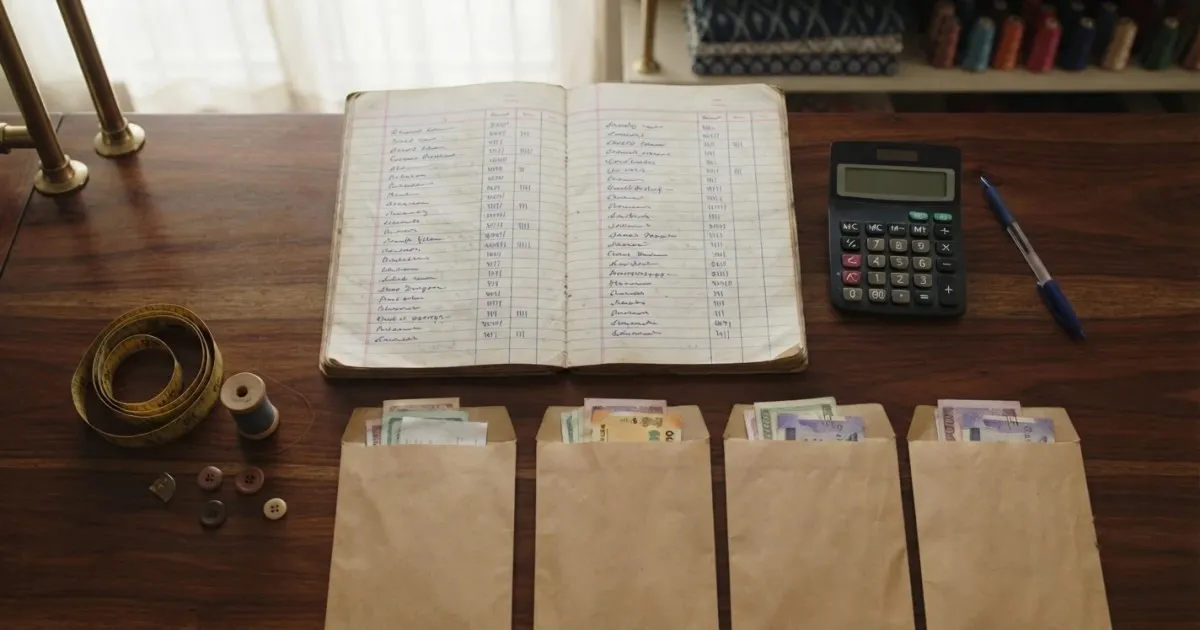
Shop money sorted into envelopes beside the accounts ledger and calculator
At the end of the month, sort every expense into one of two groups. A row of envelopes or a page for each works fine:
Fixed costs – the same every month whether the shop is busy or quiet: rent, salaries, loan or EMI instalments, internet and phone.
Variable costs – rise and fall with the work: materials, piece-rate pay, power used by machines and irons, transport for supplies.
Fixed costs tell you how much the shop must earn before it makes anything. Variable costs tell you how much each order really costs. Both are needed to set rates that cover the shop.
How to turn these costs into a rate per garment is covered in our guide to setting your tailoring charges without losing money.
The One-Page Monthly Summary
Once a month, put the totals on one page. The figures below are made up so the method is clear. Replace every one with your own.
Line | Example | Where it comes from |
|---|
Balance payments received | A | Daily record, money in for delivered work |
Advances for delivered orders | B | Advances taken earlier for orders delivered this month |
Income earned this month | A + B | Work actually completed and handed over |
Fixed costs | F | Rent, salaries, EMI, phone |
Variable costs | V | Materials, piece-rate pay, power, transport |
Shop profit before owner’s pay | (A + B) − F − V | What the shop made this month |
Owner’s fixed pay | O | What you pay yourself |
Left in the shop | (A + B) − F − V − O | Money to save, repair or invest |
Advances held for next month | H | Kept aside – not yet earned |
Notice that advances for orders still in progress are not counted as income. They are kept aside until the garment is delivered, which is what stops a good booking month from looking like a good earning month.
Five Numbers to Watch Every Month
The summary page is the raw material. These five numbers tell you what it means:
Number | What it tells you |
|---|
Income earned versus last month | Whether the shop is growing or only busy |
Fixed costs as a share of income | How hard the shop has to work just to stay open |
Materials cost per garment | Whether rates still cover the cost of making |
Advances held versus orders on the board | Whether enough advance is being taken |
Balance still unpaid on delivered garments | Money earned but not yet collected |
If advances held are low or unpaid balances are high, our guide to advance payments and unclaimed garments covers what to change. If staff pay is rising faster than income, see piece rate or salary.
Where the Records Should Live
A notebook works, as long as it is the same notebook every day and nobody tears pages out of it. Many shops move to software once orders, advances and staff payments outgrow a single book. What matters is that every order carries its rate, advance, balance and delivery date, and every expense has a date and a category.
Order, advance and balance tracking is what the billing software for tailor shop page covers. For running orders and payments from your phone, Juvee is the shop management app built for tailoring shops.
For GST, income tax and anything to do with filing, speak to a local accountant. Clean monthly records make that conversation shorter and cheaper.
Questions Tailors Ask
How do I know if my tailoring shop is making a profit?
Separate shop money from home money, record every amount in and out each day, sort expenses into fixed and variable once a month, and compare income earned on delivered orders with total costs on a one-page summary. A notebook is enough to start.
Should advances be counted as income?
Not until the garment is delivered. Until then, an advance is money held for work not yet done. Counting it early makes busy booking months look better than they are.
How much should the owner take from the shop?
Pay yourself a fixed monthly amount, as if you were staff, and record it. Anything taken beyond that should be written down as owner’s drawing, so the shop’s real result stays visible.
What are the biggest hidden costs in a tailoring shop?
Small materials – thread, hooks, buttons, lining – machine repairs, power for irons and machines, and re-work. They are rarely written down, so they rarely appear in the rate.
Do I need accounting software?
Not to start. A notebook kept every day works. Software helps once orders, advances and staff payments become too many to track by hand, and it makes monthly totals automatic.
Who should I ask about GST and tax?
A local accountant or tax practitioner. This guide is about knowing whether the shop makes money each month; tax rules depend on your turnover and situation and need professional advice.
See Where the Time Goes Too
Clear accounts show where the money goes. The other cost most shops never see is time – especially the hours spent drafting and cutting. The quickest way to see how much of it is recoverable is to watch a pattern drafted from measurements you brought yourself.
Book a free demo – on-site or online, in your language, with no commitment.