Most tailoring price lists are set by looking at what the shop down the road charges. This guide shows how to work out tailoring charges from your own costs instead — what one garment really costs you, how to find your hourly rate, what to charge extra for, and when to raise a rate without losing the customer.

Tailor at the shop counter working out stitching charges with an order book, calculator and fabric
A shop is busy every day of the season. The machines never stop, the staff work late, the delivery dates are met. At the end of the month the owner looks at what is left and cannot understand where it went.
Almost always the answer is the same. The rate was set years ago by matching the shop opposite, and everything since — cloth, power, rent, staff pay — has gone up while the rate has not.
Setting a rate by copying a neighbour is not pricing. It is guessing with extra steps, and it guarantees that your prices reflect his costs rather than yours.
In this guide you will find:
Why most shops under-charge without realising it
The seven costs behind a single garment
How to work out what an hour of your shop is worth
A worked example you can repeat with your own figures
What to charge extra for, and what to stop giving away
How to raise a rate without losing the customer
Why Most Tailoring Charges Are Set Too Low
Four reasons, and every one of them is fixable.
The Rate Was Copied, Not Calculated
If your rate came from the shop opposite, it is built on his rent, his staff and his volume. None of those are yours.
Your Own Time Is Counted as Free
The owner cuts, fits, deals with the customer and does the accounts, and none of those hours appear anywhere in the price. A shop that pays everyone except the owner is not profitable, it is subsidised.
Small Extras Are Given Away
A designer neck, a lining, an urgent delivery, a size alteration after collection. Each one is ten minutes or an hour that nobody charged for, repeated forty times a month.
The Rate Has Not Moved in Years
Cloth, thread, power, rent and wages have all risen. A rate that has not been reviewed in three years is effectively a discount that grows every month.
Stitching Charges Start Here: What One Garment Costs You
Before any rate makes sense, work out the cost of one garment. Seven lines, and most shops count only two of them.
# | Cost | How to work it out | Usually counted? |
|---|
1 | Stitching labour | What you actually pay the tailor for that garment | Yes |
2 | Thread, buttons, hooks, lining | Per garment; small, but real | Sometimes |
3 | Cutting time | Minutes spent drafting and cutting, at your hourly rate | Rarely |
4 | Your own time | Measuring, fitting, dealing with the customer | Almost never |
5 | Shop overhead | Rent, power, internet, maintenance, divided per garment | Almost never |
6 | Re-work | Alterations and re-cuts, spread across all garments | Never |
7 | Equipment | Machines, printer, plotter written off over their life | Never |
Lines 3 to 7 are where the profit disappears. They are not optional costs; they are simply costs that nobody writes down.
Working Out What an Hour of Your Shop Is Worth
This is the single number that makes the rest of the arithmetic possible, and it answers the question behind every quotation — how much to charge — with a figure instead of a guess. It takes twenty minutes to find:
Add up one month of fixed costs — rent, power, internet, wages, maintenance, loan instalments.
Count the hours your shop actually works in that month, not the hours it is open.
Divide. That is what one hour costs you before you have earned anything.
Add the margin you want on top. That is your hourly rate.
Once you know your hourly rate, every quotation becomes arithmetic instead of instinct. A garment that takes two hours of shop time cannot be priced below two hours of shop cost, whatever the shop opposite charges.
A Worked Example
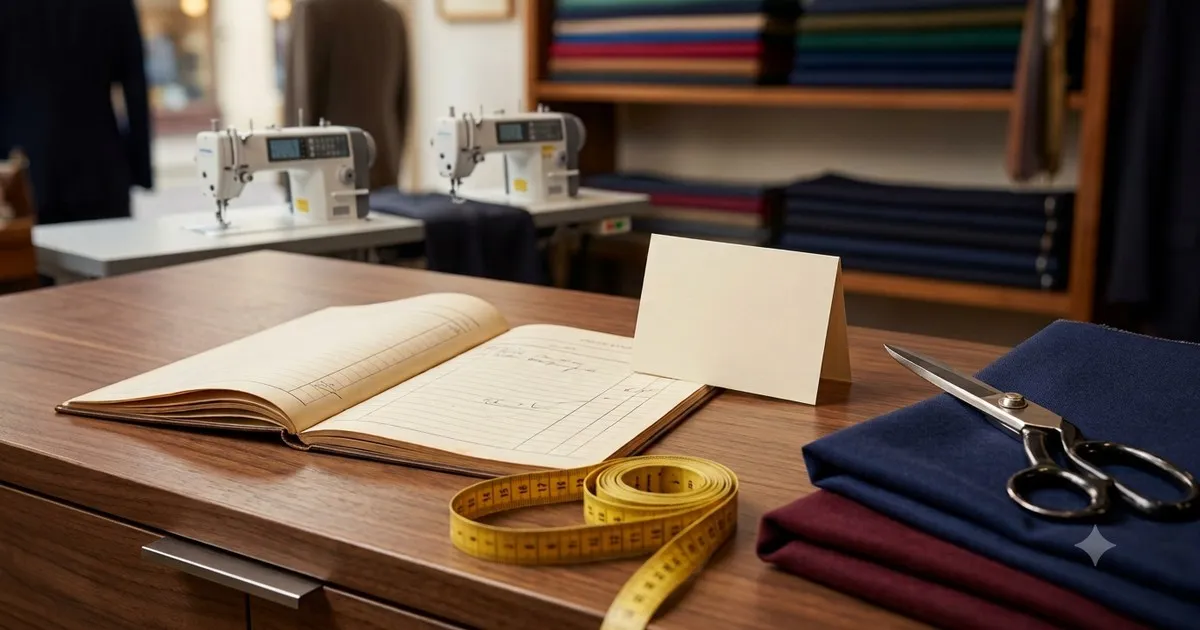
Tailor shop order book and rate card on the counter beside folded fabric and a measuring tape
The figures below are made up so the method is clear. Replace every one of them with your own — costs differ by city, by cloth and by shop, and any rate card that claims to be correct for everyone is wrong for almost everyone.
Line | Example figure | Where it came from |
|---|
Shop hourly cost | A | One month of fixed costs divided by hours worked |
Cutting time | 0.5 hour | Measured, not guessed |
Stitching labour | B | What you pay for this garment |
Materials | C | Thread, buttons, hooks, lining |
Owner time | 0.25 hour | Measuring, fitting, handover |
Sub-total | (0.75 x A) + B + C | Cost before margin |
Re-work buffer | +5% | Because some garments come back |
Margin | + your percentage | This is the part that is actually yours |
Rate | The total | Now defensible to yourself and the customer |
Do this once for each garment type you cut regularly — blouse, chudidhar, shirt, pant. Four calculations give you a rate card built on your shop rather than on somebody else’s.
What to Charge Extra For
These take real time and are given away in most shops:
Extra | Why it costs you | Typical approach |
|---|
Designer neck or back | Extra drafting and finishing | Fixed add-on per design |
Lining | Extra cloth handling and a second set of pieces | Fixed add-on |
Urgent delivery | Displaces other work and often means overtime | Percentage on top |
Heavy or delicate fabric | Slower cutting, more care, higher risk | Percentage on top |
Alteration after collection | A full handling cycle for one garment | Free window, then charged |
Customer-supplied poor cloth | Higher reject risk that lands on you | Note it on the order, quote accordingly |
Embroidery and maggam placement | Frame time is a separate skill | Quoted separately, never bundled |
Print the add-ons on the rate card. A charge the customer can see in advance is accepted; the same charge added at delivery is an argument.
How to Present Your Tailoring Price List
One page, printed, on the counter. A tailoring price list on the wall answers the customer before she asks.
Quote from the card, never from memory. A rate quoted from memory is a rate that gets negotiated.
Show the base rate and the add-ons separately, so the customer sees what she is choosing.
Put the urgent-delivery percentage on it. It stops the conversation before it starts.
Date it. A rate card with a date on it is expected to change.
Keep the same structure across garments so staff can quote without asking you.
Raising a Rate Without Losing the Customer
Rate increases lose customers when they are a surprise, not when they happen:
Review once a year, on a date you set, rather than when the pressure becomes unbearable.
Raise the whole card a little rather than one item a lot.
Give existing customers notice — a month is plenty, and it reads as respect.
Change something visible at the same time: better packing, a firm delivery promise, a fitting appointment.
Do not apologise for it. A shop that explains its rate calmly keeps more customers than one that discounts nervously.
The customers you lose to a small, well-handled increase are usually the ones costing you the most time.
What the Order Book Has to Record
None of the above works if the shop cannot answer simple questions at the end of the month. The record needs to carry:
Which garment, and which style options were chosen.
The quoted rate, and any add-ons applied.
Advance taken, part payments, and balance due.
The promised delivery date and the actual one.
Whether the garment came back, and why.
With that, you can see which garment type actually makes money — and it is often not the one the shop is busiest with. Most owners find their assumption was wrong the first time they look.
Shop billing and order records are what the billing software for tailor shop page covers.
If cutting time is the cost you want to attack, that is what tailoring CAD software is for — drafting minutes instead of an afternoon.
Questions Tailors Ask
How much should I charge for stitching a blouse?
There is no single correct figure, and any guide that gives you one is guessing on your behalf. Work out your shop hourly cost, measure how long a blouse actually takes, add materials and your margin. That number is right for your shop.
Should I charge the same as the shop next door?
Only if his rent, staff and volume match yours, which they will not. Use his rate as information about the market, never as your calculation.
How do I charge for urgent orders?
A percentage on top, printed on the rate card. Urgent work displaces other orders and usually means overtime, so it genuinely costs more.
Customers say my rate is too high. What do I do?
Show the rate card and what is included. Most objections are not about the number, they are about not knowing what the number covers.
How often should I revise my tailoring charges?
Once a year, on a date you choose. Waiting until the margin is gone forces a large increase, and large increases are what lose customers.
Which garment should I be pushing?
The one with the best margin per hour, not the one with the highest price. Those are frequently different, and you can only tell once the order book records the rate against the garment type.
See Where the Cutting Time Goes
Cutting and drafting are the costs most shops never price, because they are hard to see. The quickest way to judge how much of it is recoverable is to watch a pattern drafted and printed from measurements you brought yourself.
Book a free demo — on-site or online, in your language, with no commitment.