Most of the cloth wasted in a gents tailoring shop is not lost in the cutting. It is lost in the re-cutting. Here are the twelve measurements a shirt pattern is built from, where each one is taken, and how much ease to add.
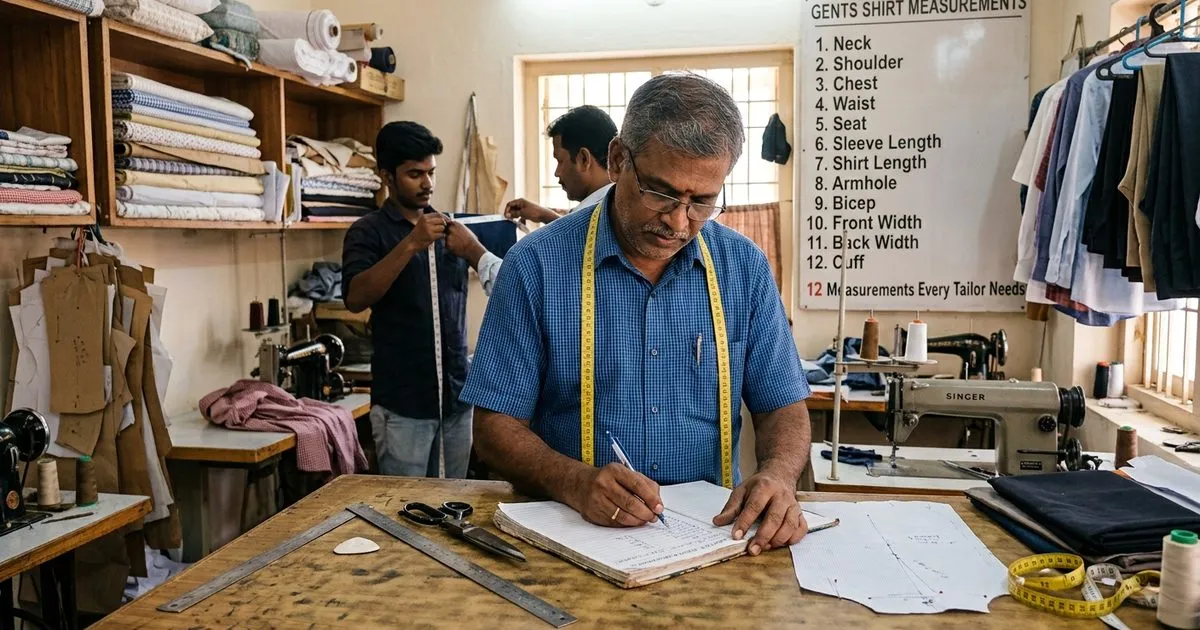
A gents shirt cutting measurement chart on the wall of a tailoring shop, with the tailor marking cloth at the cutting table.
A customer collects his shirt, puts it on, and raises his arms. The fabric pulls across the back. The sleeve twists at the cuff. The collar stands away from the neck.
The cloth was good. The stitching was good. The chest was measured two inches too high.
This happens in busy shops every week. A gents shirt has more fit points than most garments - shoulder, chest, armhole, sleeve, cuff, neck - and a small error at any one of them shows the moment the customer moves. The shirt comes back, the cloth is already cut, and the shop absorbs the loss.
Accurate gents shirt cutting does not require years of drafting experience. It requires taking the same twelve measurements the same way every time, and writing the ease down instead of keeping it in your head.
In this guide, you will learn:
The twelve measurements a gents shirt pattern needs
Where each measurement is taken on the body
How much ease to add, and why
The four mistakes that cause most re-cutting
The five pattern pieces a shirt draft produces
What changes when the pattern is drafted on a computer
Why Gents Shirt Cutting Goes Wrong
Three reasons, in the order they cost the most money.
The Measurement Was Taken Over the Wrong Point
Chest measured too high catches the armhole and the shirt binds under the arms. Measured too low, it sits on the stomach and the chest comes out tight. The tape belongs at the fullest part of the chest, level all the way round, with about two fingers of slack.
The Ease Lived in the Cutter’s Head
An experienced master adds ease without thinking about it. The problem appears the week he is on leave. Whoever covers for him adds a different amount, and the same customer receives a shirt that fits differently from his last one.
Ease belongs on the measurement sheet, in its own column, not in one person’s memory.
The Draft Was Redrawn From Scratch
Hand-drafting the same standard shirt again for every order introduces a small difference each time. Those differences are exactly what a regular customer notices when his second shirt does not fit like his first.
The 12 Measurements Every Gents Shirt Needs
Take all twelve on the body, never over a shirt the customer is already wearing. A worn shirt already contains somebody else’s ease.
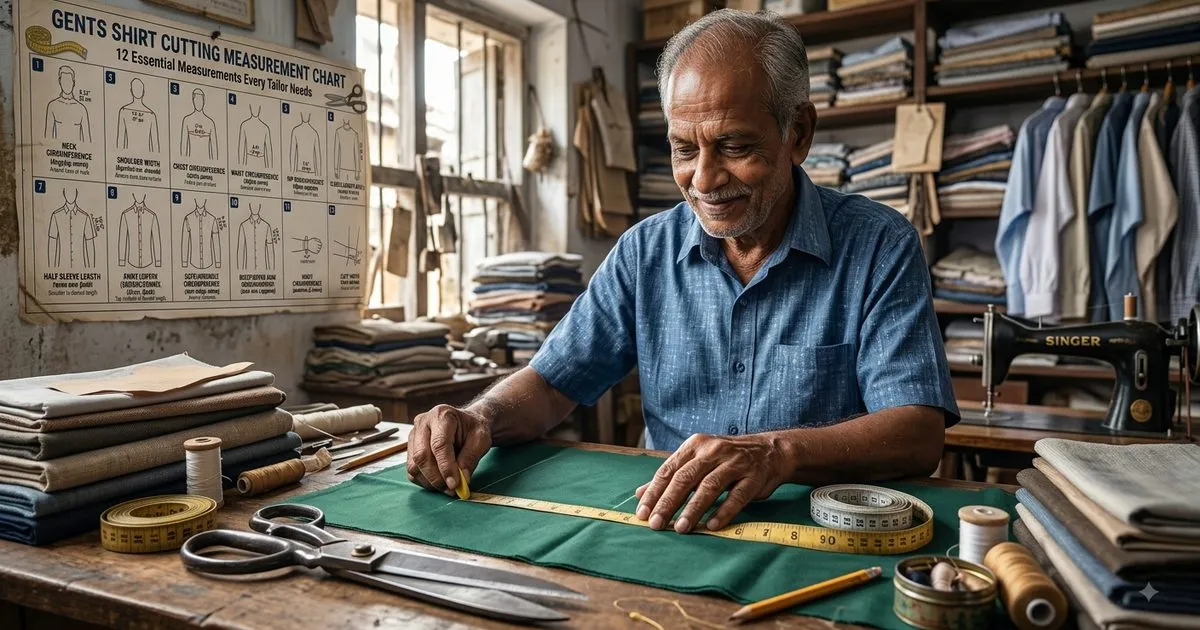
The twelve gents shirt measurements written into the order book before cutting begins.
# | Measurement | Where it is taken | Typical ease |
|---|
1 | Shirt Length | Base of the neck, straight down the back to the required hem | as ordered |
2 | Chest | Fullest part of the chest, tape level all the way round | 4-5 in |
3 | Waist | Natural waist, at its narrowest point | 4-5 in |
4 | Seat | Fullest part of the hip, for a shirt worn out | 3-4 in |
5 | Shoulder | Shoulder point to shoulder point, across the back | 0-0.25 in |
6 | Sleeve Length | Shoulder point to wrist bone, arm slightly bent | 0.5 in |
7 | Sleeve Round | Fullest part of the upper arm | 2-3 in |
8 | Cuff | Round the wrist bone | 1-1.5 in |
9 | Neck | Round the base of the neck, one finger inside the tape | 0.5 in |
10 | Yoke | Across the back, shoulder seam to shoulder seam | as shoulder |
11 | Armhole | Round the arm, through the underarm | 1-2 in |
12 | Front / Back Neck Drop | Depth of the neckline from the shoulder line | by style |
Record the raw measurement in one column and the finished measurement with ease in another. A single number leaves the next person guessing which one it is.
The Four Mistakes That Cause Most Re-Cutting
1. Chest Measured Tight to Prove a Perfect Fit
A shirt needs four to five inches of ease at the chest to close and to move. Measured tight and cut tight, it gapes at the button line the first time the customer sits down.
2. Shoulder Slope Ignored
Sloping shoulders need the shoulder seam angled more steeply, or the shirt collapses into folds under the collar. Square shoulders need the opposite. The same shoulder measurement can belong to two very different bodies.
3. Sleeve Round Taken at the Elbow
It belongs at the fullest part of the upper arm. Taken lower, the sleeve binds the moment the arm bends - and the customer notices while he is still in the shop.
4. Cuff Cut to the Wrist Measurement
With no ease the cuff will not button over the hand. One to one and a half inches is the working range.
The Five Pieces a Shirt Pattern Produces
A full gents shirt draft comes out as five pieces:
Front - carries the button placket and the pocket position
Back - with the pleat or dart the style calls for
Sleeve - with the placket opening
Cuff
Yoke - the panel across the shoulders
Get those five right and the collar, pocket and plackets follow. Get the yoke wrong and nothing above the chest sits correctly, however good the rest of the draft is.
Hand Drafting or CAD: Which Suits Your Shop?
The right approach depends less on the size of the shop and more on how many shirts are cut each week, and how many different people cut them.
Shop situation | Suitable approach |
|---|
A few shirts a week, one experienced cutter | Hand drafting with a written measurement sheet |
Regular shirt orders, more than one person cutting | Standard blocks on paper, kept in a labelled file |
Repeat customers expecting the same fit every time | Digital patterns stored against the customer |
Uniform or bulk shirt orders | CAD drafting with full-scale printed patterns |
New staff who have never drafted by hand | CAD, so the skill needed is measuring rather than drafting |
Shop losing cloth to re-cutting | CAD, where the pattern comes out identical every time |
What Changes When the Shirt Is Drafted on a Computer
Fashion Dot launched India’s first computerised gents-wear cutting software in 2012 and has refined it since with feedback from more than 11,000 tailors and boutiques, building tailoring technology from Coimbatore since 2003.
The twelve measurements do not change. What changes is everything that happens after them:
The measurements are entered once and the software drafts all five pieces to full size.
The same customer’s measurements produce the same pattern next month and next year.
The pattern prints full-scale on continuous roll paper 15 inches wide, ready to lay straight on the cloth.
Because the pieces are placed by the software rather than by eye, shops typically use 5-15% less fabric than hand marking.
Staff who have never drafted by hand can produce master-quality cutting.
Training is available in Tamil, Hindi, Telugu, Kannada and English.
None of this replaces knowing where to put the tape. It removes the redrawing.
Good Cutting Starts With the Measurement Sheet
The biggest improvement in a gents tailoring shop rarely comes from a new machine. It comes from recording the measurement properly at the counter.
If the twelve numbers, the ease, the style and the delivery date are all captured on one sheet against one order number, the cutter is not reconstructing anything later. A workflow that holds up under pressure looks like this:
Measurements taken - Ease recorded - Pattern drafted - Cloth laid - Pieces cut - Stitching assigned - Fit checked at delivery
When each stage is written down, accurate cutting becomes part of the routine rather than something that depends on one person being in the shop that day.
Frequently Asked Questions
How many measurements are needed for a gents shirt?
Twelve for a standard formal shirt. Some styles need one or two more - a mandarin collar or a curved hem, for example.
How much ease should be added at the chest?
Four to five inches for a regular fit. Slim fit runs closer to three to four, but below that the button line gapes when the customer sits down.
Can someone with no drafting experience cut a gents shirt?
By hand, not reliably. With CAD the measurements are entered and the software produces the full-size pattern, so the skill required shifts from drafting to accurate measuring.
Does the same measurement chart work for a kurta or a coat?
The body measurements carry over, but the ease and the pieces are different. A coat needs canvas allowances a shirt does not.
Why do two shirts cut from the same measurements fit differently?
Usually because the ease was applied from memory rather than from a written figure, or because the pattern was redrawn by hand instead of being reused.
Cut Gents Shirts With Fashion Dot CAD
For shops cutting shirts, pants and coats regularly, Fashion Dot drafts the pattern from the measurements you already take. It brings together:
Customer measurements stored against the order
Full-size shirt, pant and coat patterns
Front, back, sleeve, cuff and yoke pieces in one draft
Full-scale printing on continuous roll paper
Training in Tamil, Hindi, Telugu, Kannada and English
This keeps the pattern connected to the customer instead of being redrawn each time.
For the gents-wear module, see the gents tailoring software page. Plans and what is included are on the pricing page.
See a Shirt Drafted From Your Own Measurements
Bring a customer’s measurements to a free demo and watch the shirt pattern drafted and printed to full scale. The demo is available on-site or online, in your language, with no commitment.
Book a free demo and see your own shirt pattern drafted and printed to full scale.