A coat is the hardest garment in the shop, and almost everything about it can be altered afterwards except one measurement. This coat cutting measurement chart covers the twelve measurements a coat or blazer is cut from, the shoulder rule that decides whether the garment can ever be saved, and what canvas and lining change in the pattern.
Instead of a paper register, a body measurement app keeps every customer's measurements saved and ready for the next order.
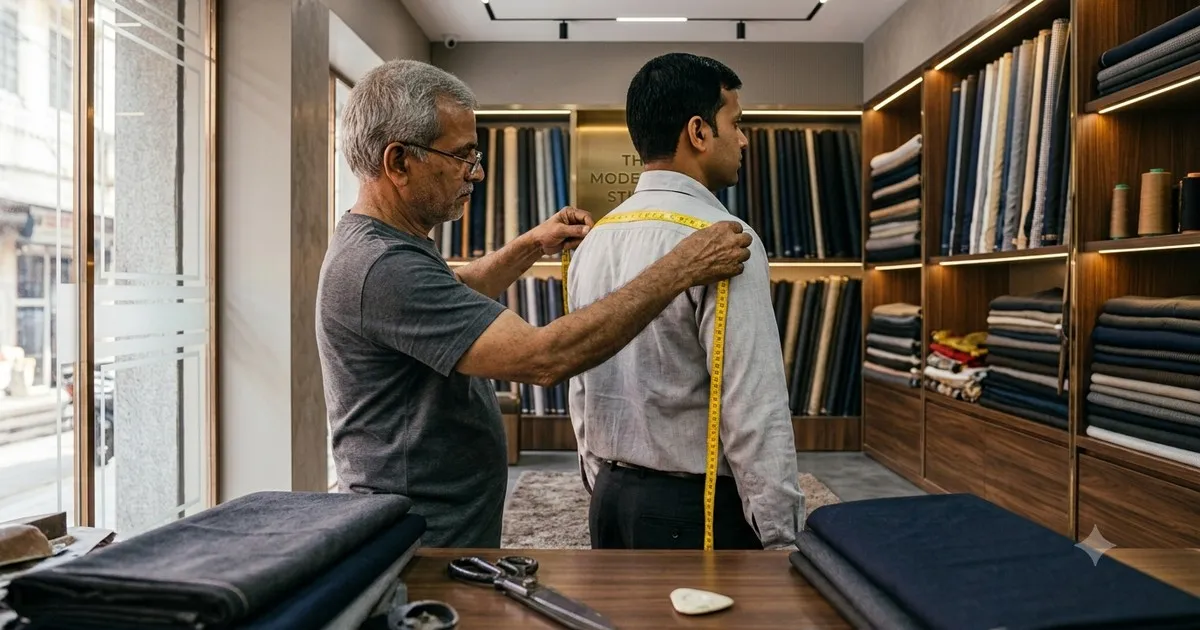
Tailor measuring a customer across the shoulders for a coat with suiting fabric on the cutting table
A customer collects his coat. The chest is right, the length is right, the sleeve is right. He puts it on and there is a soft fold below the collar at the back, and the whole garment sits a little off to one side.
The shoulder is wrong. Nothing else about that coat matters now, because the shoulder is the one seam a tailor cannot correct once the cloth is cut.
Everything else — waist, length, sleeve, even the chest within reason — can be adjusted at a fitting. That is why coat cutting is judged on two numbers taken before the scissors are picked up: the shoulder, and the balance.
In this guide you will find:
The twelve measurements a coat or blazer is cut from
Why the shoulder cannot be corrected, and how to take it properly
Balance — the measurement most shops never take at all
What canvas, lining and interlining change in the pattern
The four mistakes behind most coat re-cuts
How blazer, suit coat and bandhgala differ in the draft
Why Coat Cutting Is the Hardest Garment in the Shop
Three reasons, and they compound.
It Is Built, Not Just Stitched
A shirt is two layers of cloth. A coat is cloth, canvas, interlining, padding and lining, all of which have to agree with each other. An error in the pattern is repeated in five layers.
It Is Worn Open and Closed
A coat has to hang correctly buttoned and unbuttoned, standing and sitting. A shirt only has to work one way.
The Shoulder Cannot Be Undone
Once the shoulder seam is cut and the canvas is shaped to it, the garment is committed. Everything a fitting can fix lies below that seam.
The Coat Measurement Chart: All 12 Measurements
Take these over a shirt, never over a sweater or another coat, with the customer standing naturally rather than to attention. A man standing stiffly measures a different shape from the one who will wear the coat.
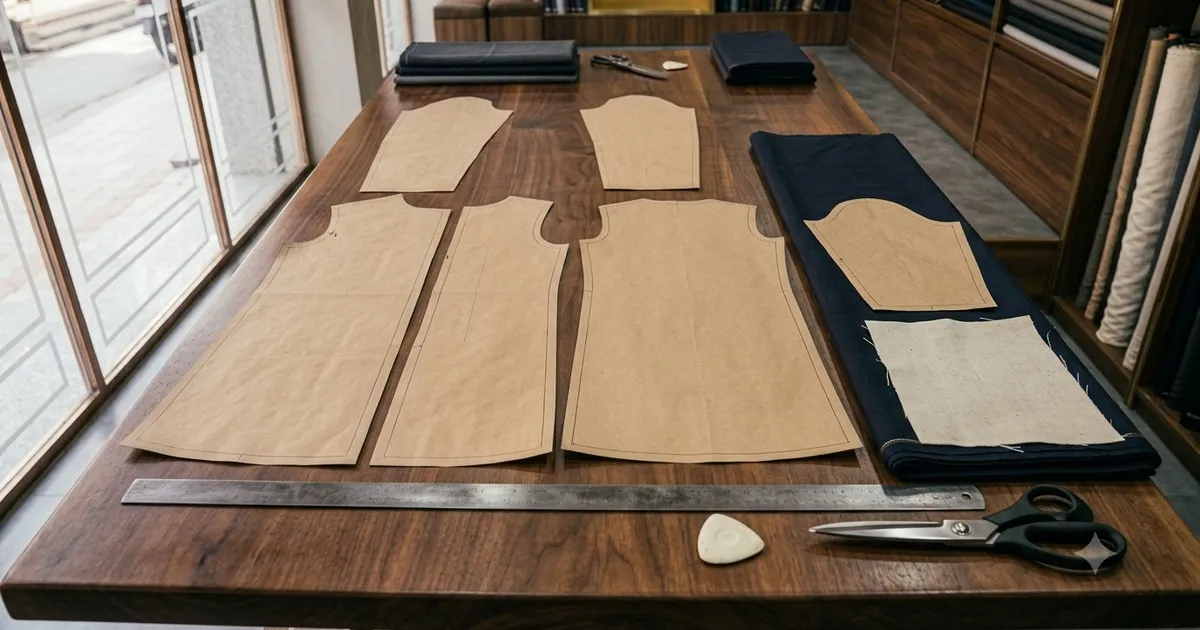
Coat pattern pieces and canvas laid out on a tailoring cutting table with chalk and shears
# | Measurement | Where it is taken | Typical ease |
|---|
1 | Chest | Fullest part of the chest, over a shirt, tape level | 4-6 in |
2 | Waist | Natural waist, tape level | 4-6 in |
3 | Seat | Fullest part of the hip | 4-5 in |
4 | Coat length | Base of the collar down the back to the required hem | as ordered |
5 | Shoulder | Shoulder point to shoulder point across the back | 0 in |
6 | Shoulder slope | Observed: square, normal or sloping | pattern adjustment |
7 | Sleeve length | Shoulder point to wrist bone, arm slightly bent | 0.5 in |
8 | Sleeve round | Fullest part of the upper arm, over a shirt | 3-4 in |
9 | Armhole (scye) | Round the arm through the underarm | 2-3 in |
10 | Cross back | Across the back at about mid-armhole height | 0.5-1 in |
11 | Front chest width | Across the front between the armhole creases | 0.5 in |
12 | Balance | Neck point to waist, front and back separately | see below |
Record the raw figure and the finished figure with ease in separate columns. On a coat the ease is larger than on any other garment, and a single number leaves the next person guessing which one it is.
The Shoulder: The One You Cannot Fix Later
If a coat is going to fail, it usually fails here. Three rules:
Take it across the back, shoulder point to shoulder point, with the tape following the curve of the body rather than pulled straight.
Add no ease. Shoulder is one of the very few measurements cut to the body figure.
Note the slope as well as the width. Two men with an eighteen-inch shoulder can need completely different shoulder seams.
Sloping shoulders need the seam angled more steeply or the coat collapses into folds under the collar. Square shoulders need the opposite, or the coat lifts away from the neck. This is not a measurement you can take from a size chart, and it is the reason a retail blazer never quite fits.
Balance: The Measurement Most Shops Never Take
Balance is the relationship between the front length and the back length, measured from the neck point to the waist on each side.
A man who stands upright with a straight back needs a different balance from one who stands with a forward head or a rounded upper back — and most men over fifty are the second kind.
If the back is short, the coat rides up at the back neck and collars away.
If the front is short, the coat swings open and the lapels will not sit flat.
If both are taken and the pattern is adjusted, the coat hangs correctly on a body that is not a mannequin.
Take it once on every coat customer. It costs a minute and it is the difference between a coat that fits and a coat that merely measures correctly.
What Canvas and Lining Change in the Pattern
A coat pattern is not just the outer shell. The inner structure has its own pieces and its own allowances:
Layer | What it does | What it changes in the pattern |
|---|
Canvas / chest piece | Holds the chest and lapel shape | Its own pattern piece, shaped to the front |
Interlining (fusible) | Stiffens facings, hems and edges | Cut slightly smaller so it does not show |
Shoulder pad | Sets the shoulder line | Its thickness must be allowed for in the armhole height |
Sleeve head roll | Keeps the sleeve head smooth | Small piece, easily forgotten |
Lining | Lets the coat slide on and off | Cut with a pleat at the back for movement |
Facings | Finish the lapel and front edge | Separate pieces, cut with the grain of the lapel roll |
Budget cloth for all of it. A coat quoted on the outer fabric alone is a coat quoted at a loss.
The Pieces a Coat Draft Produces
Front, with the dart and pocket positions
Side body panel
Back, in two halves with the centre seam
Upper and under sleeve
Collar and under-collar
Lapel facing
Pocket welts, flaps and bags
Canvas, interlining and lining pieces for each of the above
That is why a coat drafted by hand takes an afternoon. It is also why re-drafting the same standard coat for every order is the most expensive habit in a gents tailoring shop.
Four Mistakes Behind Most Coat Re-Cuts
1. Chest Measured Over a Sweater
It reads two inches large and the coat comes out loose everywhere. Measure over a shirt, and note on the order sheet what he was wearing.
2. Shoulder Taken With the Tape Pulled Straight
Pulled straight across, the tape cuts the corner and reads short. Let it follow the curve of the upper back.
3. Slope Ignored Because the Width Matched
Width and slope are two different facts about the same shoulder. Recording only the width is why two customers with the same figure get two different results.
4. Armhole Cut Small to Look Neat
A tight armhole looks elegant on the hanger and pulls the whole coat sideways when he raises his arm. It cannot be let out once the canvas is in.
Blazer, Suit Coat and Bandhgala
Style | What is different | Pattern effect |
|---|
Blazer | Worn open, softer construction | Lighter canvas, sometimes half-canvas only |
Suit coat | Matched to trousers, worn buttoned | Fuller canvas; balance matters most here |
Bandhgala / Jodhpuri | Closed high collar, no lapel | Collar drafted as a stand; front cut higher and straighter |
Nehru jacket | Closed collar, no lining in lighter versions | Simpler draft, but the collar stand is unforgiving |
Sherwani | Long, flared below the waist | Length and flare drafted separately from the bodice |
The twelve measurements are the same across all of them. What changes is the collar, the canvas and the length — which is exactly the part worth storing rather than redrawing.
What Changes When the Coat Is Drafted on a Computer
Fashion Dot launched India’s first computerised gents-wear cutting software in 2012 and has refined it since with feedback from more than 11,000 tailors and boutiques, building tailoring technology from Coimbatore since 2003.
The twelve measurements do not change. What changes is what happens after them:
Every piece — shell, canvas, interlining, lining, facings — is drafted together rather than one at a time.
Shoulder slope and balance are applied as pattern adjustments instead of being carried in someone’s memory.
The same customer’s coat next year starts from his stored pattern, not from a blank sheet.
An afternoon of drafting becomes minutes, which is the largest single time saving in gents work.
The pattern prints full scale on 15-inch continuous roll paper, ready to lay on the cloth.
The gents module, including coat and blazer, is described on the gents tailoring software page.
Plans and what each one includes are on the tailoring CAD software price page.
Questions Gents Tailors Ask
How many measurements are needed for a coat?
Twelve for a standard coat or blazer. A bandhgala needs the collar stand height as well, and a sherwani needs the flare and the lower length separately.
How much ease should be added at the chest?
Four to six inches over a shirt, depending on how he wears it. Below four the coat will not button comfortably when he sits.
Can a shoulder be altered after stitching?
Not properly. Narrowing a shoulder means re-setting the sleeve and re-shaping the canvas, which usually costs more than the coat is worth. This is why the shoulder is taken twice before cutting.
What is balance and do I really need it?
It is the front length against the back length from the neck point. You need it on any customer who does not stand perfectly upright, which is most of them.
Why do two coats cut from the same measurements hang differently?
Usually because the shoulder slope or the balance was applied from memory on one and not the other. Both are pattern adjustments, and both are lost unless they are written down or stored.
Is a blazer easier to cut than a suit coat?
Slightly. The construction is softer and it is worn open, so balance is a little more forgiving. The shoulder rule is exactly the same.
With pattern making software, these same measurements produce a ready-to-cut pattern in under a minute.
See a Coat Pattern Drafted From Your Own Measurements
The quickest way to judge whether CAD is worth it in a gents shop is to watch a full coat draft — shell, canvas and lining — come off the printer from measurements you brought yourself.
Book a free demo and bring the measurements of a customer whose coat gave you trouble. On-site or online, in your language, with no commitment.