Fabric Cutting Machine Price in India: 2026 Buyer's Guide
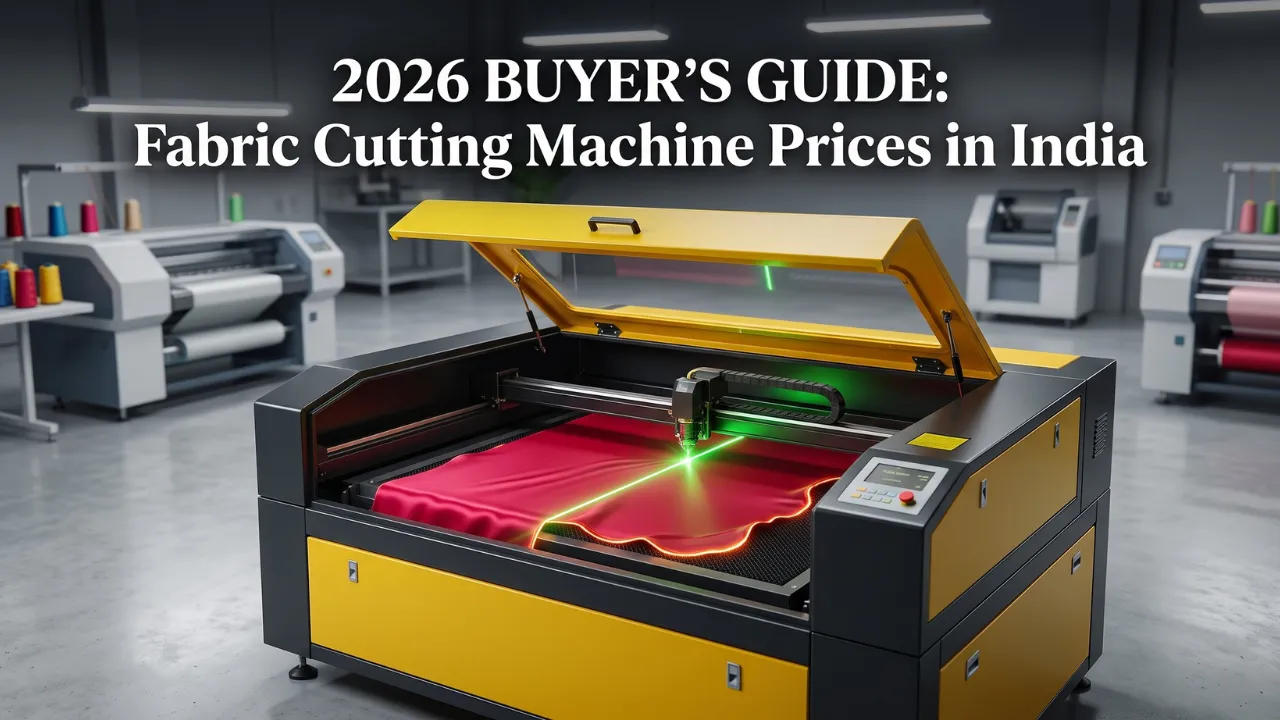
"How much does a fabric cutting machine cost?" is the very first question every modern tailor, boutique owner, and garment manufacturer asks when looking to upgrade their workshop. But the honest answer is: it depends entirely on what you cut, how complex your patterns are, and your daily production volume.
With fabric cutting software, the pieces are laid out to waste as little cloth as possible before a single cut is made.
Instead of looking for a single, generic figure, smart business owners look to understand the underlying price drivers, operational requirements, and, most importantly, the return on investment (ROI). In 2026, the Indian apparel market has become incredibly competitive; relying on traditional manual chalking and hand scissors is no longer viable for shops that want to scale. This comprehensive guide breaks down everything you need to know about purchasing a fabric cutting machine price in India today
Key Cost Drivers: What Affects the Price?
When reviewing quotes for automated cutting systems, you will notice significant variance. Three core factors move the pricing needle in the Indian market:
- Machine Technology Type: The technical architecture is the single largest price differentiator. A pattern plotter/printer setup that generates hard stencils operates at a completely different price ecosystem compared to a state-of-the-art CNC CO2 laser cutting machine that directly processes raw textiles.
- Cutting Size and Bed Width: The working area of the machine defines its price. A compact unit built for standard 1-meter blouse layouts (blouse cutting machine specifications) costs far less than an industrial wide-bed system designed to handle full 1.6-meter or wider fabric rolls for bulk lehengas, kurtis, and Western wear.
- Bundled CAD Software & After-Sales Support: Hardware is only as good as the software driving it. Premium packages include automated nesting software (which rearranges patterns to minimize fabric waste), multi-city technical support contracts, and comprehensive training programs for your master tailors.
Plotting vs. Laser: Cost & Technical Comparison
Choosing between a standard pattern plotter and a heavy-duty laser cutter determines both your upfront capital expenditure and your daily workflow structure.
1. Pattern Plotters & Sample Printers (The Low-to-Mid Cost Tier)
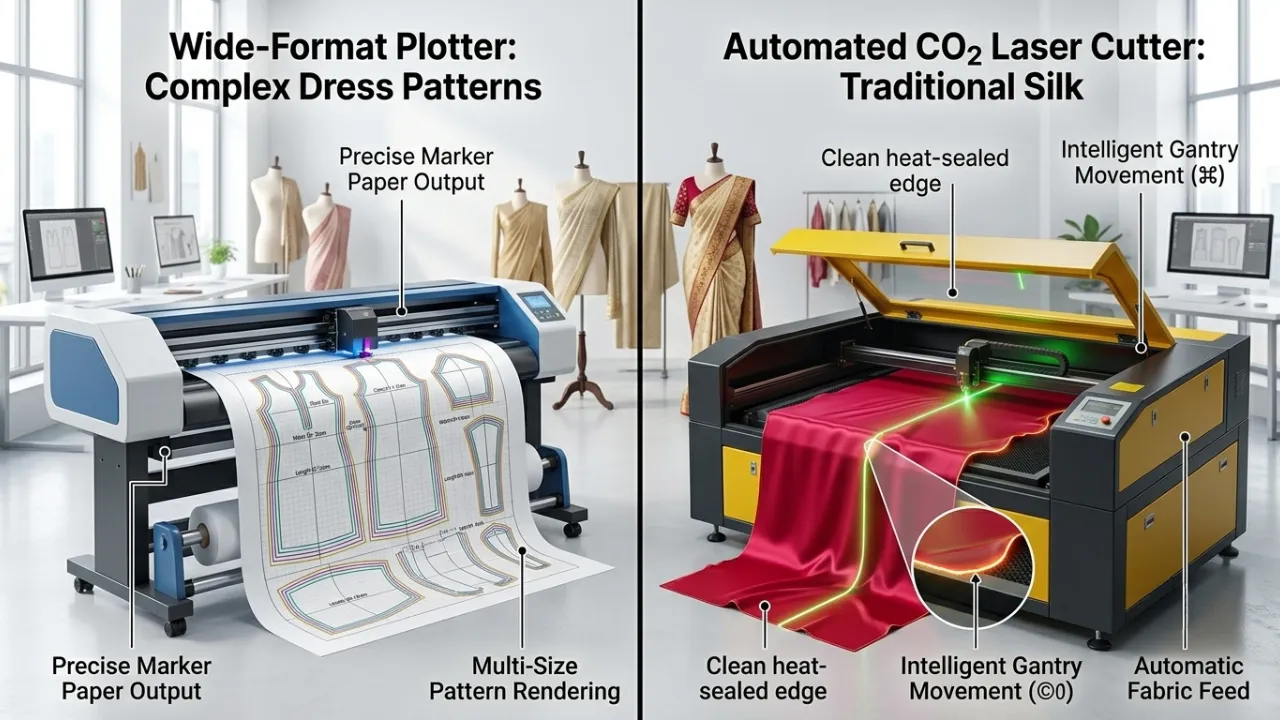
A pattern plotter does not cut the fabric directly. Instead, it digitizes your master patterns and prints them with millimeter precision onto marker paper. The master tailor then overlays this paper onto the fabric layer and cuts the fabric manually using standard mechanical shears or round-knife machines. This setup is highly affordable and represents an ideal stepping stone for traditional boutique setups transitioning away from manual hand-chalking. Looking at the entry-level pattern cutting machine segment, this provides a highly reliable starting point.
2. CNC Laser Cutting Systems (The Premium High-Volume Tier)
A fabric laser cutter completely eliminates the need for manual cutting or paper markers. The computer-controlled laser beam slices directly through single or multiple layers of fabric instantly. Because it cuts using heat, it fuses and seals the raw edges of synthetic fabrics, silks, and polyesters, completely preventing fraying. This technology is indispensable for boutiques handling delicate bridal wear, intricate designer blouses, or high-volume custom orders every day. Naturally, this pushes the laser cutting machine price into a premium tier, but the operational savings are unmatched.
Market Reference Price Guidelines (2026 Estimates)
Machine Category | Estimated Price Range (INR) | Best Suited For | Key Advantage |
|---|
Entry-Level Pattern Plotter | ₹1,50,000 – ₹3,50,000 | Small custom tailoring shops, independent boutique designers. | Lowest entry cost; perfectly replaces manual master chalking. |
|---|
Industrial Wide-Bed Plotter | ₹3,50,000 – ₹6,00,000 | Medium-sized domestic apparel brands, multi-tailor workshops. | Handles full-width commercial fabric layouts with high accuracy. |
|---|
Compact Boutique Laser Cutter | ₹4,50,000 – ₹8,50,000 | Premium bridal boutiques, specialized blouse & lehenga workshops. | Cuts fabric directly, zero edge fraying, perfect for intricate curves. |
|---|
High-Speed Industrial Laser System | ₹8,50,000 – ₹15,00,000+ | Export houses, large-scale garment mass manufacturers. | Continuous high-volume multi-layer cutting with maximum fabric yield. |
|---|
Note: The prices listed above are market indicators for 2026 and vary depending on customizations, local taxes, software inclusions, and specialized configurations. To understand how these numbers translate to your workspace, looking at a comprehensive fabric cutting machine cost analysis is key.
Understanding the Long-Term Running Costs
Upfront machinery purchase cost is only one part of the equation. To keep your tailoring business highly profitable, you must account for daily operating expenses:
- For Plotters: Ongoing operational costs include high-yield ink cartridges and specialized marker paper rolls.
- For Laser Cutters: The operational cost shifts to moderate electricity consumption, standard exhaust ventilation systems, and periodic maintenance of the high-precision optical lenses and laser tubes.
The Silk Security Rule
While these minor expenses exist, they are remarkably negligible when weighed against the massive fabric and labor savings. For instance, consider premium Indian textiles like pure Banarasi silk or Kanjeevaram brocades. A single human error or a slight slip of hand shears can ruin thousands of rupees of fabric instantly. By avoiding just one major mis-cut per month, the machine completely neutralizes its own monthly running costs, proving that the modern fabric cutting machine price in India is an investment that safeguards your inventory.
The Real Question: What is Your Real Payback Period?
Experienced business owners never look at technology as a static expense; they look at it through the lens of operational amortization. The real question isn't "What does it cost?" but rather "How fast does it pay itself back in my daily operations?"
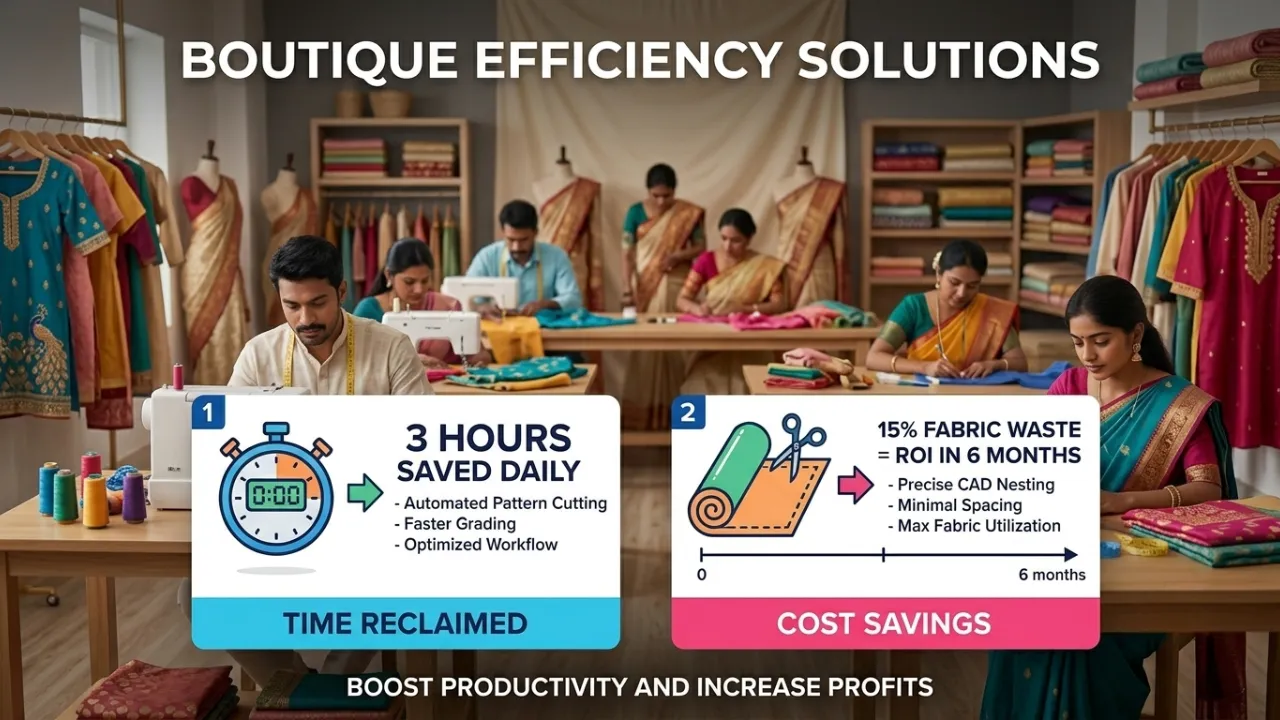
In a typical busy Indian tailoring shop or designer boutique, an automated cutting setup consistently saves between 2 to 3 hours of grueling manual cutting work every single day. Furthermore, advanced digital pattern nesting reduces raw fabric wastage by 10% to 15% across all production cycles.
When you add up the saved hours of master tailor labor, the near-zero rejection rates, and the substantial savings from textile scraps, a high-quality machine typically pays for itself completely within a matter of months. Beyond pure financials, it gives your shop the capacity to fulfill bulk festival orders (like Diwali or wedding season rushes) with zero delivery delays, exponentially increasing customer loyalty.
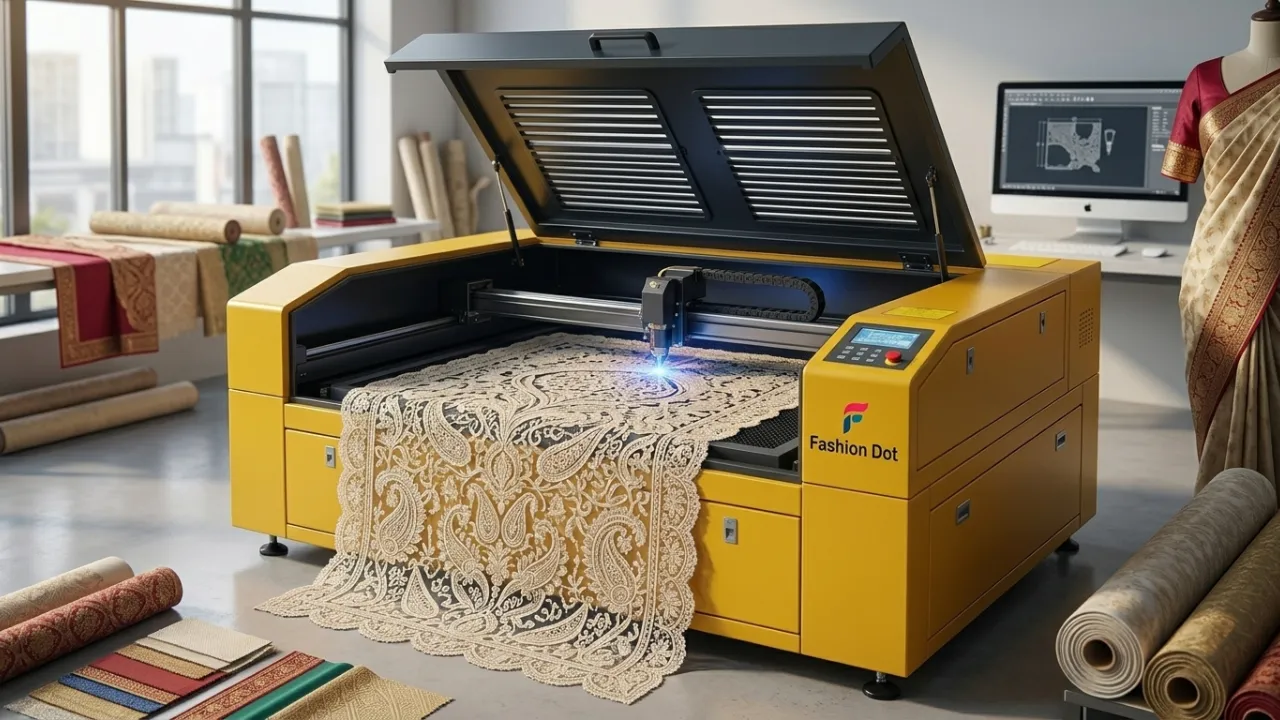
For blouse work in volume, a laser blouse cutting machine cuts several layers at once with clean, sealed edges.
Get an Accurate Custom Quote with Fashion Dot
Your ideal machinery configuration depends heavily on your specific order volume, fabric preferences, and spatial floor constraints. The technical team at Fashion Dot does not believe in a one-size-fits-all approach. We take the time to evaluate your workspace and production goals to recommend either a precision pattern plotter or a direct laser cutting machine tailored explicitly to your commercial budget.
Moreover, with our extensive network of 5 fully-equipped service branches across India, you are always assured of rapid technical support, on-site operator training, and readily available genuine spare parts, ensuring your production line never faces unexpected downtime.
Experience the Complete Fashion Dot Ecosystem
Want to see how your own custom designs and signature fabrics behave under high-precision automation? Fashion Dot offers India's most trusted end-to-end apparel ecosystem—combining proprietary CAD pattern design software, heavy-duty pattern printers, high-speed plotters, digital pattern projectors, and automated laser cutting machinery. Trusted by over 10,000+ modern tailors and premium designers across India since 2003.
👉 Book Your Free Live Demo Now