A churidar looks like the simplest thing in the shop. It is a tight bottom with a few folds at the ankle. Then the first one comes back because the customer could not get her foot through, the second one comes back because the folds sat at the calf instead of above the foot, and the third one comes back because the leg pulls every time she sits down.
None of those are stitching faults. All three are measurement faults, and all three happen at the cutting table. A churidar has a smaller margin for error than almost any other garment an Indian tailor cuts, because it is fitted along its whole length and it still has to pass over a heel that is wider than the ankle it finally sits on.
This is the full measurement list, the ease to add at each point, the extra length that makes the churi, and the four mistakes that send most churidars back for re-cutting.
Churidar, Salwar and Patiala Are Three Different Drafts
Customers use all three words for the bottom half of a suit. They are not the same garment and they do not share a pattern. Confirm which one she means before you write a single measurement down.
Churidar
Fitted from waist to ankle and cut longer than the leg on purpose, so the extra length collects into ring-like folds above the foot. Those rings are the churi, and they are the whole point of the garment. It is close-fitting, so every round measurement matters.
Salwar
Loose from the waist to below the knee, then tapered into a fixed ankle cuff called the mohri. The fullness is taken in with pleats or gathers at the waist. Thigh and knee measurements barely matter because the leg is not fitted there. The mohri width does.
Patiala
A salwar with far more fullness, carried in deep pleats falling from the waist. It takes the most cloth of the three, and the pleat depth rather than the body measurement decides how much.
A churidar bottom is normally paired with a kameez or kurti on top, and that top is a separate draft with its own sheet.
If you are cutting the full suit, take the top measurements from the kurti cutting measurement chart and keep both sheets together under the same order number.
The 12 Measurements Every Churidar Needs
Take every round measurement with the tape snug but not pulled, over the undergarments the customer will actually wear. Ease is what you add to the body measurement before drafting.
# | Measurement | Where it is taken | Typical ease |
|---|
1 | Waist | Round the natural waist, where the naada or elastic will sit | 0 to 1/2 inch |
2 | Hip (seat) | Round the fullest part of the seat, feet together | 1 to 2 inches |
3 | Waist to hip | Straight down from the waist to the fullest seat point | Nil |
4 | Crotch depth (rise) | Seated on a hard chair, waist down to the seat | 1/2 inch |
5 | Thigh round | Round the fullest part of the upper thigh | 1 to 1.5 inches |
6 | Knee round | Round the knee cap, leg straight | 1 inch |
7 | Calf round | Round the fullest part of the calf | 3/4 to 1 inch |
8 | Ankle / instep | Diagonally over the instep and round the heel, foot flexed | 1/2 to 1 inch |
9 | Inseam | Crotch point down to the ankle bone | Nil |
10 | Full length | Waist down the outside of the leg to the ankle bone | Nil |
11 | Churi extra | Added below the knee only, to form the folds | 6 to 9 inches |
12 | Waistband width | Finished naada casing or elastic width | 1 to 1.5 inches |
The Extra Length That Makes the Churi
The folds at the ankle are not a stitching trick. They are surplus length with nowhere to go, so it stacks into rings. Six inches of extra length gives a light, modern three or four ring finish. Nine inches gives the deep traditional stack that a festive or bridal churidar is expected to have.
Where you add it decides whether it looks right. The extra length belongs below the knee. If you add it to the total length at the waist end, the seat drops, the crotch hangs low and the folds begin somewhere near the calf instead of above the foot. Draft the leg to the true inseam first, then extend only the section below the knee by the churi allowance.
Write the churi extra on the sheet as its own number. It is the measurement most likely to be remembered wrongly when the same customer orders again.
Why a Churidar Is Cut on the Bias
A churidar is traditionally cut at 45 degrees to the grain. Woven cloth has almost no stretch along the warp or the weft, but it gives freely on the diagonal. That give is what lets a fitted leg bend at the knee, sit down, and still form even folds instead of hard creases.
Bias also changes your cloth calculation. A bias-cut leg will not nest the way a straight-grain leg does, so the same garment needs noticeably more cloth. Plan for that before you cut, not after.
If the fabric is a cotton lycra or any knit with stretch of its own, straight grain is acceptable and saves cloth. For plain cotton, silk or crepe, bias is what separates a churidar that moves from one that pulls.
The Ankle Measurement Is Really a Heel Measurement
This is the one that sends churidars back most often. The ankle is narrow, but the foot has to pass through it, and the widest part of that journey is the heel and instep, not the ankle bone.
Take the tape diagonally across the instep and round the back of the heel with the foot flexed, and treat that figure as your minimum opening. A bias-cut leg will stretch to let the foot through and settle back afterwards. A straight-grain leg will not, so give straight-grain churidars the full instep measurement with no reduction.
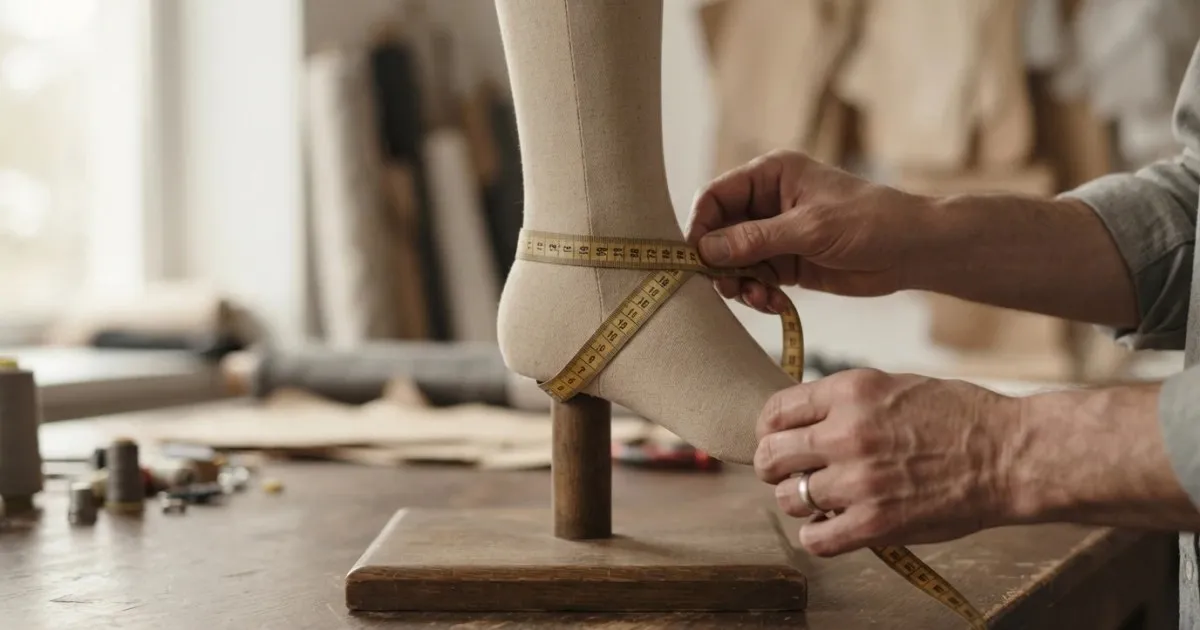
If the customer wants the ankle visibly tighter than her instep, the garment needs a side zip or a placket. There is no measurement that gives you both.
Standard Churidar Size Chart (Ready Reference)
Use this for stock cutting, sample sets and bulk orders where individual measurements are not available. For a named customer, always take the body measurements.
Size | Waist | Hip | Thigh | Knee | Ankle / instep | Length |
|---|
S | 26-28 in | 34-36 in | 20 in | 13 in | 9 in | 38 in |
M | 30-32 in | 38-40 in | 22 in | 14 in | 9.5 in | 39 in |
L | 34-36 in | 42-44 in | 24 in | 15 in | 10 in | 40 in |
XL | 38-40 in | 46-48 in | 26 in | 16 in | 10.5 in | 40 in |
XXL | 42-44 in | 50-52 in | 28 in | 17 in | 11 in | 41 in |
Length here is the finished waist-to-ankle figure. The churi extra is added on top of it.
Cloth Needed for a Churidar
These are typical single-garment figures for an average adult size on plain cloth with no border and no one-way print. A border, a large repeat or a directional print pushes every figure up.
Style | Fabric width | Typical cloth needed |
|---|
Churidar, bias cut | 36 inch | 2.75 metres |
Churidar, bias cut | 44 inch | 2.25 metres |
Churidar, straight grain or lycra | 44 inch | 2 metres |
Salwar with mohri | 44 inch | 2.25 metres |
Patiala | 44 inch | 3 to 3.5 metres |
The Four Mistakes That Cause Most Re-Cutting
1. The Ankle Was Measured Flat
The tape went round the ankle bone with the foot relaxed, so the finished opening is smaller than the heel. The garment is stitched correctly and the customer still cannot put it on. Measure over the instep and heel with the foot flexed, every time.
2. The Churi Extra Went In at the Waist
The total length was increased instead of the below-knee section. The crotch drops, the seat sags and the folds form halfway up the calf. Draft to the true inseam first, then extend below the knee.
3. It Was Cut on Straight Grain When It Should Have Been Bias
The leg has no give, so the folds crush into hard creases instead of soft rings and the calf pulls the moment the customer sits. The fabric was fine. The grain direction was not.
4. The Same Length Was Used for Cotton and for Lycra
A cotton churidar relaxes and drops slightly after the first wash. A lycra one recovers upward. Copying last year's length from a different fabric is how a customer ends up with a churidar an inch short. Record the fabric next to the length on the sheet.
The Pieces a Churidar Pattern Produces
A complete churidar draft produces five pieces, and two of them are the ones most often forgotten.
Front leg and back leg are the obvious pair. The back leg is cut wider through the seat and thigh than the front, and the two are never interchangeable even though they look similar lying on the table.
The diamond gusset sits at the crotch. It is the traditional churidar piece that carries the strain when the customer sits or steps up, and a churidar drafted without it splits at the crotch seam far sooner.
The naada casing or waistband finishes the waist, and an ankle facing is added on fine or transparent fabric so the last ring of the churi holds its shape.
On bias-cut churidars each leg is often cut in two sections joined at the back seam. That is not extra work for its own sake. It is how you keep a true 45 degree grain on a leg that is longer than the usable width of the cloth.
What Changes When the Churidar Is Drafted on a Computer
Everything above is the same whether you draft with chalk or with software. What changes is what happens after the measurements are written down.
A churidar drafted on CAD holds the grain line as part of the pattern, so the 45 degree bias is not something the cutter has to remember at the table. The churi extra becomes a parameter rather than a guess, so a six inch and a nine inch version of the same customer's churidar are two clicks apart instead of two fresh drafts.
The measurement sheet stays attached to the customer. When she orders a second suit six months later, the draft is already there with her instep and her churi extra recorded next to the fabric they were cut for.
Nesting is where bias cutting pays for itself. Laying bias legs by hand wastes cloth because the pieces will not sit square, and pattern making software can fit them into the width automatically and print or cut the marker at full size.
Good Churidar Cutting Starts With the Measurement Sheet
A churidar is unforgiving because it is fitted everywhere and it still has to get past a heel. No amount of stitching skill rescues a leg cut two inches short in the instep, or a churi allowance added at the wrong end of the leg.
Take the twelve measurements, add the ease listed against each one, write the churi extra and the fabric as separate lines, and confirm whether she means a churidar, a salwar or a patiala before the scissors touch the cloth. That sheet, filled in properly, prevents almost every re-cut described in this article.
Frequently Asked Questions
How many measurements are needed for a churidar?
Twelve: waist, hip, waist to hip, crotch depth, thigh, knee, calf, ankle or instep, inseam, full length, churi extra and waistband width. Skipping the instep and the churi extra is what causes most re-cutting.
How much extra length is added for the churi folds?
Six to nine inches, added below the knee only. Six inches gives a light three or four ring finish. Nine inches gives the deep traditional stack used on festive and bridal wear.
Why is a churidar cut on the bias?
Woven cloth stretches on the diagonal but not along the grain. A 45 degree cut lets a fitted leg bend, sit and form even folds. Knits and cotton lycra have stretch of their own and can be cut on straight grain to save cloth.
How much cloth does a churidar need?
About 2.25 metres on 44 inch cloth when cut on the bias, or 2 metres on straight grain or lycra. On 36 inch cloth a bias-cut churidar needs roughly 2.75 metres. Borders and one-way prints add to all of these.
What is the difference between a churidar and a salwar?
A churidar is fitted the whole way down and cut long so the surplus forms rings at the ankle. A salwar is loose to below the knee and tapers into a fixed cuff called the mohri. They are different drafts and different cloth quantities.
Cut Churidars With Fashion Dot CAD
Fashion Dot CAD drafts churidars, salwars and patialas from the measurements on your sheet, holds the bias grain line in the pattern, and nests the pieces to the width of the cloth you actually have. Customer measurements stay saved for the next order. See what it costs on the tailoring CAD software price page.
See a Churidar Drafted From Your Own Measurements
Bring one customer's churidar measurements to a free demo and we will draft it live, print the pattern full size and show you the marker on your own fabric width. Book a free demo at a time that suits your shop.