The blouse fitted perfectly on the day of delivery. Two weeks later the customer is back at the counter: it is tight under the arm, the sleeves have crept up, and the kurti that reached the knee now stops above it. Nothing was cut wrong. The cloth shrank, and it shrank after it was stitched.

Folded white cotton, a printed cotton and a green silk with a gold border on a tailoring table, with a measuring tape beside them
Shrinkage is the one fitting fault a tailor cannot fix after delivery, and the customer always blames the tailor for it. Yet it is the easiest one to prevent: a cloth that is shrunk before it is cut has nothing left to lose.
All it takes is a test, a bucket of water and the habit of doing it every time.
In this guide you will find:
- Why a garment shrinks after it is stitched
- How much each fabric usually shrinks
- How to test a new cloth before you cut it
- How to turn the test into a cutting length
- How to pre-shrink cotton, silk, wool and synthetics
- What to do when the cloth cannot be washed
Why Garments Shrink After Stitching
Four reasons, and only the last one is the customer's doing.
The Cloth Was Stretched at the Mill
Cloth is woven and finished under tension, so the threads are held a little longer than they want to be. The first time it gets wet the threads relax and pull back. This is why most of the shrinkage happens in the first wash, and almost none after the third.
The Cloth Was Never Tested
Two cloths sold as cotton can shrink two percent or eight percent, depending on the weave and the finish. A handloom cotton that has never been washed shrinks far more than a mill poplin. Going by the name on the bill is not enough.
The Lining and the Outer Shrank Differently
A silk blouse with an unwashed cotton lining is two fabrics that behave differently in water. The silk stays put, the lining shrinks, and the blouse puckers at the hem and pulls at the armhole. Every layer that goes into the garment has to be pre-shrunk, not just the outer cloth.
The Garment Was Washed Hot or Dried in the Sun
Hot water, a tumble dryer or hours in strong sun shrink cotton and rayon further. You cannot control the customer's washing, but you can tell them, and write it on the order slip.
How Much Each Fabric Shrinks
These are working figures that most shops see on the first wash; your own test on the actual cloth always wins. Length means along the selvedge, width means across it.
Fabric | Length | Width | How to pre-shrink |
|---|
Handloom cotton | 5 to 8% | 3 to 5% | Soak overnight in plain water, dry in the shade |
Mill cotton, poplin | 2 to 4% | 1 to 3% | Soak one hour, dry in the shade |
Cotton lining | 3 to 5% | 2 to 3% | Soak one hour before cutting, every time |
Linen | 4 to 6% | 3 to 4% | Soak and dry flat |
Rayon, viscose | 3 to 8% | 2 to 4% | Cold soak, do not wring, dry flat |
Silk, pattu | 1 to 3% | About 1% | Steam press through a cloth; do not soak |
Wool, terry wool suiting | 1 to 3% | About 1% | Steam the whole length with a damp cloth |
Polyester, poly-viscose | Under 1% | Under 1% | Usually not needed; press only |
Which cloth suits which garment in the first place is covered in our guide to which fabric for which garment.
How to Test a Cloth Before Cutting
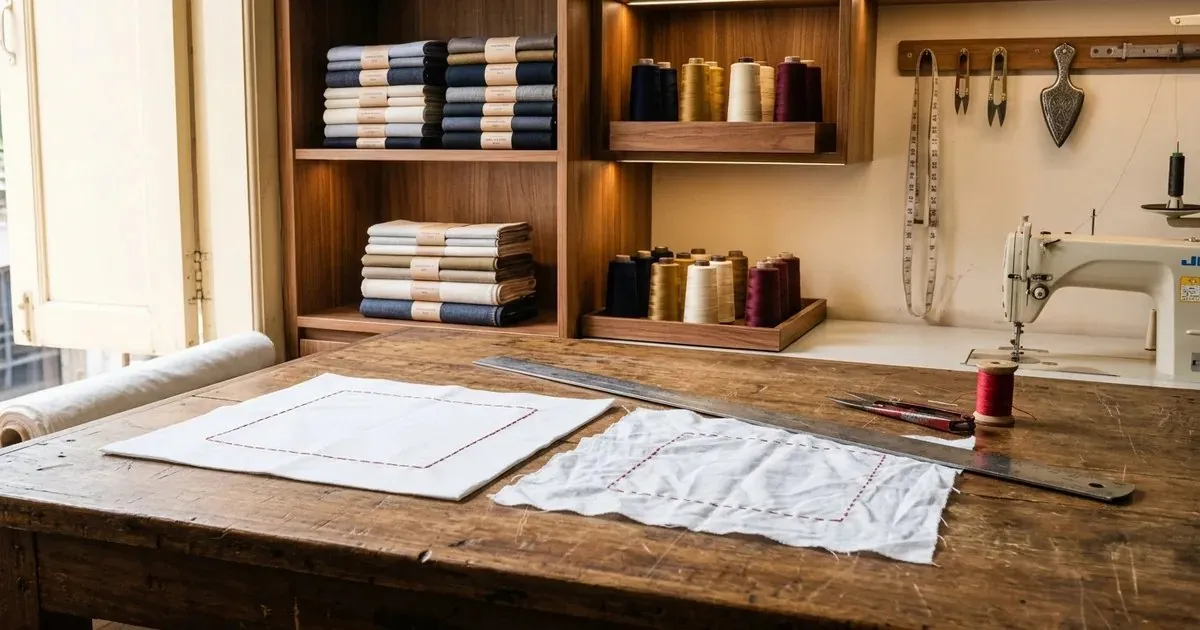
Two cotton test squares outlined in red thread tacking on a cutting table, the washed one visibly smaller, with a steel ruler laid across them
- Cut a piece about 12 inches square from the end of the cloth, on the grain.
- Mark a square exactly 10 by 10 inches on it with thread tacks. Chalk washes out, so use thread.
- Soak it in plain water for an hour, the way the customer will wash it. Squeeze it gently; do not wring.
- Dry it flat in the shade, then press it without stretching.
- Measure the square again, along the length and across the width.
- Every quarter inch lost on 10 inches is 2.5 percent. Write the figure on the cloth tag or in the order book, so the cutter sees it.
Turning the Test Into a Cutting Length
If you cannot pre-shrink the cloth, cut it larger by the tested shrinkage, so that it shrinks to the right size. Divide the finished length by what is left after shrinking; the table does it for two common lengths, rounded to the nearest eighth of an inch:
Lost on a 10-inch square | Shrinkage | Cut length for a 40.00 kurti | Cut length for a 15.00 blouse |
|---|
0.125 | 1.25% | 40.50 | 15.25 |
0.25 | 2.5% | 41.00 | 15.375 |
0.50 | 5% | 42.125 | 15.75 |
0.75 | 7.5% | 43.25 | 16.25 |
1.00 | 10% | 44.50 | 16.625 |
Do the same across the width for the chest, waist and hip, using the width figure from the test. The finished lengths to start from are in our kurti cutting measurement chart.
How to Pre-Shrink Each Fabric
- Cotton and handloom – soak in plain water, overnight for handloom. Do not wring; roll it in a towel, dry it in the shade and press it while slightly damp.
- Cotton lining – the same, and always before cutting. An unwashed lining is the most common reason a lined blouse puckers after the first wash.
- Rayon and viscose – cold water only, and handle it gently, because it is weak when wet. Dry it flat so it does not stretch out of shape.
- Silk and pattu – do not soak. Steam press the length through a damp pressing cloth, and tell the customer it is dry-clean only.
- Wool and terry wool suiting – lay a damp cloth over the length and steam it section by section, then let it dry flat on the table before cutting.
- Zari, embroidered and printed cloth – never soak the whole piece. Test a scrap first; zari can tarnish and some prints run.
- Polyester and poly-viscose – usually stable. A press is enough.
When the Cloth Cannot Be Washed
- Cut it larger by the tested shrinkage, using the table above.
- Leave a wider seam allowance on the side seams so the garment can be let out later. How much to leave on each seam is in our seam allowance guide for tailors.
- Turn a deeper hem on kurtis, pants and skirts so a shrunk length can be let down. Our hem allowance guide gives the depth for each garment.
- Write the care instruction on the order slip: cold wash, dry in the shade, no dryer, or dry-clean only.
- Tell the customer at delivery, not after the complaint. A sentence at the counter saves a remake later.
Shrinkage in Tailoring CAD
In tailoring CAD a shrinkage figure is simply a scale on the pattern. The pieces are drafted to the customer's measurements, then enlarged by the tested percentage along the length and across the width before they are printed. The cutter no longer has to remember to add it, and every piece of the garment is enlarged by the same amount.
Our tailoring CAD software page shows how the pieces are drafted and printed from one set of measurements.
Questions Tailors Ask
Should I wash the cloth before stitching?
Cotton, handloom, linen, rayon and every cotton lining, yes. Silk and wool are steamed instead of soaked, and polyester usually needs only a press.
How much does cotton shrink?
A mill cotton usually shrinks two to four percent in length on the first wash, and a handloom cotton can shrink five to eight percent. Test the actual cloth to be sure.
Does silk shrink?
A little, usually one to three percent, and more if it is washed in hot water. Steam press silk before cutting and advise the customer to dry-clean it.
How do I pre-shrink cloth without washing it?
Lay a damp pressing cloth over it and steam it with a hot iron, section by section, then let it dry flat. This works for wool and silk; for cotton a proper soak is better.
Can a shrunk garment be stretched back?
Only a little. A damp press can recover a small amount in cotton, but it does not last. The reliable fix is to let out the seams and the hem, which is why it pays to leave them wide.
How much extra cloth should the customer bring?
For handloom and other cloth that has not been washed, ask for about ten percent more length than usual. For a mill cotton, five percent is generally enough.
Shrink It Before You Cut It
Shrinkage is the fitting fault that appears after the garment has left the shop. Test every new cloth, soak the cotton and the lining, steam the silk and the wool, and cut what is left. The garment that fits on delivery will still fit after the tenth wash.
Book a free demo – on-site or online, in your language, with no commitment. Bring a garment that shrank after delivery and we will show how the pattern is cut to allow for it.