Pattern Cutting Machine: The 2026 Guide for Tailors & Boutiques
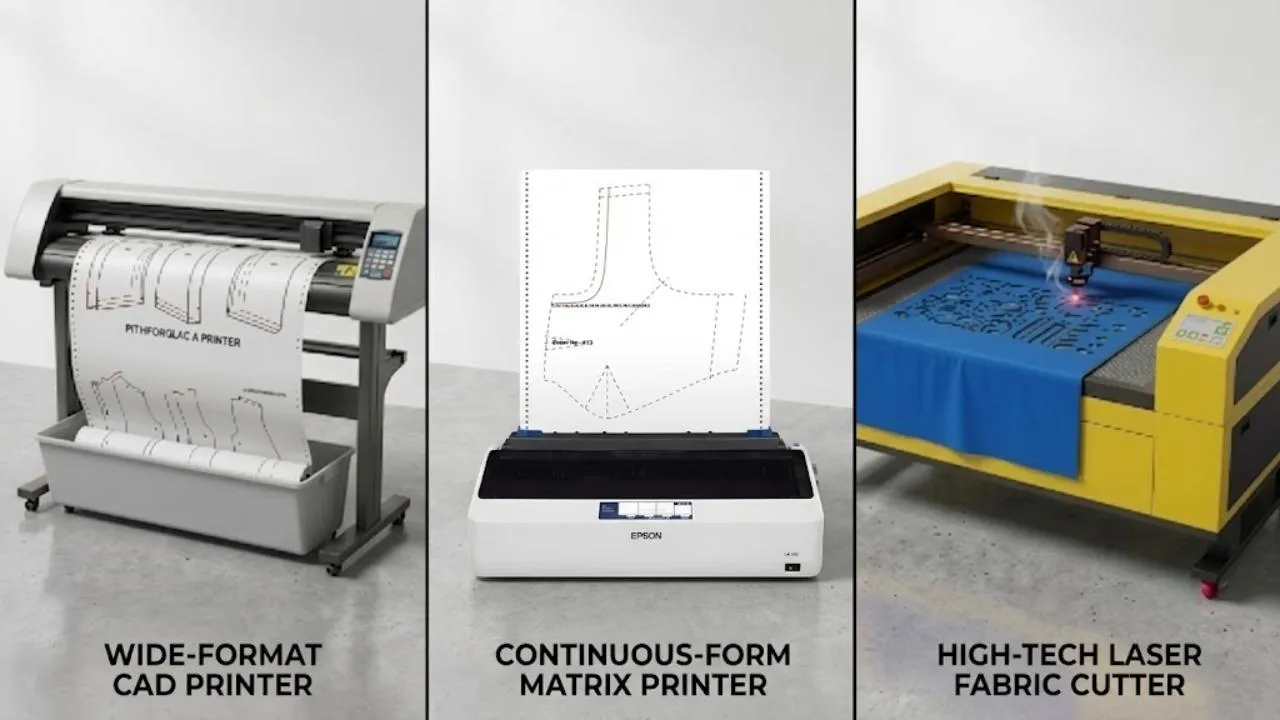
A pattern cutting machine turns a digital pattern into something you can actually stitch — either paper to cut around, or fabric cut and ready. In 2026 there are three practical types for Indian tailors and boutiques. Here is what each does, and how to pick.
Type 1: CAD Pattern Printer
Prints the graded pattern on plain paper at full size. Affordable, compact, and perfect for shops that want exact patterns but are happy to scissor-cut. Pair it with drafting software and the cutting master's drawing time drops to zero.
Type 2: Pattern Plotter
Handles bigger, continuous patterns — chudidhar tops, kurtis, gowns and gents wear — on wide paper rolls. The workhorse for boutiques producing many mixed garments a day. Check the roll width and plotting speed against your largest patterns.
Type 3: Laser Cutting Machine
Skips paper entirely: the machine cuts the fabric itself, straight from the software, with a clean sealed edge that never frays. Fastest of the three and the only one that removes manual cutting completely. Check bed size, speed, and whether the software supports your garment types.Specs That Actually Matter
Bed or roll width (can it fit your biggest pattern in one piece?), speed at your daily volume, software included — pattern drafting from measurements is the heart of the system — plus training and Indian service support. A cheap machine with no garment software or nearby service costs more within a year.
Which One for Your Shop?
Small shop, mostly blouses: pattern printer or projector. Busy boutique with mixed garments: plotter. High daily volume, costly silks, no cutting master: laser. Fashion Dot supplies all three — driven by the same software — so you can start small and upgrade without changing systems.
Which Machine Fits Which Shop
The right machine follows from how many garments leave the shop each week and how many different people cut them, not from the size of the premises.
| Your situation | Sensible choice |
|---|
| A few garments a week, one cutter | CAD pattern printer on plain paper |
| Mixed blouse, chudidhar and kurti work daily | Pattern plotter on roll paper |
| Repeat customers expecting the same fit | Printer or plotter, with measurements stored per customer |
| Uniform or bulk orders | Plotter, moving to laser as volume grows |
| Heavy embroidery and net work | Laser, for the sealed edge that will not fray |
| New staff who cannot draft by hand | Any of the three — the skill becomes measuring, not drafting |
What to Check Before You Buy
- Paper width. Continuous roll paper is normally 15 inches. Check it against your largest pattern piece, not your average one.
- Speed under real load. A quoted speed is for a simple outline. Ask to see your own busiest pattern printed.
- Software included or separate. A machine without drafting software behind it is only half a system.
- Consumables. Paper, ink or laser tube life decide the running cost more than the purchase price does.
- Who services it. Find out where the nearest engineer is before you need one.
- Upgrade path. Can you start with a printer and move to a plotter or laser without changing the software?
The Running Costs People Forget
The purchase price is the part everyone compares. These are the numbers that decide what the machine actually costs over three years:
- Roll paper, bought by the box rather than the roll.
- Ink or toner for a printer; tube replacement for a laser.
- Power draw, which matters for a laser running most of the day.
- Annual support or software renewal, if it is not one-time.
- Floor space and ventilation, which a laser needs and a printer does not.
Frequently Asked Questions
Can an ordinary A4 printer be used instead?
Only by printing a pattern in segments and taping them together, which reintroduces exactly the inaccuracy the machine is meant to remove. It is workable for testing, not for daily production.
Does a laser cutter replace the plotter completely?
For fabric, yes. Many shops still keep a printer for paper patterns they want to check or file before cutting expensive cloth.
How long does a pattern take to print?
A single blouse pattern prints in a few minutes on a plotter. The time that disappears is the drafting, not the printing.
Will it work with the patterns I already have?
Hand-drawn patterns have to be entered once. After that they are stored and reprinted, so it is a one-time job rather than a repeated one.
What space does each type need?
A pattern printer sits on a table. A plotter needs a dedicated stand and clear space for the paper to feed. A laser needs a fixed position, power and extraction.
Not sure which machine fits your volume? Fashion Dot gives you the full ecosystem — software, pattern printer, plotter, projector and laser cutting machine — trusted by 11,000+ tailors across India since 2003. Book a free demo → https://www.fashiondot.in/book-demo |
|---|