A petticoat is the garment nobody compliments and everybody notices when it is wrong. A ridge across the hip under a soft silk saree, a hem that sweeps the floor, a waist that has to be folded over twice before the saree will sit flat: none of those are stitching faults, and all of them come back to the shop.
It is also the garment most often cut from memory. The customer has ordered petticoats before, the tailor knows her size, and nobody writes anything down. Then she brings a georgette saree instead of a cotton one, or a pair of heels instead of flats, and the same measurements produce a petticoat that does not work.
This is the full measurement list for a saree petticoat, the three shapes and when each one is right, how many kalis a flared petticoat needs, the cloth each style takes, and the four mistakes that cause most re-cutting.
Three Petticoat Shapes, Three Different Drafts
Ask which saree the petticoat is for before you take a single measurement. The fabric of the saree decides the shape of the petticoat under it.
Plain or Straight Cut
Cut in six panels, close through the hip and falling almost straight to the hem with a small amount of flare. It uses the least cloth and sits flattest under a heavy saree such as Kanjivaram or a thick cotton, where the saree itself provides the fall.
Umbrella or Kali Cut
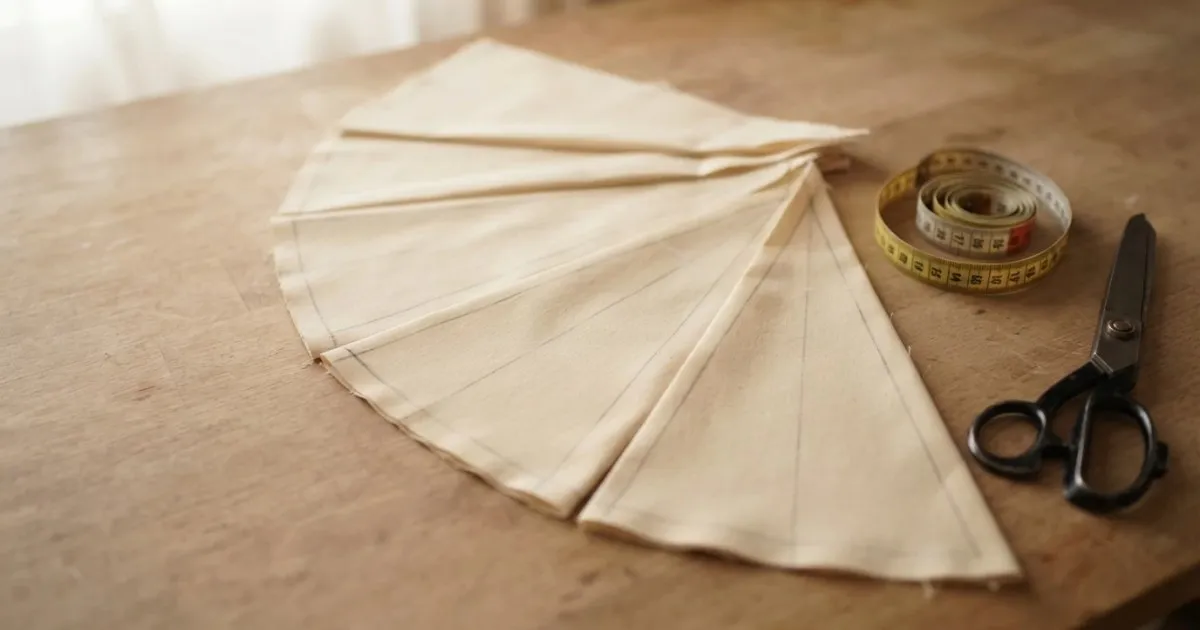
Cut in kalis, each one narrow at the waist and wide at the hem, so the petticoat flares evenly all the way round without any gathering at the waist. This is the shape for georgette, chiffon, crepe and any soft saree that needs support underneath to hold its drape.
Mermaid or Fish Cut
Fitted through the hip and thigh down to around the knee, then flared sharply to the hem. It is a party and wedding shape worn under light sarees. It needs two measurements the other two shapes do not, and it is the least forgiving of a wrong hip measurement.
The blouse is cut from a separate sheet with its own measurements.
If you are cutting the full set, take the upper body measurements from the blouse cutting measurement chart and keep both sheets under the same order number.
The 9 Measurements Every Petticoat Needs
Take the round measurements with the tape snug but not pulled. Ease is what you add to the body measurement before drafting. The last two rows are needed only for a mermaid cut.
# | Measurement | Where it is taken | Typical ease |
|---|
1 | Waist (tie line) | Where the saree will actually be tied, usually below the navel, not the natural waist | 0 to 1/2 inch |
2 | Hip | Round the fullest part of the seat, feet together | 1 to 2 inches |
3 | Waist to hip | Straight down from the tie line to the fullest hip point | Nil |
4 | Full length | Tie line to the floor, standing in the footwear she will wear | Nil |
5 | Hem sweep | Finished circumference at the hem, set by the style | By style |
6 | Waistband width | Finished naada casing or elastic width | 1 to 1.5 inches |
7 | Hem allowance | Turn-up at the bottom edge | 2 to 3 inches |
8 | Thigh round (mermaid) | Round the fullest part of the upper thigh | 2 inches |
9 | Knee round (mermaid) | Round the knee, where the flare begins | 2 inches |
Length Is Measured From the Tie Line, Not the Natural Waist
This is the single most common petticoat fault. The tape starts at the narrowest part of the waist, but a saree is tied lower than that, often two to three inches below the navel. Measure from the natural waist and the finished petticoat is two to three inches too long, so it sits on the floor and frays at the back within a month.
Ask the customer to stand as she would with the saree on, put the tape where the petticoat cord will sit, and measure from there to the floor.
Footwear matters as much as the tie line. A petticoat measured barefoot and worn with two inch heels is short enough to show the ankle through the saree fall. Take the length with the shoes she will actually wear, or add the heel height and write it on the sheet.
Cotton petticoats shrink. If the cloth has not been pre-washed, add half an inch to the length and say so on the sheet so nobody treats it as a measuring error later.
How Many Kalis, and How Wide the Hem Should Be
Kali count is not decoration. It controls how evenly the flare falls and how much the petticoat weighs. More kalis give a smoother, rounder fall with no visible panel lines, but each seam adds bulk at the waist, which is exactly where a soft saree shows every ridge.
Style | Panels / kalis | Typical hem sweep | Suits |
|---|
Plain, straight cut | 6 panels | 60 to 72 inches | Kanjivaram, heavy cotton, heavy silk |
Umbrella, light flare | 8 kalis | 88 to 96 inches | Soft cotton, light silk, daily wear |
Umbrella, full flare | 10 kalis | 108 to 116 inches | Georgette, chiffon, crepe |
Umbrella, bridal | 12 kalis | 128 to 140 inches | Heavy georgette, party and bridal wear |
Mermaid, fish cut | 6 panels plus flare | 76 to 88 inches | Light sarees, party wear |
A hem sweep below about 60 inches restricts the stride and the customer will feel it on stairs. Above about 140 inches the petticoat starts to carry its own weight and drags the saree down at the waist.
Cloth Needed for a Petticoat
Typical single-garment figures for an average adult length of 38 to 40 inches, on plain cloth with no border and no one-way print. A border or a directional print pushes every figure up, because the kalis can no longer be laid head to tail.
Style | Fabric width | Typical cloth needed |
|---|
Plain, straight cut | 44 inch | 2.25 metres |
Umbrella, 8 kali | 44 inch | 2.75 metres |
Umbrella, 10 kali | 44 inch | 3.25 metres |
Umbrella, 12 kali | 44 inch | 3.75 metres |
Mermaid, fish cut | 44 inch | 2.5 metres |
On 36 inch cloth add roughly half a metre to each figure. Kali petticoats are where a good marker saves the most cloth, because a kali is a long triangle and two of them nest head to tail almost perfectly.
The Four Mistakes That Cause Most Re-Cutting
1. The Length Was Taken From the Natural Waist
The saree is tied two to three inches lower than the tape started, so the petticoat is that much too long and sweeps the floor. Measure from the tie line the customer actually uses.
2. The Footwear Was Never Asked About
Measured barefoot, worn with heels. The hem lifts and the ankle shows through the fall of the saree. Record the heel height on the sheet next to the length.
3. A Wide Elastic Was Used Under a Soft Saree
A two inch elastic is comfortable and invisible under a Kanjivaram. Under georgette or chiffon it prints a ridge round the waist that shows in every photograph. Use a cord casing, or a narrow flat elastic, whenever the saree is soft.
4. The Kali Count Was Chosen by Habit
Ten kalis under a heavy Kanjivaram adds bulk at the waist for a flare the saree will never show. Six panels under a georgette leaves the saree with nothing to fall over. The saree decides the kali count, not the shop's default.
The Pieces a Petticoat Pattern Produces
A plain petticoat produces six panels, a waistband or cord casing and a hem facing. The panels are not identical: the two at the centre back carry the opening and the cord ends, and they are cut with extra width at the waist so the petticoat can be tightened as the customer's size changes.
An umbrella petticoat replaces the panels with kalis, all cut to the same template. The template is the whole job. Get the waist arc and the hem arc right once and the kalis join into a true circle; get the arc slightly wrong and the error multiplies by the number of kalis, so a petticoat that should close flat ends up with a step at the last seam.
A mermaid petticoat adds a flare section joined below the knee, usually cut as four or six separate flare panels so the fullness sits at the hem and not on the thigh.
All three need a hem facing on light cloth. Without it the hem of a soft petticoat rolls, and a rolled hem shows as a line through the saree at exactly ankle height.
What Changes When the Petticoat Is Drafted on a Computer
Everything above stays the same whether you draft with chalk or with software. What changes is the kali template and the cloth.
A kali is a shape a computer gets right every time. The waist arc, the hem arc and the seam allowance are calculated from the hem sweep and the kali count, so eight kalis and twelve kalis of the same petticoat are one setting apart instead of a fresh draft and a fresh set of arithmetic.
The customer's tie line, her heel height and the saree the petticoat was cut for stay on her record, so the next petticoat does not start with somebody trying to remember.
Nesting is where the cloth is saved. Kalis are long triangles that fit head to tail, and pattern making software lays them into the width automatically and prints or cuts the marker at full size, which is most of the difference between 3.25 metres and 3.75 metres on a ten kali petticoat.
Good Petticoat Cutting Starts With the Measurement Sheet
A petticoat is judged entirely through another garment. Nobody sees it, so every fault it has shows up as a fault in the saree: a ridge at the waist, a hem on the floor, a flare that will not hold the drape.
Take the nine measurements, ask which saree it is for and which footwear she will wear, choose the kali count from the saree rather than from habit, and write the tie line and the heel height on the sheet. That sheet, filled in properly, prevents every re-cut described in this article.
Frequently Asked Questions
How many measurements are needed for a petticoat?
Seven for a plain or umbrella petticoat: waist at the tie line, hip, waist to hip, full length, hem sweep, waistband width and hem allowance. A mermaid cut adds thigh and knee, making nine.
How many kalis should a petticoat have?
Six panels for a heavy saree such as Kanjivaram, eight for daily cotton and light silk, ten for georgette and chiffon, and twelve for bridal wear. More kalis give a smoother flare but add bulk at the waist, which shows under a soft saree.
How much cloth does a petticoat need?
About 2.25 metres on 44 inch cloth for a plain six panel petticoat, 2.75 metres for an eight kali, 3.25 metres for a ten kali and 3.75 metres for a twelve kali. Add roughly half a metre on 36 inch cloth.
Where should petticoat length be measured from?
From the tie line where the saree cord will actually sit, usually two to three inches below the navel, down to the floor in the footwear she will wear. Measuring from the natural waist makes the petticoat too long.
Should a petticoat have elastic or a cord?
A cord casing under soft sarees such as georgette and chiffon, because a wide elastic prints a ridge that shows through. Elastic is fine under heavy silk and cotton, where the saree hides it.
Cut Petticoats With Fashion Dot CAD
Fashion Dot CAD drafts plain, umbrella and mermaid petticoats from the measurements on your sheet, builds the kali template from the hem sweep and the kali count, and nests the kalis to the width of the cloth you actually have. Customer records stay saved for the next order. See what it costs on the tailoring CAD software price page.
See a Petticoat Drafted From Your Own Measurements
Bring one customer's petticoat measurements to a free demo and we will draft it live, print the kali template full size and show you the marker on your own fabric width. Book a free demo at a time that suits your shop.