Coimbatore has more tailoring shops per street than most cities in India have per area, and almost every one of them is now being sold something. This guide is about choosing tailoring software in Coimbatore without wasting money: what to ask a vendor, what being local actually buys you, and what to see working before you pay anything.
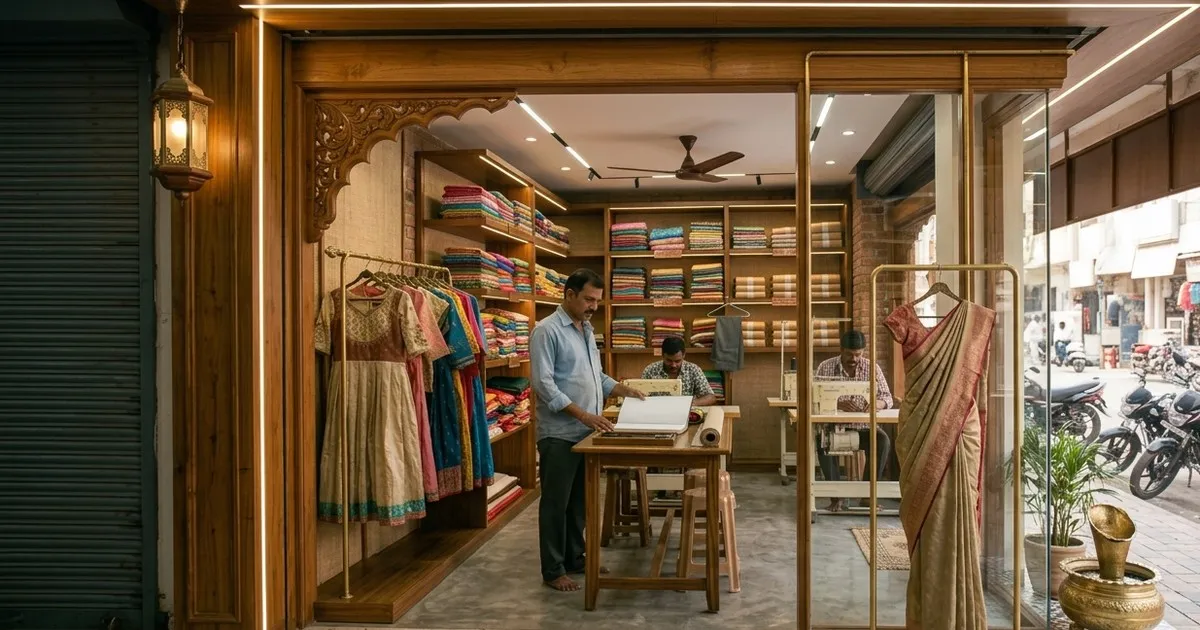
Owner of a tailoring shop in Coimbatore standing at the cutting table with his order book while tailors work behind him
A shop owner in Coimbatore is not short of options. He is short of a way to tell them apart.
One vendor demonstrates on a laptop in a hotel room. One sends a video link. One quotes a price over the phone and asks for an advance. All three say the same words: patterns, measurements, CAD, saves time.
None of that tells him whether the thing will draft the blouse his customer ordered this morning, in the fabric he already bought, at a size he actually gets.
In this guide you will find:
Why a Coimbatore shop has a different problem from a Mumbai one
The eight questions to ask any vendor before paying
What buying local actually changes, and what it does not
The one thing to insist on seeing before you decide
The mistakes that cost shops money on the first purchase
Why the Problem Is Different Here
Coimbatore sits inside a textile belt. Tirupur is forty kilometres away, Erode is a hundred, and the fabric, the labour and the customers all move between them. That changes what a tailoring shop here is actually competing with:
Customers can compare. In a town with three tailors, the work speaks for itself. Here a customer who does not like a fit simply goes to the next shop on the same street.
Wedding season arrives all at once. Between Aadi and the December muhurtham dates, a shop takes months of work in weeks, and cutting speed decides how much of it can be accepted.
Skilled cutters are scarce and expensive, and the good ones get poached. A shop that depends entirely on one master cutter is one resignation away from a crisis.
Export-side work nearby has already normalised graded patterns and printed markers, so customers who have seen that expect the same finish from a local shop.
That last point is the one most vendors miss. The competition is not the tailor next door. It is the standard of finish that the whole region has quietly moved to.
Eight Questions to Ask Any Vendor
Ask these before price is discussed. The answers, not the quotation, tell you what you are buying.
# | Ask this | What a poor answer sounds like |
|---|
1 | Can you draft the garment I name, from measurements I give you, right now? | We will show that in the full training |
2 | Can I see the pattern printed full size on paper? | You can see it on the screen |
3 | Which garments are covered, and which are not? | Everything is covered |
4 | What happens when a customer measurement is unusual? | The software adjusts automatically |
5 | Who trains my staff, where, and in which language? | Videos are provided |
6 | What happens when something breaks on a Saturday in season? | Raise a ticket |
7 | What is the total cost - software, machine, paper, service? | Only the software price is quoted |
8 | Can I speak to a shop like mine that already uses it? | We cannot share customer details |
Question 2 is the one that separates real systems from demonstrations. A pattern that only exists on a screen has not been proved. A pattern printed full size on paper can be laid on cloth and checked by anyone in the shop.
What Buying Local Actually Changes
Being local is not automatically better. It matters for four specific things, and it is worth being clear about which:
What | Why it matters here | Honest limit |
|---|
On-site demo | Someone comes to your shop and drafts your order on your table | Only useful if you bring a real order, not a sample |
Language | Your cutter is trained in Tamil, not through a translated video | Matters for the staff, less for the owner |
Service visit | A machine problem can be attended to in person | Ask what the actual response time is, in season |
Local references | You can visit a shop that already runs it | Ask for one in your line of work, not any shop |
Fashion Dot is headquartered in Coimbatore, so the demo, the training and the service are handled from here in Tamil. That is the reason the local page exists at all.
Details for this city are on the tailoring software in Coimbatore page. Shops elsewhere should start from the
tailoring software India page, which covers the same ground without the local part.
The One Thing to Insist On Seeing
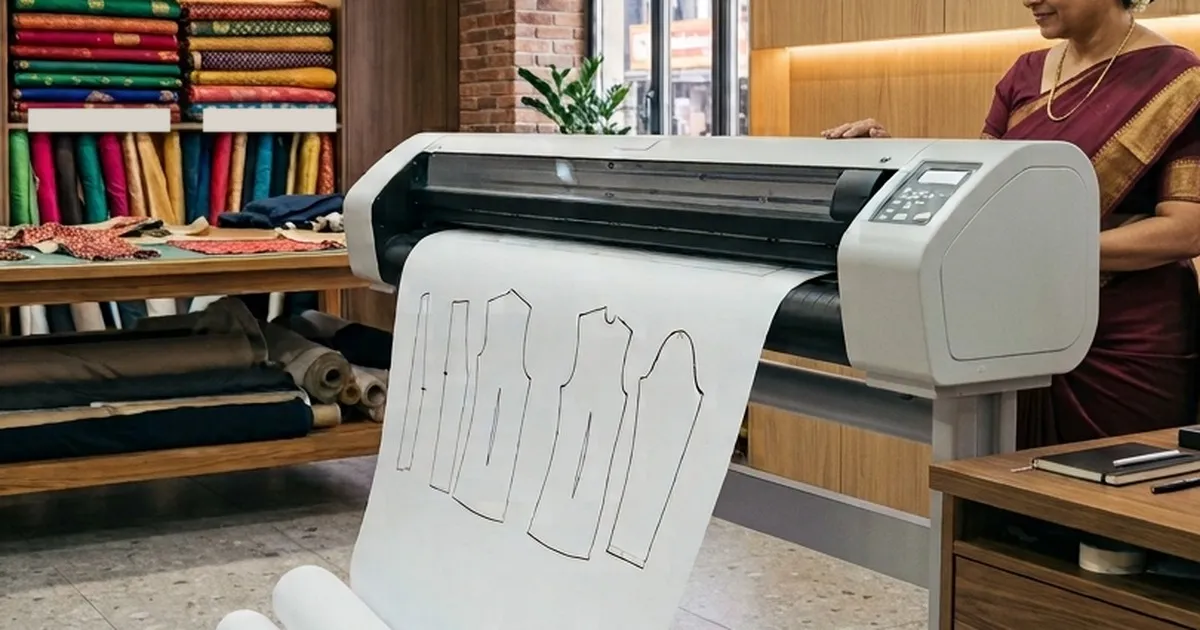
Wide-format plotter printing a full-size garment pattern on paper in a tailoring workroom
Ask for a pattern to be printed full size, on paper, from measurements you supply on the day.
It sounds small. It is the whole test:
It proves the draft is real and not a stored picture.
It proves your measurements went in and came out, rather than a demo file being opened.
It puts something in your hand that your own cutter can check against cloth.
It shows you the paper cost and the print time, which nobody mentions in a quotation.
If a vendor cannot do this in front of you, there is a reason, and the reason is never good.
The machine that does the printing is covered on the plotter machine page.
Mistakes That Cost Shops Money
1. Buying in Season
A shop that buys in the middle of wedding season has no time to train anyone, and the system sits unused until the rush ends. Buy in the slack months and be ready for the next one.
2. Training Only the Owner
The owner is the person least likely to be drafting at nine at night in December. Train the cutter, and train a second person, because the first one will eventually leave.
3. Quoting Software Only
Software, machine, paper, power, service and training are one budget. A quotation that mentions only the first is not a quotation.
What each part costs is set out on the software price page.
4. Judging It on the Demo Garment
Every vendor demonstrates the garment their system handles best. Name your own difficult one, the one that comes back for alteration most often, and ask for that.
Which Shops Gain Most, and Which Gain Least
Not every shop should buy. It is worth being honest about where the gain actually comes from, because it is not the same for every kind of shop in the city.
Type of shop | What it gains | How much |
|---|
Boutique taking wedding orders | Accepts more orders in season instead of refusing them | Highest |
Shop dependent on one master cutter | The drafts stop leaving when the cutter leaves | Very high |
Shop doing repeat uniform or bulk work | The same graded set is cut again without redrawing | High |
Ladies tailor doing daily blouse work | Consistent fit, fewer alterations coming back | Moderate |
One-person shop with steady local work | Mainly time saved on drafting | Lowest |
If your shop is in the last row and you never turn work away, say so to the vendor and see what he says. A vendor who still insists you need it today is telling you something useful about himself.
The First Thirty Days Decide It
Most systems that end up unused were not bad purchases. They were purchases nobody was given time to learn. Plan the first month before you pay:
Week one - one person, one garment. Draft the same garment repeatedly until it is faster by hand than by habit.
Week two - the same person, on real customer orders, with the old method still running as a check.
Week three - a second person trained, so the shop is not depending on one again.
Week four - stop the old method for that garment, and only then add the next one.
A shop that tries to move every garment across in the first week usually moves none of them.
Questions Coimbatore Shops Ask
Is tailoring software worth it for a small shop?
It depends entirely on how much cutting the shop turns away. A shop that refuses work in season, or that depends on one cutter, gains the most. A shop with spare capacity all year gains the least.
Do I need to know computers?
The cutter needs to learn one screen, not a computer course. That is what the training is for, and it is the part to ask hard questions about.
Will it work with the fabric widths I buy?
It should, but ask. Bring the width you actually buy to the demo and have the marker made for that width rather than a standard one.
Can I use it for both ladies and gents work?
Ask which specific garments are covered on each side. A vendor who answers everything is a vendor who has not been asked this before.
What happens if the machine has a problem in season?
Ask for the actual response time and what happens meanwhile. A shop that cannot cut for three days in December has lost more than the cost of the service call.
Is training available in Tamil?
It should be, and for the cutter rather than the owner. Fashion Dot trains in Tamil from Coimbatore, which is the practical reason most local shops give for choosing locally.
Bring a Real Order to the Demo
The demo is worth exactly as much as what you bring to it. Bring a customer order you are cutting this week, with the measurements and the fabric width, and ask for the pattern printed full size on paper before you leave.
Book a free demo at your shop in Coimbatore, in Tamil, with no commitment.