Maggam (aari) hand embroidery stands as the absolute crown jewel of Indian bridal fashion. Every wedding season, the demand for complex, customized zardosi and beadwork skyrockets as brides look to transform their rich silk heirlooms into distinct couture statements. However, while intricate needlework often steals the spotlight, a luxury piece only succeeds when masterfully drafted to a flawless fit.
If the baseline neck geometry or shoulder bias is even slightly inaccurate, heavy metallic threads will cause silk fabric to warp or sag. To keep your boutique ahead, here is an architectural review of the top 12 Maggam work blouse designs dominating 2026.
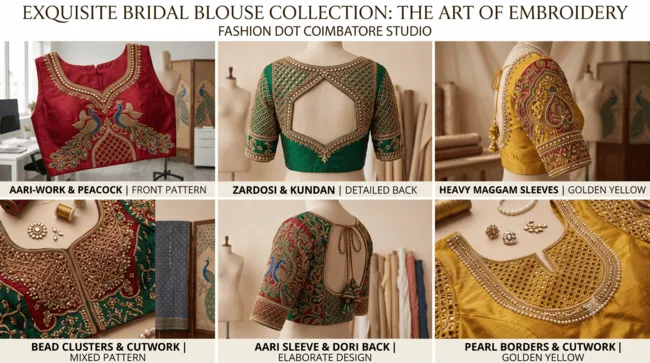
1. Bridal Maggam Designs (Heavy & Regal)
These high-investment masterworks are engineered for primary wedding ceremonies, maximizing gold thread density.
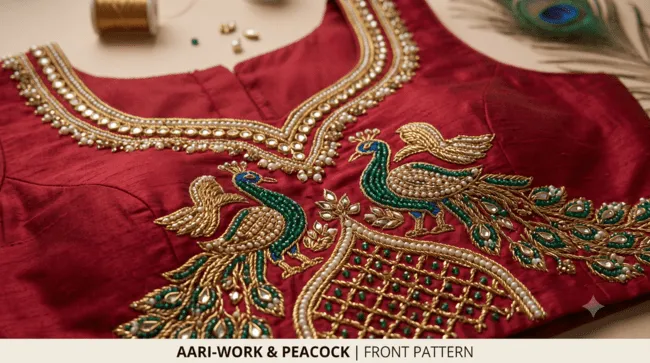
- Full Peacock-Motif Front Plunge: Twin majestic peacocks rendered in antique zardosi wire and micro-glass beads.
- Architecture-Inspired Temple Border: Replicates South Indian temple silhouettes using structural zari, coin rows, and micro-pearls.
- Lotus-and-Vine Entwined Front: Organic patterns of blooming pink lotuses winding along gold salma wire.
- All-Over Shimmering Stonework Mosaic: A surface grid of handset Swarovski crystals, perfect for grand mandap lighting.
2. Party Maggam Designs (Sleek & Light)
For upscale sangeet functions, these latest Maggam blouse patterns prioritize contemporary necklines and lightweight wearability.
- Minimalist Boat Neck: A clean, broad neckline outlined with a precise sequence of cut-dana work.
- Shield-Style Shoulder Accent: Focuses heavy embroidery on the shoulder caps while keeping the chest plain to highlight the fabric.
- Asymmetric Single-Motif Front: A bold floral bouquet on one shoulder, balanced by a clean back.
- Maggam-Bordered Deep-U Plunge: Combines modern confidence with traditional floral trailing vines.
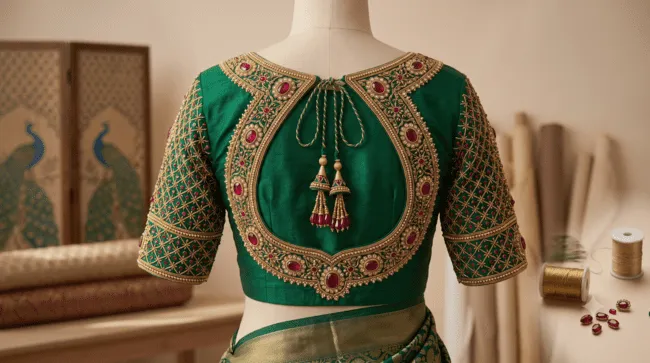
3. Back & Sleeve Designs: The Portrait Focus
Since back panels are focal points in photography, these Aari work blouse designs maximize visual impact.
- Full Tapestry Back Panel: Recreates mythological scenes or Mughal jaal patterns across the entire rear canvas.
- Geometric Cut-Out Back Window: A diamond-shaped central window framed by heavy threadwork and crystal tassels.
- Ornate Elbow-Length Jhumka Sleeves: Adorned with chandelier motifs that sway with every movement.
- Regal Royal Yoke: A high-coverage panel framing the upper shoulders, ideal for sheer overlays.
"Maggam work is performed on fabric stretched tightly across wooden frames. If the baseline cutting outline is asymmetric, the embroiderer will end up stitching expensive
zardosi over a faulty layout—rendering the fabric a financial loss."
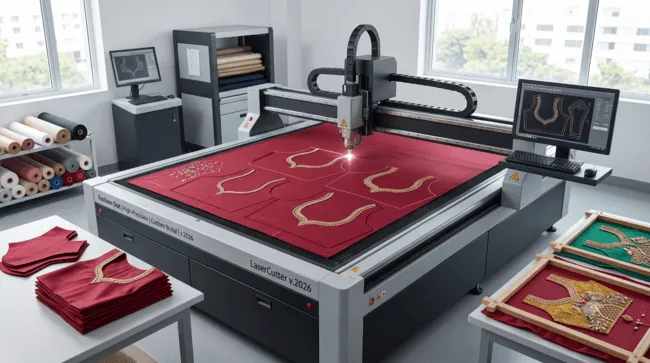
The Golden Canvas Rule: Precision First
Standardizing your base fabric layout with mathematical precision is the only way to ensure profitability. Whether you are creating a classic silk saree Maggam blouse or a contemporary designer embroidery blouse 2026, your foundation must be perfect.
Achieve Flawless Symmetry with Fashion Dot
To eliminate alteration disputes and lower material waste, use the Fashion Dot CAD ecosystem. Our software houses a library of these geometries, allowing you to auto-grade patterns to custom proportions instantly. Provide your embroidery masters with a mathematically symmetric fabric canvas every time. Join over 10,000 fashion centers trusting Fashion Dot since 2003.
Schedule your free live technical demo today
Placing Maggam Work on the Pattern, Not the Cloth
Maggam work is the one blouse job where cutting order decides the result. The motif has to be positioned while the piece is still a pattern, because once the cloth is cut a misplaced peacock cannot be moved.
- Draft the blouse to the customer’s measurements first, seam allowance included.
- Mark the motif position on the pattern, measured from the centre back and the shoulder line.
- Trace onto the fabric while it is still uncut, so there is margin if the frame pulls.
- Do the embroidery, then cut — never the other way round.
- Re-check the piece against the pattern after framing; heavy work shrinks the fabric slightly.
That last point catches most shops. A blouse embroidered before cutting can come off the frame half an inch tighter than it went on.
Which Maggam Designs Suit Which Occasion
| Occasion | Work that suits | Typical placement |
|---|
| Bridal | Full back peacock, temple motifs, kundan | Whole back panel and sleeves |
| Reception | Mirror work, stone and zardosi combination | Yoke and sleeve caps |
| Festival | Floral vines, mango motifs | Neckline border and back centre |
| Party | Light bead and sequin scatter | Sleeve and shoulder only |
| Daily silk | Fine zari outline | Neck border |
Costing Maggam Work Properly
- Charge frame time separately from stitching time. They are different skills and different rates.
- Count the motifs, not the design. Twenty small flowers cost more time than one large peacock.
- Add the lining, which heavy work always needs and which customers rarely expect to pay for.
- Quote re-work risk into bridal pieces. Any change after framing means starting the panel again.
Frequently Asked Questions
Should the blouse be cut before or after maggam work?
After. Embroider on the uncut piece with the pattern marked on it, then cut. Cutting first leaves no margin when the frame pulls the fabric.
Does maggam work need a lining?
Yes on anything heavier than a light outline. Without it the knots rub and the blouse becomes uncomfortable within an hour.
How far in advance should a bridal maggam blouse be ordered?
Three to four weeks is realistic for full back work, longer in season. The embroidery, not the stitching, sets the timeline.
Can the same motif be reused for another customer?
The motif can. The placement has to be recalculated for her measurements, which is quick if the pattern is stored and slow if it is redrawn.
What causes maggam blouses to fit badly?
Almost always shrinkage during framing. Measure the piece again after the work is done and before the final cut.