An Anarkali is two garments joined at one seam. Above that seam it is a fitted bodice that has to sit like a blouse. Below it, it is a flared skirt heavy enough to pull on everything above. Almost every Anarkali that comes back for alteration failed at that one seam, or at the measurement that decides where it sits.
It is also the order where a customer's own words are least reliable. She asks for an Anarkali and shows a photograph of a gown, or asks for a gown and means a floor-length kurti. Those are three different drafts, three different cloth quantities and three different prices.
This is the full measurement list for an Anarkali, how to decide where the flare starts, how many kalis the fabric can carry, the cloth each version needs, and the four mistakes that cause most re-cutting.
Anarkali, Gown and Floor-Length Kurti Are Not the Same Cut
Settle this before the tape comes out. All three reach the ankle and only one of them has kalis.
Anarkali
A fitted yoke joined to a flared kali skirt at a horizontal seam, usually under the bust or at the waist. The flare comes entirely from the kalis, so it falls in even folds all the way round with no gathering at the join.
Gown
Shaped in one piece from shoulder to hem, with the fit built into princess seams or darts instead of a horizontal join. There is no yoke seam, so a gown follows the body further down and flares later and more softly.
Floor-Length Kurti
A kurti drafted to ankle length, straight or A-line, with no kali flare and no yoke seam. It uses the least cloth of the three and is the one customers most often mean when they say they want something simple.
If the customer wants the plain floor-length version, the draft is the kurti block extended, and the measurements come from the kurti cutting measurement chart rather than from this sheet.
The 14 Measurements Every Anarkali Needs
Take the round measurements over the undergarments she will wear with the finished garment, particularly the bust. Ease is what you add to the body measurement before drafting.
# | Measurement | Where it is taken | Typical ease |
|---|
1 | Shoulder width | Shoulder point to shoulder point across the back | Nil |
2 | Bust (full) | Round the fullest part of the bust | 2 to 3 inches |
3 | Under bust | Round the body directly under the bust | 1 to 1.5 inches |
4 | Waist | Round the natural waist, the narrowest point | 2 to 3 inches |
5 | Hip | Round the fullest part of the seat | 2 to 3 inches |
6 | Shoulder to flare joint | Shoulder point down the front, over the bust, to where the flare will start | Nil |
7 | Full length | Shoulder point to the hem, in the footwear she will wear | Nil |
8 | Front neck depth | Shoulder line down the centre front to the lowest point of the neckline | By design |
9 | Back neck depth | Shoulder line down the centre back to the lowest point | By design |
10 | Armhole round | Round the arm through the armpit and over the shoulder point | 1.5 to 2 inches |
11 | Sleeve length | Shoulder point to where the sleeve will end | Nil |
12 | Sleeve round | Round the fullest part of the upper arm | 1.5 to 2 inches |
13 | Cuff round | Round the arm where the sleeve finishes | 1 to 1.5 inches |
14 | Hem sweep | Finished circumference at the hem, set by the kali count | By style |
Where the Flare Starts Is the Whole Design
Measurement 6 decides what the garment looks like, and it is the one most often taken carelessly. There are three normal positions and they are not interchangeable.
An empire join sits one to two inches below the bust. It is the classic Anarkali line, it flatters most figures and it hides the waist completely, so the waist measurement matters only for the lining.
A waist join sits at the natural waist. It gives a defined shape and needs the waist measurement to be accurate, because the seam sits exactly where any error shows.
A drop-waist join sits two to three inches below the natural waist, near the top of the hip. It is the least forgiving of the three: the hip measurement now has to pass through the yoke, so hip ease cannot be skipped.
Take this measurement down the front, over the bust, not down the side or the back. The front travels further than the back over the same vertical distance, and a yoke cut to the back length rides up at the centre front and pulls the neckline back.
Kali Count and Hem Sweep
The kali count sets the fullness, and the fabric sets the kali count. Every kali seam adds weight, and all of that weight hangs from the yoke seam and the shoulders. Twelve kalis of heavy brocade will drag the shoulders down no matter how well the yoke is cut.
Kalis | Typical hem sweep | Suits | Feel |
|---|
6 kali | 90 to 100 inches | Cotton, light silk, office and daily wear | Light flare, easy to walk in |
8 kali | 110 to 125 inches | Soft silk, rayon, function wear | The common all-purpose Anarkali |
10 kali | 135 to 150 inches | Georgette, chiffon, net, party wear | Full flare, needs a light fabric |
12 kali | 155 to 175 inches | Light georgette and net, bridal wear | Maximum flare, usually with a net layer |
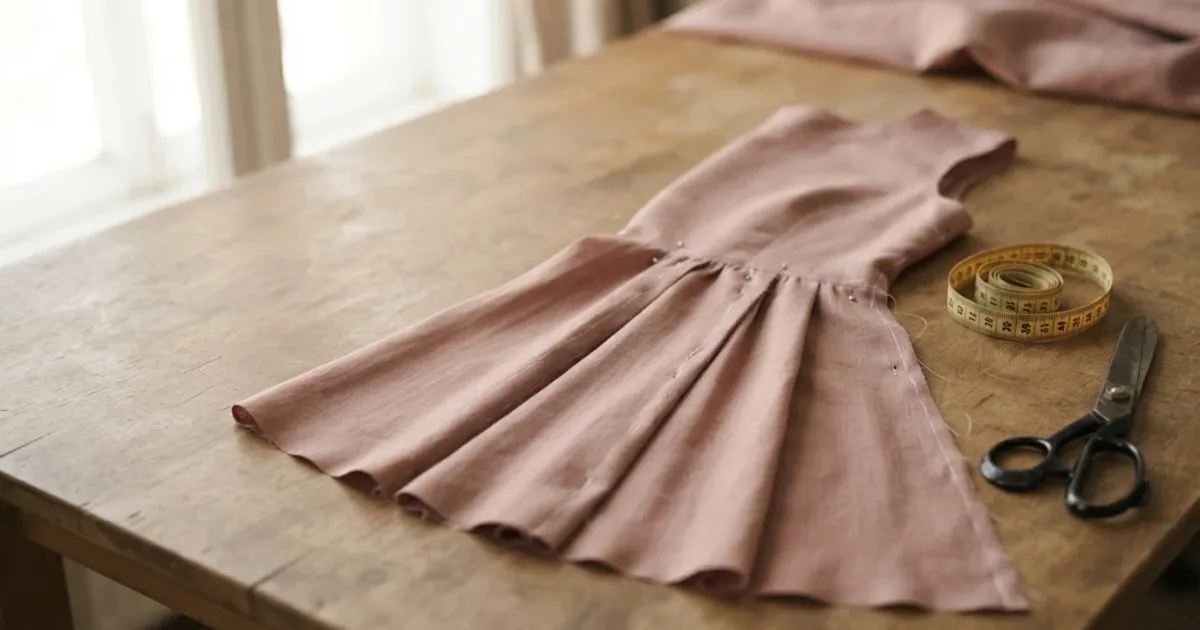
A net or can-can layer under the kalis adds visible fullness without adding kalis, which is how a bridal silhouette is built without hanging more weight from the shoulder seam.
Cloth Needed for an Anarkali
Typical figures for an adult full length of 52 to 56 inches on 44 inch cloth, including the yoke and sleeves, on plain fabric with no border and no one-way print. A border or a directional print stops the kalis nesting head to tail and pushes each figure up by roughly half a metre.
Version | Fabric width | Typical cloth needed |
|---|
6 kali Anarkali | 44 inch | 3.25 metres |
8 kali Anarkali | 44 inch | 3.75 metres |
10 kali Anarkali | 44 inch | 4.5 metres |
12 kali Anarkali | 44 inch | 5.25 metres |
Gown, princess seamed | 44 inch | 3.5 metres |
Add the same quantity again in lining for a sheer fabric, and about 1.5 metres of net for a can-can layer. On 36 inch cloth add roughly three quarters of a metre to every figure.
The Four Mistakes That Cause Most Re-Cutting
1. The Yoke Length Was Taken Down the Back
The front of the body travels further than the back over the same vertical distance, because it goes over the bust. A yoke cut to the back measurement rides up at the centre front, drags the neckline backwards and puts a horizontal pull across the bust. Measure to the flare joint down the front.
2. The Length Was Taken Barefoot
An Anarkali is almost always worn with heels and over a churidar. Measured barefoot it finishes above the ankle and shows the churidar folds it was meant to cover. Take the length in the footwear she will wear, or record the heel height on the sheet.
3. The Kali Count Ignored the Weight of the Fabric
Ten or twelve kalis in a heavy brocade or a thick raw silk produce a skirt the yoke cannot hold. The shoulder seams drop, the armholes bind and the yoke seam shows a strain line all the way round. Match the kali count to the fabric, and use a net layer instead of extra kalis when the fabric is heavy.
4. The Armhole Was Cut With Blouse Ease
A saree blouse carries nothing. An Anarkali yoke carries the entire skirt, and that weight pulls the armhole downward and forward. An armhole cut tight to blouse ease binds the moment the customer raises her arms. Give it the full one and a half to two inches.
The Pieces an Anarkali Pattern Produces
A complete Anarkali draft produces seven pieces, and the kali template is the one that has to be exact.
The front yoke and back yoke are cut separately and are not mirror images: the front is longer to the flare joint and carries the neckline depth, the back is shorter and usually carries the opening.
The kalis are all cut from one template. The waist arc and the hem arc are calculated from the join circumference and the hem sweep, and any error in that arc multiplies by the number of kalis, so a template that is a few millimetres out closes with a visible step at the last seam.
The sleeve, the yoke lining and the neck facing complete the set. On a sheer fabric the kalis are lined as well, and the lining is cut a fraction shorter so it never shows below the hem.
A gown replaces the yoke and kalis with four to six shaped panels running the full length, so it has no horizontal seam at all. That is why a gown is more forgiving of the flare-joint measurement and far less forgiving of the bust and waist.
What Changes When the Anarkali Is Drafted on a Computer
Everything above is the same whether you draft with chalk or with software. The kali template and the cloth are what change.
The waist arc and the hem arc of a kali are geometry, and a computer gets them right the first time. Eight kalis and twelve kalis of the same Anarkali are one setting apart instead of a fresh draft and a fresh page of arithmetic, and the kalis always close into a true circle.
The flare joint becomes a parameter too, so an empire version and a waist version of the same customer's Anarkali are two drafts from one set of measurements.
Kalis are long tapered pieces and the marker is where the cloth is saved, exactly as it is on a lehenga - the same logic as in the lehenga cutting guide applies here.
Nesting them by hand on a five metre length is slow and wasteful, and pattern making software fits them into the width automatically and prints or cuts the marker at full size.
Good Anarkali Cutting Starts With the Measurement Sheet
An Anarkali fails at the join. Either the join is in the wrong place, or the yoke above it was cut without allowing for what hangs below it. Both of those are decided before any cloth is cut.
Take the fourteen measurements, measure to the flare joint down the front, choose the kali count from the fabric rather than from the photograph, and record the heel height and the flare position on the sheet. Confirm whether she means an Anarkali, a gown or a floor-length kurti before you quote a price, because the cloth alone differs by more than two metres.
Frequently Asked Questions
How many measurements are needed for an Anarkali?
Fourteen: shoulder, bust, under bust, waist, hip, shoulder to flare joint, full length, front and back neck depth, armhole, sleeve length, sleeve round, cuff and hem sweep. The flare joint and the armhole are the two that cause most alterations.
Where should the flare of an Anarkali start?
One to two inches below the bust for a classic empire Anarkali, at the natural waist for a defined shape, or two to three inches below the waist for a drop-waist line. Measure to that point down the front, over the bust, not down the back.
How many kalis does an Anarkali need?
Six for cotton and daily wear, eight for the usual function Anarkali, ten for georgette and party wear, and twelve for bridal. Heavy fabrics should stay at six or eight and gain fullness from a net layer instead of extra kalis.
How much cloth does an Anarkali need?
On 44 inch cloth, roughly 3.25 metres for six kalis, 3.75 for eight, 4.5 for ten and 5.25 for twelve, including the yoke and sleeves. Add the same again in lining for sheer fabric.
What is the difference between an Anarkali and a gown?
An Anarkali has a fitted yoke joined to a kali skirt at a horizontal seam. A gown is shaped in one piece from shoulder to hem with princess seams and no horizontal join, so it follows the body further down and flares later.
Cut Anarkalis With Fashion Dot CAD
Fashion Dot CAD drafts Anarkalis, gowns and floor-length kurtis from the measurements on your sheet, builds the kali template from the join circumference and the hem sweep, and nests the kalis to the width of the cloth you actually have. Customer records stay saved for the next order. See what it costs on the tailoring CAD software price page.
See an Anarkali Drafted From Your Own Measurements
Bring one customer's Anarkali measurements to a free demo and we will draft it live, print the kali template full size and show you the marker on your own fabric width. Book a free demo at a time that suits your shop.