Leggings look like the easiest thing in the shop. Two pieces, one seam each side, an elastic at the top. Most shops cut them in bulk without a pattern at all.
They are also the only garment on this list that is cut smaller than the customer. Every other draft starts with the body measurement and adds ease. A legging starts with the body measurement and takes ease away, and how much it takes away is not decided by the customer at all. It is decided by the cloth.
That is why two batches cut from the same pattern in two different lots of cotton lycra come back with two different complaints: one bags at the knee by lunchtime, the other cannot be pulled past the calf. This is the full measurement list, how to test the cloth before cutting, how much to reduce for each stretch level, and the four mistakes that cause most re-cutting.
Leggings, Churidar Leggings and Jeggings
Three versions of the same block, and the differences matter at the cutting table rather than at the machine.
Ankle Leggings
The plain version, finishing at the ankle bone with a plain hem. Two leg pieces and an elastic waistband, and usually no side seam at all.
Churidar Leggings
Cut six to eight inches longer than the leg so the surplus gathers into rings above the foot, the ready-made answer to a stitched churidar. The extra length goes below the knee only, exactly as it does on a stitched one.
Jeggings
A heavier knit made to look like denim, usually with a proper waistband, a mock fly and pockets. The fabric stretches less, so the reduction you cut is smaller and the waistband has to be drafted rather than just elasticated.
Leggings are almost always cut to be worn under a kurti, and the two lengths have to be decided together - take the top measurements from the kurti cutting measurement chart.
The 10 Measurements Every Legging Needs
Take the round measurements with the tape snug but not pulled. The ease column here is negative, because the finished garment is smaller than the body and the cloth makes up the difference. The exact figure comes from the stretch test in the next section.
# | Measurement | Where it is taken | Reduction |
|---|
1 | Waist | Round the natural waist, where the elastic will sit | By stretch |
2 | Hip (seat) | Round the fullest part of the seat, feet together | By stretch |
3 | Waist to hip | Straight down from the waist to the fullest seat point | Nil |
4 | Rise (crotch depth) | Seated on a hard chair, waist down to the seat | Nil |
5 | Thigh round | Round the fullest part of the upper thigh | By stretch |
6 | Knee round | Round the knee cap, leg straight | By stretch |
7 | Calf round | Round the fullest part of the calf | By stretch |
8 | Ankle / instep | Diagonally over the instep and round the heel, foot flexed | Half the usual reduction |
9 | Inseam | Crotch point down to the ankle bone | Nil, or add for 4-way |
10 | Waistband width | Finished elastic or waistband width | 1.5 to 2 inches |
Measurement 8 is reduced by only half as much as the rest. The ankle is the narrowest opening and the foot still has to pass through it, so it is the one place where the cloth's stretch is being asked to do two jobs at once.
The Stretch Test: The Measurement That Is in the Cloth
Before you cut a single legging from a new lot, test the cloth. It takes half a minute and it is the difference between a batch that fits and a batch that comes back.
Mark ten centimetres across the width of the fabric, on the grain that will run round the leg. Stretch it comfortably, the way a body stretches cloth, not as far as it will physically go. Read the new length. Ten centimetres that becomes fourteen is forty per cent stretch.
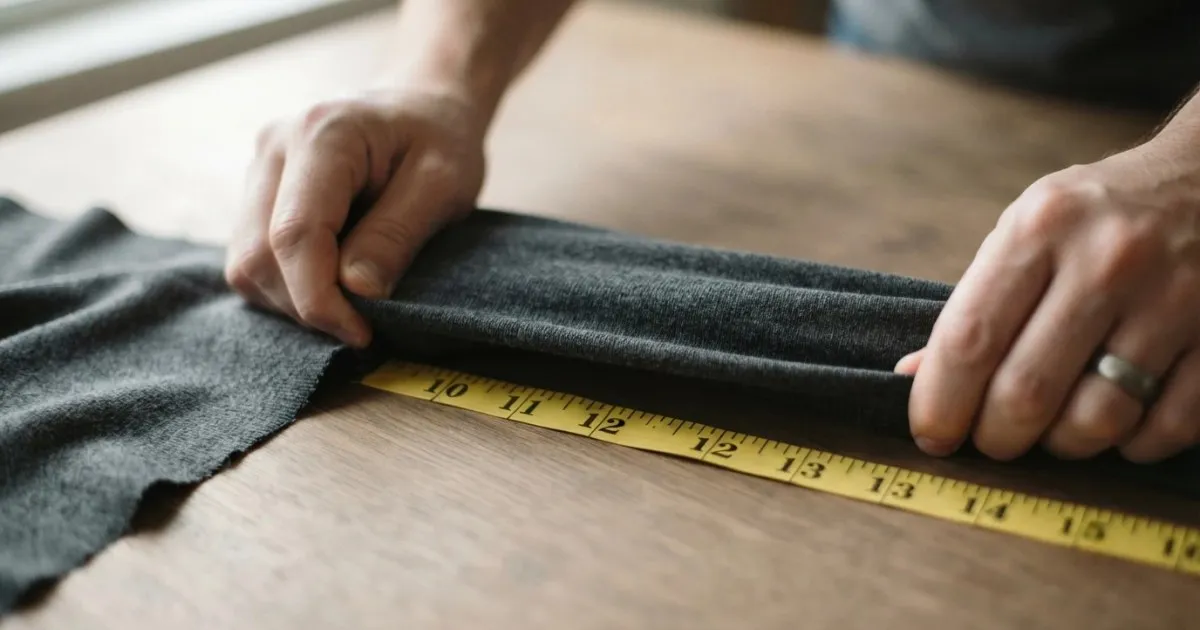
Check the recovery in the same movement. Let it go and see whether it returns to exactly ten centimetres. Cloth that comes back to ten and a half has poor recovery, and a legging cut from it will bag at the knee and the seat however well you cut it. That is a cloth problem, not a pattern problem, and it is better found before the order than after.
Check both directions too. Two-way stretch gives round the leg only. Four-way stretch gives round the leg and along it, and a four-way fabric shortens as it stretches round the body, so the length has to be cut one to two inches longer than the tape says.
How Much Smaller to Cut
Reduce the round measurements by the percentage below and leave the lengths alone, except on four-way cloth. Reducing more than this does not make a better fit, it makes a legging that the customer cannot get on and that shows every seam under strain.
Stretch measured | Typical cloth | Reduce round measurements by | Ankle reduction |
|---|
25 to 30 per cent | Cotton with 2 to 3 per cent lycra, jeggings knit | 5 per cent | 2.5 per cent |
40 to 50 per cent | Standard cotton lycra legging fabric | 10 per cent | 5 per cent |
60 to 75 per cent | Four-way stretch poly lycra | 15 per cent | 7.5 per cent |
80 per cent and above | High stretch sports knit | 20 per cent | 10 per cent |
A worked example. A 38 inch hip in a cloth that tested 45 per cent stretch is cut at 38 less 10 per cent, so 34.2 inches finished, which is 17.1 inches across the pattern for front and back together. The same 38 inch hip in a jeggings knit that tested 28 per cent is cut at 36.1 inches. Same customer, same pattern block, nearly two inches of difference, decided entirely by the cloth.
Cloth Needed for Leggings
Knit fabric usually comes 58 to 60 inches wide, which is why a legging takes so much less cloth than a woven bottom. Figures are for an average adult length of 38 to 40 inches.
Version | Fabric width | Typical cloth needed |
|---|
Ankle leggings | 58 to 60 inch | 1.25 metres |
Churidar leggings | 58 to 60 inch | 1.5 metres |
Jeggings with waistband and pockets | 58 to 60 inch | 1.5 metres |
Ankle leggings | 44 inch | 1.75 metres |
Capri or three-quarter | 58 to 60 inch | 1 metre |
In bulk the saving is in the marker rather than the garment, because two legs nest head to tail almost perfectly - the approach is the same as in the guide to reducing fabric wastage.
The Four Mistakes That Cause Most Re-Cutting
1. The Leggings Were Cut to the Body Measurement
With no reduction the knit has nothing to grip, so it sits loose from the first wearing and bags at the knee and the seat within hours. A legging holds its shape because it is under slight tension, not because of the seams.
2. The Stretch Direction Runs Down the Leg
The greatest stretch has to go round the leg, not along it. Cut the other way, the legging is tight round the calf and stretches lengthwise instead, so it sags at the seat and drags the waistband down. On tubular knit this is easy to get wrong because the piece looks the same either way.
3. One Pattern Was Used for Every Lot of Cloth
The same pattern in a 45 per cent stretch and a 28 per cent stretch produces two different garments. Test each new lot and adjust the reduction, or keep two graded sets and pick by the test.
4. The Waistband Was Cut From the Same Stretch as the Body
A waistband cut from the main cloth has nothing holding it, so it rolls over and creeps down through the day. Use a firmer band, a proper elastic, or cut the band with the stretch running across it and at a greater reduction than the body.
The Pieces a Legging Pattern Produces
A plain legging produces three pieces: a front leg, a back leg and a waistband. Many are cut with no side seam at all, joining only at the inside leg and the centre seam, which is faster and leaves nothing to rub on the outside of the leg.
The front and back are not the same shape even though they look similar. The back is cut with a deeper curve through the seat and slightly wider through the thigh, because that is where the body is. A legging cut with two identical pieces twists on the leg and the inside seam migrates forward as it is worn.
A gusset at the crotch is worth adding on a heavier jeggings knit. It takes the strain off the point where four seams meet, which is where a legging splits first.
Hems on knit are turned once and stitched with a stretch stitch or a twin needle. A hem that is stitched with a straight lock stitch will snap the first time the customer pulls the legging on, which reads to her as a stitching fault even though the cutting was right.
What Changes When the Legging Is Drafted on a Computer
Everything above is the same whether you draft with chalk or with software. What changes is what happens when the cloth changes.
The reduction is a percentage applied to the round measurements. On CAD it is one setting, so a new lot of cloth that tests at a different stretch produces a corrected pattern in seconds instead of a fresh draft or, more often, a batch cut from the old one and hoped for.
For bulk work the size set is graded once and re-scaled for each stretch level, which is the part that is genuinely painful to do by hand across eight sizes.
Nesting is where the cloth is saved on a long knit roll, and pattern making software lays the legs head to tail across the full 60 inch width and prints or cuts the marker at full size.
Good Legging Cutting Starts With the Cloth Test
Every other garment in this series starts with the customer. A legging starts with a ten centimetre mark on the fabric, because the cloth decides how much smaller than her body the garment has to be.
Test each new lot for stretch and recovery, reduce the round measurements by the figure in the table, halve that reduction at the ankle, run the greatest stretch round the leg, and give the waistband something firmer than the body cloth. Write the stretch percentage on the job sheet next to the lot, so the next batch from the same roll starts from a number instead of a guess.
Frequently Asked Questions
How many measurements are needed for leggings?
Ten: waist, hip, waist to hip, rise, thigh, knee, calf, ankle, inseam and waistband width. The round measurements are all reduced, and by how much is decided by a stretch test on the cloth rather than by the customer.
How much smaller should leggings be cut than the body?
Five per cent for a low stretch cloth around 25 to 30 per cent, ten per cent for standard cotton lycra at 40 to 50 per cent, fifteen per cent for four-way stretch at 60 to 75 per cent and twenty per cent above that. The ankle takes half the reduction the rest of the leg takes.
How do you test fabric stretch?
Mark ten centimetres across the width, stretch it comfortably and read the new length. Ten that becomes fourteen is forty per cent stretch. Check that it returns exactly to ten, because cloth with poor recovery will bag at the knee no matter how it is cut.
Which way should the stretch run?
The greatest stretch runs round the leg, never down it. Cut the other way the legging grips the calf, stretches lengthwise and drags the waistband down as it is worn.
How much cloth do leggings need?
About 1.25 metres on 58 to 60 inch knit for ankle length, 1.5 metres for churidar leggings or jeggings and 1 metre for capri length. On 44 inch cloth an ankle legging needs about 1.75 metres.
Cut Leggings With Fashion Dot CAD
Fashion Dot CAD drafts leggings, churidar leggings and jeggings from the measurements on your sheet, applies the stretch reduction as a single setting so a new lot of cloth does not mean a new draft, grades the size set for bulk orders and nests the legs across the full knit width. See what it costs on the tailoring CAD software price page.
See Leggings Drafted From Your Own Cloth
Bring a metre of the knit you actually buy and one customer's measurements to a free demo. We will test the stretch, draft the legging live at the right reduction and show you the marker on your own fabric width. Book a free demo at a time that suits your shop.